
NCHR, LAS research reveals factors and effects of forced conversion through marriage
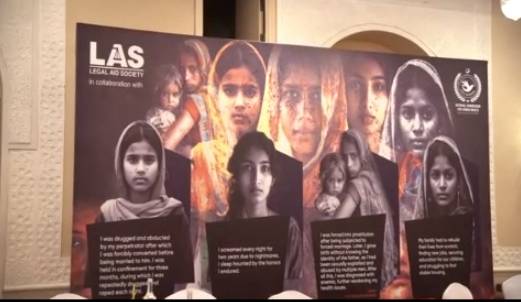

The National Commission for Human Rights (NCHR) in collaboration with the Legal Aid Society (LAS) has released a comprehensive documentary and research report to understand the factors of forced conversion through marriage and its multifaceted impact on victims, religious minority communities and Pakistani society.
The research report and documentary were presented on Monday during a national dialogue aimed at discussing the factors of forced conversion through marriage. The report includes direct statements from victims of forced conversion through marriage and clarifies the factors of forced conversion through marriage to better understand the concepts of “coercion” and “consent”.
The event brought together legal experts, minority rights advocates and criminal justice professionals to discuss practical steps to address the serious issue of forced conversion through marriage.
The event began with opening remarks by Haya Iman Zahid, CEO of Legal Aid Society (LAS), followed by a speech by NCHRC Chairperson Rabia Javeri Agha and then a comprehensive overview of the findings of the report by LAS Director Maleeha Zia.
The event featured a screening of a documentary film on forced conversion through marriage by Ayesha Gazdar (Filmmaker), produced by Bond Advertising. A panel discussion was also held, led by Maleeha Zia (LAS).
The participants engaged in a meaningful conversation and shared their thoughts and experiences, which will help protect and promote the rights of religious minorities in Pakistan. The discussion provided a collaborative environment for service providers to find solutions to the issue of forced conversion through marriage in Pakistan and to further promote future dialogue in this regard.
Speaking on the occasion, NCHR Chairperson Rabia Javeri Agha said the issue of forced conversion through marriage is a pervasive and deep-rooted challenge in Pakistan, which has disproportionately affected girls and women from religious minority communities.
She said that despite the existence of constitutional and legal frameworks to protect religious freedom, the practice of forced conversion through marriage continues. This is largely due to a complex combination of socio-cultural, economic and political factors, which reflect our administrative weaknesses and societal pressures.
The NCHR Chairperson also said the Commission has taken suo motu notice of several cases of forced conversion through marriage, in which minor girls and women were abducted and forcibly converted to Islam and married off to these abductors, however, relief was provided to the victims and their families due to the intervention of the NCHR.
In her opening remarks, LAS CEO Haya said the effects of forced conversion through marriage are very serious, due to which the victims are subjected to mental trauma, physical and sexual violence and social stigma. This practice not only destroys the life of the individual but also weakens the social cohesion and cultural heritage of religious minority communities, making it difficult for them to maintain their religious freedom and faith.
According to the research report, the factors behind forced conversion through marriage are divided into two parts, namely the reasons of the perpetrators and the vulnerabilities of the victims. The reasons for the perpetrators include misuse of religious beliefs, ideological sexual exploitation and grooming, trafficking and prostitution, abuse of sexual desire and power, the escape of the perpetrators from punishment, and the media exaggeration of the issue.
The report divides the vulnerabilities of the victims into four subcategories: the mental vulnerability of children, which makes them easy targets for sexual violence and forced marriage; the adolescent, rebellious and risk-taking stage of girls, which predators exploit for exploitation; the gender-specific vulnerabilities of women; and the interplay of social, cultural, and economic factors.