
Deal reached for Gaza hostages to receive medicines

A deal to allow the delivery of medicines to hostages in Gaza and aid into the territory has been agreed following mediation by Doha and Paris, Qatar and Israel announced on Tuesday.
In a statement to the official Qatar News Agency (QNA), Doha announced the deal "between Israel and (Hamas), where medicine along with other humanitarian aid is to be delivered to civilians in Gaza... in exchange for delivering medication needed for Israeli captives in Gaza".
Israeli Prime Minister Benjamin Netanyahu's office confirmed the deal and said: "The medicines will be forwarded by Qatari representatives in the Gaza Strip to their final destination."
The drugs are intended for 45 hostages, according to the French presidency, which said 83 were initially identified as needing medication in November, but 38 have since been released or killed.
After the medicines arrive at a hospital in the southern Gaza border town of Rafah on Wednesday, they will be received by the International Committee of the Red Cross, divided into batches and immediately transferred to the hostages.
The deliveries will go on for three months, and were coordinated by the French foreign ministry's crisis centre, which purchased the drugs and sent them to Doha on Saturday by diplomatic pouch, said the centre's director, Philippe Lalliot.
Qatar, which hosts Hamas's political office, has led negotiations between Israel and the Palestinian militant group, having mediated a week-long break in the war in Gaza in November that included the release of scores of Israeli and foreign hostages.
The conflict followed an unprecedented Hamas attack on October 7 that resulted in the death of around 1,140 people in Israel, most of them civilians, according to an AFP tally based on official Israeli figures.
Militants also dragged about 250 hostages back to Gaza, 132 of whom Israel says remain there, including at least 27 believed to have been killed.
At least 24,285 Palestinians, more than 70 percent of them women and children, have been killed in the Gaza Strip in Israeli bombardments and a ground offensive since October 7, according to the territory's health ministry.
Qatari foreign ministry spokesman Majid Al-Ansari told QNA "the medications and aid will leave Doha tomorrow to the city of Al-Arish in the sisterly Arab Republic of Egypt, on board two Qatari Armed Forces aircrafts, in preparation for their transport into the Gaza Strip".
A diplomat briefed on the talks told AFP the deal followed a visit by the families of hostages to Qatar and a meeting with the Gulf nation's prime minister.
"Qatar has fast tracked engagement with Hamas and Israel on the need to get medicine in to the hostages and to civilian Palestinians in Gaza. Both have shown willingness," the diplomat said on condition of anonymity because of the sensitivity of talks.
The diplomat said mediators were working to finalise details and discussing with international organisations logistics for delivery, while stressing that the talks are separate from wider efforts towards a ceasefire.
Fears grow of widening war
Israel pummelled Gaza on Tuesday but reached a deal with Hamas to deliver medicines to hostages and desperately needed aid to civilians in the war-torn Palestinian territory following Qatari and French mediation.
The war raging since October 7 has devastated the Hamas-ruled Palestinian territory, which is suffering a severe humanitarian crisis, and inflamed tensions across the Middle East.
Fears of a regional escalation have spiked, with Iran and its proxies stepping up attacks across the region in solidarity with Hamas.
In their unprecedented October 7 attacks that triggered the war, Hamas militants dragged about 250 hostages back to Gaza, 132 of whom Israel says remain there, including at least 27 believed to have been killed.
The United Nations says the war has displaced roughly 85 percent of Gaza's 2.4 million people, many of whom have been forced to crowd into shelters and struggle to get food, water, fuel and medical care.
Qatar's foreign ministry announced Israel and the Palestinian Islamist group had agreed to deliver medicines to Israeli hostages held by Hamas in Gaza in exchange for supplying aid to civilians, following French and Qatari mediation.
Qatari foreign ministry spokesman Majid Al-Ansari told the official Qatar News Agency the medicine and aid would leave Doha on Wednesday for the Egyptian city of El-Arish before transport to the Gaza Strip.
Israeli Prime Minister Benjamin Netanyahu's office confirmed the deal and said: "The medicines will be forwarded by Qatari representatives in the Gaza Strip to their final destination."
A diplomat briefed on the talks told AFP the deal followed a visit by the families of hostages held in Gaza to Qatar and a meeting with the Gulf nation's prime minister.
Hamas released dozens of hostages in exchange for Palestinian prisoners held by Israel during a November ceasefire mediated by Qatar, which hosts the group's political office.
US National Security Council spokesman John Kirby said on Tuesday he was "hopeful" that Qatar-brokered talks could lead to another such deal "soon".
- 'We are steadfast' -
The unprecedented Hamas attack on October 7 resulted in about 1,140 deaths, mostly civilians, according to an AFP tally based on official Israeli figures.
At least 24,285 Palestinians, about 70 percent of them women and children, have been killed in Gaza in Israeli bombardments and ground operations since October 7, according to the territory's health ministry.
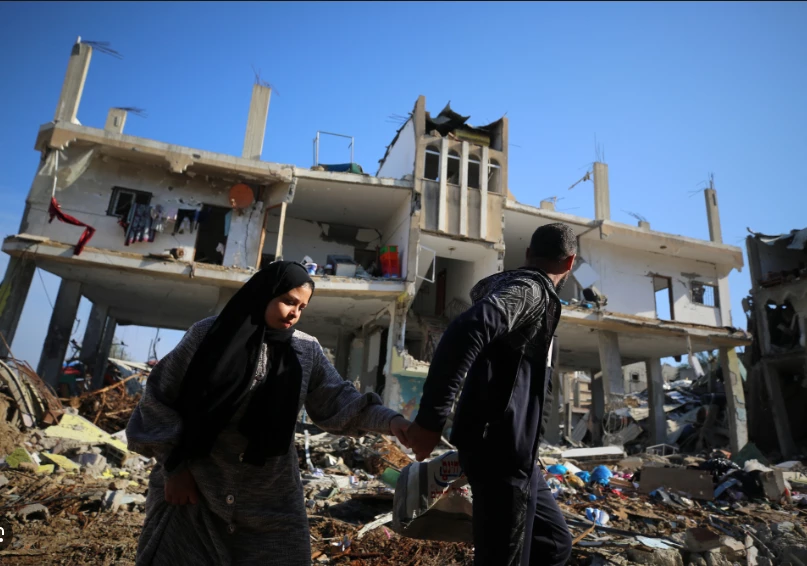
Surrounded by warped metal, gutted buildings and overturned vehicles in central Gaza's Al-Maghazi refugee camp, Fatima al-Masry said Netanyahu would not succeed and must bear responsibility for the destruction.
"The Israeli army killed children and young people, destroyed us, and threw us in the cold, but we are steadfast," said Masry, who was displaced from Jabalia refugee camp in northern Gaza.
As temperatures plunge, families living in makeshift tents in the southern city of Rafah have resorted to burning plastic to ward off the chill, despite the noxious fumes.
"I pray every day that we will all be martyred. Death is better than this life," said Abdul Karim Muhammad, a 29-year-old father of three whose family fled to Rafah from Jabalia camp.
Internet monitor NetBlocks said the internet blackout in Gaza had passed 96 hours, calling it "the longest sustained telecoms disruption" since the war began in a post on X, formerly Twitter.
- Hostage deaths announced -
Israel has concentrated operations on Khan Yunis since announcing on January 6 that it had dismantled Hamas's military structures in the north.
Israeli Defence Minister Yoav Gallant on Monday said intense operations would "soon" wind down in the territory's south.
But Israeli officials have repeatedly warned the fighting will continue for months.
The army announced Tuesday the death of two more soldiers in Gaza, bringing to 190 the total number killed since its ground invasion began.
The Israeli public has kept up pressure on Netanyahu's government to secure the return of the hostages.
An Israeli kibbutz on Tuesday confirmed that two hostages whose deaths were announced by Hamas in a video had been "murdered" in Gaza.
Kibbutz Beeri said it was informed that Yossi Sharabi, 53, and Itay Svirsky, 38, had been "murdered" and their bodies were in the custody of Hamas.
At an event in Berlin, Hagit Chen said it was "hard to live, to sleep, to breathe, to eat" because she had heard nothing from her son Itay, 19, since Hamas kidnapped him.
- US strikes Yemeni targets -
Violence involving regional allies of Iran-backed Hamas -- considered a terrorist group by the United States and the European Union -- has surged since the war began.
The US military said it carried out fresh strikes on Yemen on Tuesday after the country's Huthi rebels claimed their latest missile attack on a cargo ship in the Red Sea.
It came just days after the United States and Britain bombed scores of targets inside Huthi-controlled Yemen in response to attacks by the rebels, who say they are targeting Israeli-linked shipping in the Red Sea in solidarity with Gaza.
The US military also said it had seized Iranian-made missile parts that were en route to the Huthis on a boat in the Arabian Sea.
Iran's Islamic Revolutionary Guard Corps said it carried out an overnight missile attack that destroyed an Israeli spy headquarters in Iraq's Kurdistan region -- a claim Baghdad denied.
The Guards said they also struck a "gathering of anti-Iranian terrorist groups" in the Iraqi Kurdish capital Arbil and hit Islamic State group sites in Syria.
On Tuesday, Israel's army said it conducted air and artillery strikes on Hezbollah, Lebanon's powerful Iran-backed Shiite movement that has exchanged regular cross-border fire with Israeli forces since the war started.
"We are already in a regional war... even though it's still at a low simmer," said Ali Vaez, director of the Iran Project at the International Crisis Group.