
Pakistan seeks China’s support for New Development Bank membership
Aurangzeb takes up Panda Bond issuance with Chinese deputy finance minister: Welcomes Chinese investment in key sectors
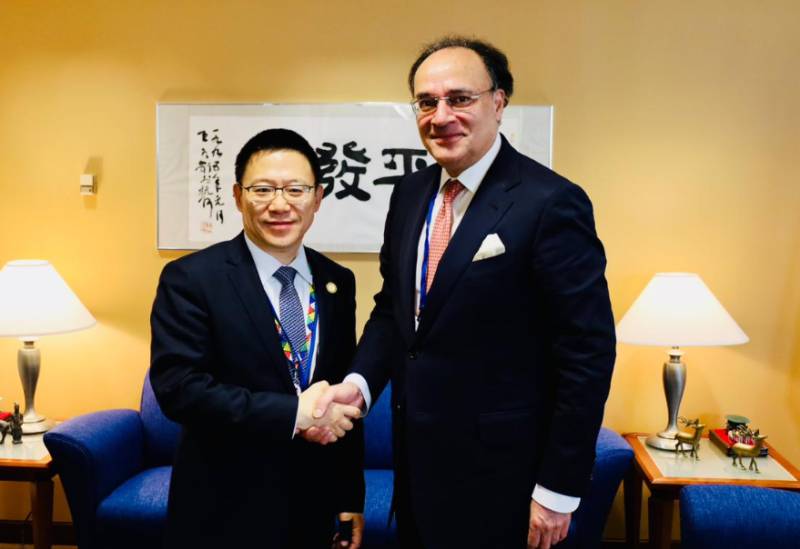

Federal Minister for Finance and Revenue Senator Muhammad Aurangzeb met with Chinese Deputy Finance Minister Liao Min in Washington D.C and discussed with him a number of issues, reported 24NewsHD TV channel on Friday.
Aurangzeb briefed the Chinese Deputy Finance Minister on the recently concluded Staff Level Agreement with the International Monetary Fund, terming it an external validation of the government’s ongoing economic reform agenda.
The minister also apprised him of the latest developments regarding the issuance of the Panda Bond in the Chinese market.
He sought China’s support for Pakistan’s membership in the New Development Bank and welcomed enhanced investment from Chinese enterprises in key sectors including information and communication technology, agriculture, industry and minerals.
Meeting with Bangladesh adviser
Aurangzeb emphasized the importance of continued knowledge-sharing and capacity-building between Pakistan and Bangladesh to strengthen regional development efforts.
During a meeting with Special Envoy to the Chief Adviser of Bangladesh Lutfey Y. Siddiqi, in Washington D.C, he reiterated that sustainable economic growth must be led by the private sector, with the public sector creating a conducive ecosystem for investment and innovation.
Meeting with Japan Bank governor
During another meeting with Governor of Japan Bank for International Cooperation Nobumitsu Hayashi, in Washington D.C, the Finance Minister appreciated bank’s formal commitment to join the Reko Diq lender group, noting that this would send a strong and positive signal to Japanese businesses regarding investment opportunities in Pakistan.
Muhammad Aurangzeb reaffirmed that the government attaches high importance to ensuring the security and confidence of foreign investors. He also emphasized the need to explore further avenues of bilateral cooperation between Pakistan and Japan.
FBR’s digital transformation
Aurangzeb on Thursday highlighted the Federal Board of Revenue (FBR) transformation plan aimed at developing a modern, transparent, and efficient tax administration.
Addressing the Regional Roundtable on Digital Transformation in Tax Administration organized by the World Bank, the minister said that Pakistan’s tax collection had risen from 8.8% of GDP in 2024 to 10.24% in 2025, reflecting improved performance and stronger revenue mobilization.
The minister highlighted that the government’s reform agenda focuses on end-to-end digitalization of core tax processes, greater use of digital tools for deeper integration with the economy, and improved documentation.
He also underscored the initiatives undertaken by Pakistan Customs to curb under-invoicing and strengthen trade facilitation mechanisms.
Aurangzeb further emphasized the government’s commitment to enhancing human resource capacity and optimizing FBR’s organizational structure to sustain efficiency and transparency across the tax system.
Meanwhile, Finance Minister also met with the S&P Global team in Washington D.C.
He appreciated the recent ratings upgrade by S&P Global and expressed satisfaction that the ratings of all three major international agencies are now aligned.
He termed this development as a strong external validation of the government’s ongoing reform agenda.
Senator Aurangzeb informed the S&P team that a Staff Level Agreement (SLA) had recently been reached with the IMF on the second review of the Extended Fund Facility (EFF) and the first review of the Resilience and Sustainability Facility (RSF).
He also presented an overview of recent developments on the fiscal, monetary, and external sector fronts, highlighting progress achieved under the reform program.
The Minister looked forward to continue engagement and constructive dialogue with S&P Global in support of Pakistan’s sustained economic stability and growth trajectory.
Economic reforms agenda
Aurangzeb on Thursday attended a session at The Atlantic Council in Washington D.C. on the theme “Reform efforts in Pakistan and the challenges ahead.”
The session was opened by Fred Kempe, President and CEO of The Atlantic Council, and moderated by Dr. Aasim M. Husain, former Deputy Director of the IMF’s Middle East and Central Asia Department, said a news release.
Dr. Husain, who recently authored the Council’s issue brief “Rescuing Pakistan’s Economy,” began the discussion by congratulating the Minister and his team on the successful completion of the first year of Pakistan’s International Monetary Fund (IMF)-supported program and the announcement of a new Staff-Level Agreement earlier this week.
In remarks, Senator Aurangzeb underlined that Pakistan had consolidated macroeconomic stability over the past year, backed by external validations from the IMF and major global rating agencies.
He noted that the government’s disciplined fiscal management had restored confidence, improved sovereign spreads, and contributed to the first current account surplus in 14 years.
Addressing the recent floods, the minister stated that Pakistan is facing two existential challenges—population growth and climate change.
He highlighted the government’s decision to finance rescue and relief efforts through domestic resources rather than external appeals, reflecting strengthened fiscal capacity.
He added that the government has launched a 300-day national plan to accelerate rehabilitation and build climate resilience, while revising growth forecasts modestly to above 3 percent for FY2025.
On fiscal reforms, the Minister emphasized ongoing structural changes aimed at broadening and deepening the tax base.
He outlined recent initiatives to bring agriculture, retail, and real estate sectors into the tax net, improve compliance through technology and AI-driven analytics, and curb leakages in sales tax collection.
He reaffirmed the government’s commitment to raise the tax-to-GDP ratio from 10.2% to 11% this year, and to 13% over the medium term, ensuring fiscal sustainability.
Discussing intergovernmental fiscal relations, Senator Aurangzeb highlighted the National Fiscal Pact signed with provincial governments, setting the stage for deliberations on a new NFC Award.
He informed that the inaugural NFC meeting is expected to convene in early November after being deferred due to the flood situation.
Turning to the medium-term growth outlook, the Minister reiterated that Pakistan is pursuing a private sector-led, export-driven growth model.
He noted that the new National Tariff Policy aims to reduce import dependence and enable export competitiveness through the gradual reduction of customs and regulatory duties on raw materials and intermediate goods.
He cited emerging opportunities in IT, mineral exports, and projects like Reko Diq as future growth drivers.
On monetary and exchange rate policy, Senator Aurangzeb reaffirmed the government’s commitment to maintaining a competitive, market-based exchange rate under the oversight of the State Bank of Pakistan, adding that productivity gains and structural reforms are as vital as external price competitiveness in sustaining export growth.
The session concluded with Dr. Aasim M. Husain commending the Minister’s reform agenda and wishing continued success for Pakistan’s economic recovery and transformation.
Reporter Waqas Azeem