
SC rejects govt’s full court request in civilians’ military trial case
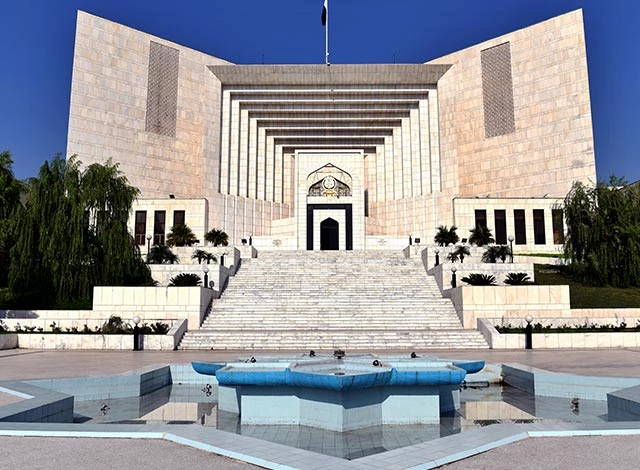

While hearing a set of petitions challenging the trial of civilians in military courts, the Supreme Court has rejected the government’s request to form a full court, reported 24NewsHD TV channel.
A six-judge larger bench headed by Chief Justice of Pakistan, Justice Umar Ata Bandial on Tuesday resumed hearing a set of petitions challenging civilians trial in military courts.
Justice Ijazul Ahsan, Justice Munib Akhtar, Justice Yahya Afridi, Justice Sayyed Mazahar Ali Akbar Naqvi and Justice Ayesha A Malik were also part of the apex court bench.
During the hearing, the chief justice remarked that he was surprised when the government objected to the bench. The top judge rejected the request of the attorney general, saying that the full court cannot be formed at this time.
CJP Bandial, however, expressed his satisfaction that the Army detainees are being allowed to meet their families.
Explaining the reason behind his decision to reject the full court request, the chief justice remarked ‘the judges are not available at this time. It is impossible to form a full court. No judge has a personal interest in a case of public interest. The bench has already been reduced from nine judges to six judges as three judges recused themselves from hearing the case. Some judges are not in the country’.
The top judge went on to remark “Everyone in the country is worried how the civilians would be passed through the strict domain of the Army Act. The Army Act is a strict law, everyone admits it. The events of May 9 were of a serious nature.”
CJP Bandial said that the court would hear the case again tomorrow. He asked the attorney general to think about it and ‘we will also consult with each other’.
With this, the court adjourned the case till tomorrow.
Earlier, as the proceedings were set into motion today, Abid Zuberi, President Supreme Court Bar Association (SCBA), informed the court that he had submitted a detailed response and was representing the SCBA, adding that he would assist the court on five points.
Abid Zuberi pointed out that the apex court had decided in the Liaqat Hussain case that civilians could not be tried in military courts. He cited the judgement by former CJP Justice Ajmal Mian and said that only military personnel could be tried under army laws. “The judgement stated that a constitutional amendment is needed to try civilians under the Army Act,” he added.
Zuberi maintained “The main point is, how the suspects would be connected with the crime in question.” He said there were previous verdicts in this regard, saying the courts had ruled that suspects could only be tried if they were directly linked with the crime.
CJP Bandial interrupted: “You are saying that a suspect’s link with the crime is the first requirement of the trial. According to you, civilians can be tried in military courts only after they are directly linked to the crime and after a constitutional amendment.”
However, Justice Ahsan then pointed out that the Liaqat Hussain case was tried without introducing a constitutional amendment. He also asked if a constitutional amendment was needed if it concerned the Army’s internal matters. “Can you summarize your position?” the CJP asked. He also asked what would happen if the suspect was proven to be linked to the crime.
Zuberi then said, “In the current situation, a trial is only possible through a constitutional amendment.” He pointed out that the Official Secrets Act was invoked against some suspects involved in May 9 violence but not against others. He further argued that the extent of prosecution by military trials was also not known, adding that trials were conducted by the members of the executive and not the judiciary.
After Zubairi’ arguments, Attorney General Mansoor Awan started his arguments. He requested the Chief Justice of Pakistan to form a full court.
Justice Ayesha Malik said that he himself raised an objection to a judge, then how could he request to make a full court. Why did you not talk about making a full court when the case started, then you objected to a judge? Now you are asking for a full court, she wondered.
On this, the attorney general requested that a larger bench consisting of available judges be formed. Justice Muneeb Akhtar replied that all the available judges are currently hearing the case.
‘Civilians can’t be tried under an act which is not in accordance with constitution’
Chief Justice Bandial made important remarks that civilians cannot be tried under an act which is not in accordance with the Constitution. Every citizen of this country is concerned that civilians should not be tried in military courts.
The CJP remarked that there is a question of the independence of the judiciary in this case. He said that reasons are not given in the decisions of the military courts, civilians do not have access during the hearing of the cases in the military courts. The petitioners said that there are flaws in the military courts and the civilians’ trial should not be held there, the top judge added.
Defence minister’s lawyer objects to inclusion of CJP, two other senior judges in bench
The court then allowed Defence Minister Khawaja Asif’s lawyer Irfan Qadir to present his arguments in just two minutes.
CJP Bandial said that his colleagues were insisting to hear him out.
While on the rostrum, Qadir raised objections against the Chief Justice and two other senior judges. He said that he would argue for the removal of the Chief Justice of Pakistan and two senior judges from the bench.
During his arguments, the judges started retiring from the courtroom.
Yesterday, Attorney General for Pakistan Mansoor Usman Awan submitted a reply from the federal government in the case.
In its response, the government stated that the constitution allows it to hold the military trial of those accused who were involved in the attack on military installations. It told the court that trying civilians accused of attacking sensitive installations in military courts was an “apt and proportionate response” to the events of May 9.
It said that external forces are constantly conspiring against Pakistan. It further stated that constitutional rights are not affected by holding military trials.
The government said that the military properties and installations were systematically targeted on May 9.
Reporter Amanat Gishkori