
Apple price hikes could add up to Rs42,000 to iPhone costs in Pakistan


Apple plans to increase prices for some of its products as soaring memory chip costs driven by the artificial intelligence (AI) boom continue to pressure the global technology industry, a move that could add tens of thousands of rupees to the cost of iPhones and other Apple devices in Pakistan.
Speaking to the Wall Street Journal, outgoing Apple Chief Executive Officer Tim Cook said price increases had become "unavoidable" as memory chip prices surged amid growing AI-related demand and supply constraints.
"We're doing our best to mitigate the huge increases that are being passed to us, and we've been trying to shield our customers from the increases, but the situation has become unsustainable," Cook said.
While Apple has not announced the timing or scale of the planned price increases, analysts expect the company's next generation of devices, including the anticipated iPhone 18 lineup, to become more expensive if current semiconductor market conditions persist.
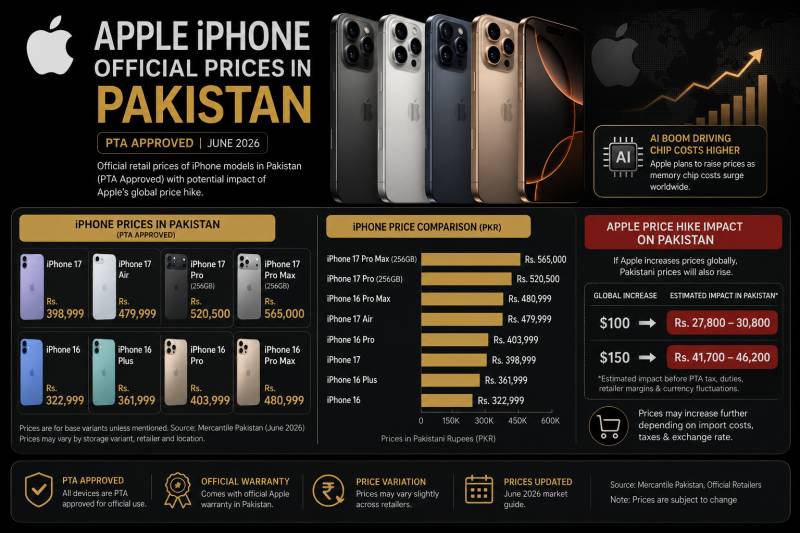
For Pakistani consumers, the impact could be even greater. Industry estimates suggest that every $100 increase in Apple's global retail price could translate into roughly Rs28,000 in additional cost, while a $150 increase could add around Rs42,000 before PTA taxes, import duties, retailer margins and exchange-rate fluctuations are factored in.
The development comes at a time when Apple devices are already among the most expensive smartphones available in Pakistan. Official retail prices for PTA-approved iPhone 17-series devices currently range from around Rs399,000 for the iPhone 17 to well above Rs565,000 for premium Pro Max variants, with higher-storage models costing significantly more.
Memory chips, which are essential components in smartphones, computers and AI servers, have seen sharp price increases over the past several months. The rapid expansion of AI data centers and advanced computing systems has intensified demand for high-performance memory, creating shortages across the technology supply chain.
Cook said Apple was facing the challenge of rising consumer demand at a time when chip manufacturers were passing on substantial cost increases.
"There's less supply at a time when consumers want devices and the memory guys are passing along huge price increases," he said.
Industry data shows that the price of RAM, one of the most widely used memory components in electronic devices, has more than doubled since October 2025.
In addition to AI-driven demand, geopolitical factors have also contributed to rising semiconductor costs. The conflict involving Iran has disrupted supplies of helium, a critical gas used in semiconductor manufacturing, further increasing production expenses for chipmakers.
Market research firm Omdia expects average smartphone selling prices worldwide to rise by around 20% in 2026, reaching record levels.
Omdia smartphone analyst Chiew Le Xuan said Apple's next-generation smartphones could cost as much as $150 more than current models as the company upgrades hardware to support new AI features.
He noted that many smartphone manufacturers have already responded to rising costs by increasing prices, reducing promotional offers or scaling back specifications.
"This is the new pricing reality, not a temporary spike," he said.
The pressure is being felt across the technology industry. Taiwan Semiconductor Manufacturing Company (TSMC), which manufactures advanced chips for Apple, Nvidia and AMD, has indicated that further price increases cannot be ruled out as production costs continue to rise.
Samsung has also warned that shortages in memory chip supplies could make electronic devices more expensive.
Meanwhile, US President Donald Trump said Apple had agreed to work with Intel to manufacture chips in the United States as Washington pushes to strengthen domestic semiconductor production.
In a post on Truth Social, Trump said the United States needed to design and build advanced chips domestically and described support for Intel as part of that strategy.
The announcement helped push Intel shares more than 10% higher in Thursday trading.
Despite the cost pressures, demand for Apple products remains strong. The company reported a 17% increase in device sales during the first quarter of 2026 compared with the same period last year, driven largely by robust demand in China.
Earlier this year, Apple also discontinued the entry-level version of its Mac Mini desktop computer, effectively increasing the starting price of that product line by about $200.
Cook, who is scheduled to step down in September after 15 years as Apple's chief executive, said the company hopes memory chip pricing and supply conditions eventually return to normal levels.
"We definitely need memory pricing and supply to return to reasonable levels for consumer products. That's the bottom line," he said.
For Pakistani consumers, however, the prospect of higher global prices means the next generation of iPhones could become significantly more expensive, further widening the gap between premium Apple devices and the broader smartphone market.