
No peace sans justice, no solution sans Palestinians’ rights, Dar tells UNSC
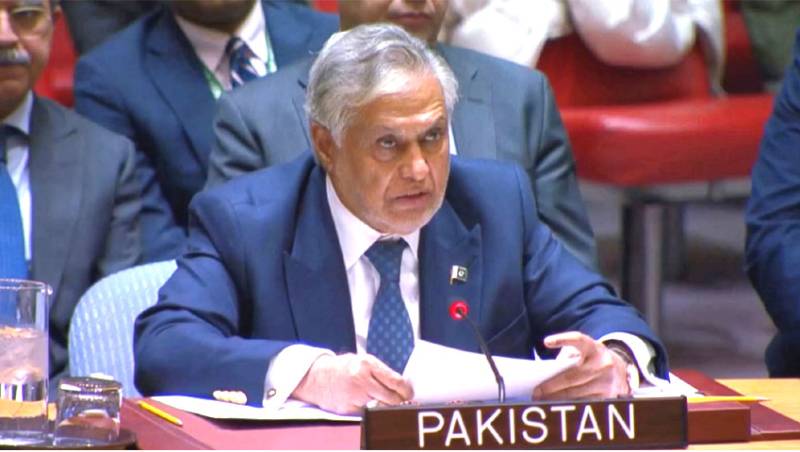

Pakistan on Thursday told the United Nations Security Council that there could be no durable peace without justice, no stability without accountability, and no sustainable solution without the realization of the Palestinian people’s right to self-determination, reported 24NewsHD TV channel.
Deputy Prime Minister and Foreign Minister Senator Ishaq Dar, in his remarks at the United Nations Security Council’s briefing on “the Middle East, including the Palestinian Question” held at the United Nations in New York, emphasized Pakistan’s unwavering solidarity with the Palestinian people in their legitimate pursuit of dignity, freedom, and self-determination.
Dar highlighted ongoing diplomatic efforts to consolidate the ceasefire in Gaza, alleviate civilian suffering, and implement the Comprehensive Plan to End the Gaza Conflict, as endorsed by UN Security Council Resolution 2803.
Dar appreciated peace initiatives led by US President Donald Trump and noted Pakistan’s active collaboration within the Group of eight Arab and Islamic countries — Egypt, Jordan, Qatar, Saudi Arabia, the United Arab Emirates, Indonesia, Pakistan, and Türkiye — to advance a just resolution.
Dar strongly condemned Israel’s recent illegal measures to expand control over the West Bank, including annexation attempts, settlement entrenchment, and designation of lands as “state land.”
These actions, he said, violate international law, the Fourth Geneva Convention, Security Council Resolution 2334, and the 2024 International Court of Justice advisory opinion.
The deputy prime minister also expressed grave concern over repeated Israeli ceasefire violations in Gaza and condemned attacks on UN premises, including UNRWA facilities, restrictions on humanitarian aid, and impediments to assistance, describing the situation as unacceptable and fragile.
He said that a credible, irreversible, and time-bound political process was essential for Palestinian statehood on pre-1967 borders with Al-Quds Al-Sharif as its capital, in line with international legitimacy and UN resolutions.
“Palestinian-led governance and institutional strengthening, with a central role of the Palestinian Authority, are indispensable in this regard,” he added.
DPM Dar said that Pakistan had joined the Board of Peace to support a permanent ceasefire, scaled-up aid, Gaza reconstruction, and realization of Palestinian self-determination through coordinated diplomacy.
Deputy Prime Minister Dar, who is part of Prime Minister Shehbaz Sharif’s delegation in Washington for the inaugural meeting of the Board of Peace, said that Pakistan would attend the session to reinforce these efforts and affirmed that sustained diplomacy, rooted in international law and the UN Charter, with accountability, offered the only path to just and lasting peace in the Middle East.
Pakistan remains ready to contribute to initiatives like President Trump’s Peace Plan, the BoP, the High-Level Conference on the Peaceful Settlement of the Question of Palestine, and the Global Alliance for the Two-State Solution, all aligned toward comprehensive regional peace.
“Pakistan is ready and willing to contribute to all diplomatic initiatives, including President Trump’s Peace Plan, the BoP, the High-Level Conference on the Peaceful Settlement of the Question of Palestine and the Global Alliance for the Two-State Solution, which must reinforce one another through coordinated and concrete implementation, in the interest of our shared objective of a just, lasting and comprehensive peace in the Middle East,” the deputy prime minister reaffirmed.
Israel’s land grabbing ‘gravely disturbing’
Pakistan has called as “gravely disturbing” Israel’s decision to resume land registration procedures in a large part of the occupied West Bank, saying “Actions that alter facts on the ground and prejudice final status issues are mala fide and profoundly counter-productive.”
“Israel’s continued ceasefire violations, annexation attempts and illegal actions across the Occupied Palestinian Territories” continue to undermine efforts aimed at ending the Middle East conflict that threats prospects for a just and lasting peace,” Ishaq Dar told a high-level meeting of the UN Security Council on Wednesday.
“A successful peace process requires a conducive environment built on trust, restraint and good faith,” he stressed.
The meeting on the situation in Palestine was chaired by United Kingdom Foreign Secretary, Yvette Cooper MP, in her capacity as President of the 15-member Council for the month of February.
The Council deliberated on the unresolved conflict a day before US President Donald Trump’s Board of Peace (BoP) holds its inaugural meeting in Washington mainly to discuss war-shattered Gaza’s reconstruction.
Highlighting that the 15-member Council was meeting at a critical juncture”, DPM/FM Dar said since the ceasefire, hundreds of Palestinians have been killed, UN premises, including UNRWA facilities have been attacked, as restrictions on humanitarian operations and pressure on international humanitarian organizations continue to impede relief assistance, which has yet to flow at the scale required.
“This is unacceptable, and also reminds us of the fragility of the current situation.”
On its part, he said, Pakistan is “fully engaged” in diplomatic efforts aimed at permanent cessation of hostilities and a just resolution of the conflict.
In joint statements on 7 and 17 February, the foreign ministers of the Group of Eight Arab and Islamic countries – Egypt, Jordan, Qatar, Saudi Arabia, United Arab Emirates, Indonesia, Turkiye and Pakistan – “condemned in the strongest terms” Israel’s recent decisions to expand control over the West Bank.
“These illegal measures are null and void,” DPM Dar emphasized, and a clear violation of international law, particularly the Fourth Geneva Convention, Council resolution 2334 (2016) and the 2024 advisory opinion of the International Court of Justice.
Against this backdrop, he said, full and faithful implementation of UNSC resolution 2803, with full respect for ceasefire to achieve a permanent cessation of hostilities.
“We must ensure safe, sustained and unimpeded humanitarian assistance at scale,” DPM Dar said, underscoring that recovery and reconstruction phase begin without delay, and without annexation, forced displacement or alteration of the territorial unity of the Occupied Palestinian Territory.
“Illegal settlement activity, settler violence, and attempts to alter the demographic, legal or historical character of the occupied territory, including holy sites, must cease immediately. And it is imperative to advance a credible, irreversible and time-bound political horizon leading to Palestinian statehood, in accordance with international legitimacy. ”
Pakistan, as part of the Group of Eight Arab and Islamic countries, he said, has joined the Board of Peace (BoP) in support of its mandate, as endorsed by UNSC resolution 2803.
“We hope that the BoP, under the framework of resolution 2803, will lead to concrete steps towards the implementation of a permanent ceasefire; further scaling up of humanitarian aid; reconstruction of Gaza; and realization of the right to self-determination of the people of Palestine through a credible, time-bound political process, consistent with international legitimacy and relevant UN resolutions, resulting in an independent, sovereign and contiguous state of Palestine based on pre-1967 borders with Al-Quds Al-Sharif as its capital.”
“This is the ultimate goal supported by the international community,” DPM Dar said, with an “indispensable” central role of the Palestinian Authority.
Tomorrow, he said, Pakistan will participate in the inaugural meeting of the BoP with the objective of reinforcing ongoing diplomatic efforts.
“We engage in this process with the firm conviction that sustained diplomacy, anchored in international law and the UN Charter and guided by accountability, provides the only viable pathway to a just and lasting peace.”
DPM Dar said there can be no durable peace without justice, no stability without accountability, and no sustainable solution without the realization of the Palestinian people’s right to self-determination.
“Pakistan’s solidarity with our Palestinian brothers and sisters and their just cause remains unwavering,” he declared.
“We stand with them in their legitimate pursuit of right to self-determination, dignity and freedom.”
Opening the debate, Rosemary DiCarlo, UN under-secretary-general for political and peacebuilding affairs, said that collective efforts must consolidate the ceasefire in Gaza and promote stabilization and recovery.
To these ends, she said, the 19 February meeting of the Board of Peace is an important step. However, Ms. DiCarlo underscored that “despite the ceasefire, Gaza is still not at peace”. The Israeli military has recently intensified strikes across the Strip and armed exchanges between Palestinian armed groups and Israeli soldiers have continued.
Meanwhile, the situation in the occupied West Bank is “deteriorating rapidly”, Ms DiCarlo reported. Israeli forces have continued large-scale operations — frequently involving live fire — while widespread raids have been accompanied by home takeovers, mass detentions, movement restrictions and repeated displacement of Palestinian families. These unfold alongside settlement expansion, and — echoing the Secretary-General’s concern and condemnation over Israeli Government actions — she stressed: “We are witnessing the gradual de facto annexation of the West Bank, as unilateral Israeli steps steadily transform the landscape.”
“We cannot afford half measures” at this fragile juncture, she said, urging a reversal of the dangerous trajectory in the West Bank and restoration of a political horizon towards lasting peace in Gaza, an end to the occupation and pursuit of a two-State solution.
“There is no peace anywhere, anytime,” said Riyad Mansour, Permanent Observer of the State of Palestine, detailing the destruction of centuries-old Christian and Muslim houses of worship, military check points and restrictions against the pilgrimages of Muslims and Christians alike.
Israel’s goal is to remove Palestinians and seize Palestinian land, he said, and while the scale and pace have changed dramatically, the tools and objectives remain the same: Settlements, settler terrorism, land expropriation, house demolitions and the takeover of land registrations — all to serve the ultimate objective, annexation.
“Palestine belongs to the Palestinian people,” Mansour insisted. “It is not up for grabs. And it is not for sale.” Despite its efforts, “Israel will not transform us into a people without a land.”
Indeed, annexation is in full display. Unchallenged, it will define – and doom – the region’s future, the Palestinian envoy added.