
Eye in Sky: Pakistan launches first Hyperspectral Satellite in historic space milestone
SUPARCO hails launch HS-1 as turning point in national space policy and Vision 2047: Satellite to provide early warnings for disasters and improve crop forecasting: Brigadier Aftab describes the launch as a "historic day" for Pakistan: FO spokesperson says HS-1 launched from China's Satellite Launch Centre: Dar expresses his gratitude to Pakistani and Chinese scientists' efforts
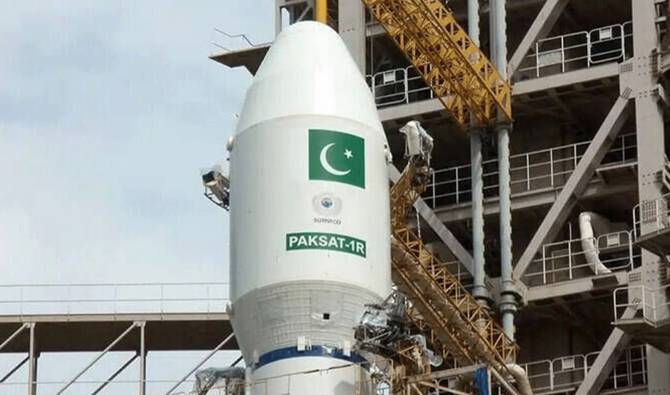

In a landmark achievement for its national space ambitions, Pakistan successfully launched its first Hyperspectral Satellite (HS-1) into space on October 19 from the Jiuquan Satellite Launch Centre (JSLC) in China, signalling a new era in the country’s remote sensing and scientific capabilities, 24NewsHD TV channel reported on Sunday.
According to the report, the launch of HS-1 is being hailed as a key milestone in Pakistan’s National Space Policy and Vision 2047. The mission, developed by the Space and Upper Atmosphere Research Commission (SUPARCO), will dramatically enhance the country’s ability to monitor environmental change, predict natural disasters, boost agricultural productivity, and assist in sustainable urban development.
The launch ceremony was simultaneously held at SUPARCO headquarters in Karachi and Islamabad. Speaking at the event, SUPARCO Secretary Brigadier Aftab described the launch as a "historic day" for Pakistan. “This satellite is a major step for Pakistan into the space world,” he said, emphasizing its transformative role across multiple sectors.
Brigadier Aftab added that hyperspectral technology enables identification of material composition by analyzing how objects reflect different wavelengths of light. “This satellite will help us understand what things are made of,” he explained. “It will assist us in the agriculture sector, provide real-time flood alerts, and support efforts to prevent deforestation and promote environmental sustainability.”
SUPARCO officials stated that the HS-1 satellite will significantly improve early warning systems for natural disasters such as floods, landslides, and earthquakes, particularly across high-risk areas like the Karakoram Highway and northern Pakistan. It will also support geo-hazard monitoring and post-disaster response, including transportation network analysis and water resource modeling.
For agriculture, HS-1 brings a revolution in precision farming. The satellite will capture high-resolution hyperspectral data, allowing scientists to assess crop health, soil moisture, and irrigation patterns—enhancing yield estimation by 15 to 20 percent and contributing to national food security.
In urban planning, HS-1’s cutting-edge sensors will enable real-time mapping of infrastructure, environmental changes, and urban sprawl. By capturing the unique spectral signatures of man-made structures, the satellite will support sustainable city planning, land-use optimization, and better resource management.
This marks Pakistan’s third satellite to be launched into space, following PRSS-1 in July 2018, and ahead of two more expected launches—EO-1 in January 2025 and KS-1 in July 2025. The integration of HS-1 into the country’s growing remote sensing fleet underscores Pakistan’s commitment to building a modern, space-based infrastructure that can support environmental resilience, economic development, and national security.
SUPARCO called the HS-1 mission “a transformative milestone in Pakistan’s national space programme,” adding that the country is entering a new phase of advanced space-based applications that align with its long-term strategic goals.
According to a Foreign Office spokesperson, SPARCO launched the HS-1 satellite from China's Satellite Launch Centre. HS-1 is equipped with advanced hyperspectral imaging technology.
The satellite is capable of acquiring data in hundreds of spectral bands. HS-1 will enable accurate analysis of land use, crops, water and urban development.
The satellite will be helpful in environmental monitoring and natural disaster management. HS-1 will improve resource utilisation and increase environmental resilience.
The satellite project will assist in sustainable development projects under CPEC.
HS-1 is a new milestone in Pakistan's development journey in space.
SPARCO reiterated its commitment to national development through space technology.
Space cooperation between Pakistan and China continues for peaceful and developmental purposes.
Deputy Prime Minister Ishaq Dar has expressed his gratitude to Pakistani and Chinese scientists' efforts.
Reporters: Anwar Abbas and Aqsa Shaikh