
Health experts call for greater breastfeeding awareness in Pakistan
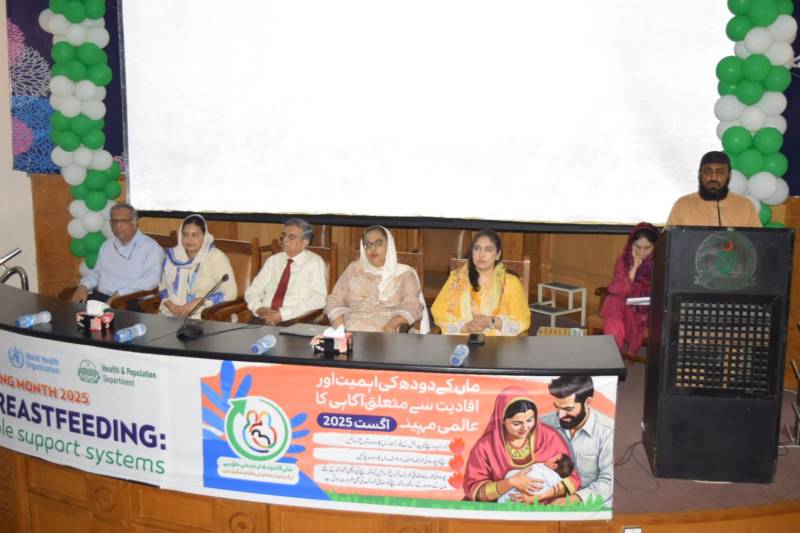

Health experts on Wednesday called for greater awareness of breastfeeding, noting that the rate in Pakistan remains only 48 per cent despite its proven health benefits for both mothers and children, 24NewsHD TV reported.
They were speaking at a seminar on breastfeeding organised by the University of Health Sciences (UHS) in collaboration with Pakistan.
The event was attended by faculty members, students, and health professionals.
Prof Sajid Maqbool, a senior paediatrician and chief guest on the occasion, stressed that mothers and children should be treated as a single unit because the health of one directly affects the other.
He said there is no substitute for mother’s milk, and preparation for breastfeeding should ideally begin before pregnancy.
He emphasised that newborns must be given breast milk within the first hour of birth, exclusively for six months, and continued with complementary food for two years.
UNICEF nutritionist Najma Ayub said breastfeeding is the fundamental right of every child and highlighted that global Breastfeeding Awareness Week is observed in August.
Citing 2024 data, she pointed to a worrying decline in breastfeeding rates in Punjab. Formula milk, she said, was not a benevolent product but a marketing ploy.
She urged stronger legislation and workplace facilities to support nursing mothers.
Prof Khawaja Ahmad Irfan Waheed, neonatologist, said breastfeeding prevents about 800,000 child deaths worldwide each year and could reduce child mortality under five years by 13 per cent.
In Pakistan, the breastfeeding rate is just 48 per cent, he said, whereas it should be universal.
He added that breastfed children have higher IQs and mothers who breastfeed face lower risks of breast and ovarian cancers. Globally, breastfeeding could save the health sector $302 billion annually.
He further said that household resistance, particularly from grandmothers, was a major obstacle, and cultural attitudes needed to change. “Weakness comes from within the household. The blame cannot be put solely on formula milk,” he remarked. He added that formula feeding places an additional 15 to 30 per cent burden on the household budget.
Prof Rubina Sohail, a gynaecologist, noted that infections remain the leading cause of infant mortality in Pakistan, where neonatal deaths stand at 39 per 1,000 live births and have not declined over the past two decades.
She described the first breast milk as the “golden drop” and nature’s first vaccine, but regretted that medical and nursing students in Pakistan receive inadequate training on breastfeeding during their studies.
Other participants included Prof Sidrah Saleem, Prof Asif Naveed, Dr Midhat Salman, and Dr Uzma Jabeen.