
Sirens sounded in Israel as Iran fires fresh missiles salvo
Fearing attack, US hides military aircraft at Qatar base: Iran appoints new Revolutionary Guards intelligence chief: European, Iranian diplomats to hold talks
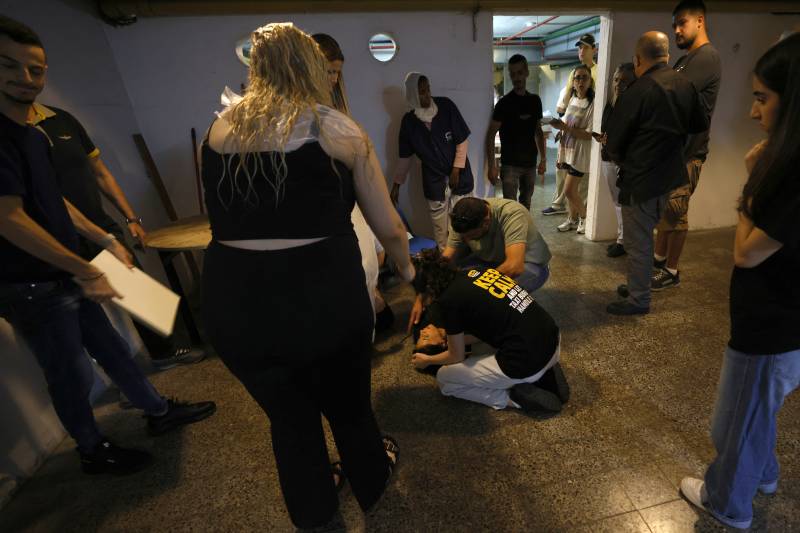

The Israeli army said Friday sirens had sounded in southern Israel after missiles were fired from Iran.
"Sirens sounded in several areas across Israel following the identification of missiles launched from Iran toward the State of Israel," the military said on Telegram, adding it was working to intercept them.
Meanwhile, dozens of US military aircraft are no longer on the tarmac at a major US base in Qatar, satellite images show -- a possible move to shield them from eventual Iranian air strikes, as Washington weighs whether to intervene in Tehran's conflict with Israel.
Nearly 40 military aircraft -- including transport planes like the Hercules C-130 and reconnaissance aircraft -- were parked on the tarmac at the Al Udeid base on June 5, according to images published by Planet Labs PBC and analysed by AFP.
In an image taken on June 19, only three aircraft are visible.
The US embassy in Qatar announced Thursday that access to the base would be limited "out of an abundance of caution and in light of ongoing regional hostilities," and urged personnel to "exercise increased vigilance."
The White House says US President Donald Trump will decide sometime in the next two weeks whether to join ally Israel's strikes on Iran. The Islamic republic could then respond by striking US bases in the region.
Mark Schwartz, a former lieutenant general in the US Army and a defense researcher at the Rand Corporation, said the personnel, aircraft and installations at Al Udeid would be "extremely vulnerable" given its "close proximity" to Iran.
Schwartz, who served in the Middle East, told AFP that even shrapnel could render the aircraft "non-mission capable."
"You want to reduce risk to US forces, both personnel and equipment," he said.
The planes that have left the tarmac since early June could have been moved to hangars or to other bases in the region.
A US defence official would not discuss the specific positioning of assets but told AFP: "We remain committed to maintaining operational security while executing our mission with the highest level of readiness, lethality and professionalism."
US forces in the Middle East have been mobilized since Israel's first strikes on Iran nearly a week ago, with an additional aircraft carrier en route and significant aircraft movement.
An AFP analysis of open source data tracking aircraft positioning showed that at least 27 military refuelling planes -- KC-46A Pegasus and KC-135 Stratotanker planes -- travelled from the United States to Europe from June 15-18.
Twenty-five of them were still in Europe as of late Wednesday, with only two returning to American soil, the data showed.
Iran appoints new Revolutionary Guards intel chief
Iran appointed a new chief of intelligence at its Revolutionary Guards on Thursday, the official Irna news agency said, after his predecessor was killed in an Israeli strike last week.
Major General Mohammad Pakpour, the commander of Iran's Islamic Revolutionary Guards Corps (IRGC), appointed Brigadier General Majid Khadami as the new head of its intelligence division, Irna said.
He replaces Mohammed Kazemi, who was killed on Sunday alongside two other Revolutionary Guards officers -- Hassan Mohaghegh and Mohsen Bagheri -- in an Israeli strike.
Pakpour had himself been recently appointed after Israel killed his predecessor Hossein Salami in a strike on June 13.
"During the years that our martyred commanders Kazemi and Mohaqeq led the IRGC Intelligence, we witnessed significant growth in all aspects of intelligence within the IRGC," said Pakpour.
Israel launched air strikes on nuclear and military sites in Iran last week, claiming that its arch enemy was on the verge of developing a nuclear weapon, which Iran denies.
Israel killed several top Iranian officials, prompting a counter-attack by Iran, which on Thursday hit an Israeli hospital.
Upon his appointment by Iran's supreme leader Ali Khamenei last Friday, Pakpour threatened to open "the gates of hell" in retaliation for Israel's attacks.
Top Israeli figures have openly talked about killing Khamenei.
European, Iranian diplomats to meet
European foreign ministers will hold talks Friday with their Iranian counterpart, hoping to reach a diplomatic solution to the war with Israel as US President Donald Trump mulls the prospect of US involvement.
Israel, claiming Iran was on the verge of developing a nuclear weapon, launched air strikes against its arch-enemy a week ago, triggering deadly exchanges.
Sirens sounded in southern Israel on Friday morning after missiles were launched from Iran, the Israeli army said. It earlier warned people in Iran's northern industrial area of Sefidrood to evacuate ahead of Israeli strikes.
European leaders urging de-escalation have scrambled to hold talks with Iran, as Trump said he would decide "within the next two weeks" whether to involve the United States in Israel's bombing campaign.
Iranian Foreign Minister Abbas Araghchi will meet with his French, German, British and EU counterparts in Geneva on Friday to discuss Iran's nuclear programme.
Britain's Foreign Secretary David Lammy said "a window now exists within the next two weeks to achieve a diplomatic solution", after meeting senior US officials in Washington on Thursday.
Lammy and US Secretary of State Marco Rubio "agreed Iran can never develop or acquire a nuclear weapon", according to the State Department.
Netanyahu welcomed the prospect of US involvement in its campaign, while Russia, an Iranian ally, told the United States that joining the conflict would be an "extremely dangerous step".
The UN Security Council is also due to convene on Friday for a second session on the conflict, which was requested by Iran with support from Russia, China and Pakistan, a diplomat told AFP on Wednesday.
While Netanyahu has not publicly said that Israel is trying to topple Iran's supreme leader Ayatollah Ali Khamenei, defence minister Israel Katz warned after the strike on Israel's Soroka hospital that Khamenei "can no longer be allowed to exist".
A week of deadly exchanges between the two countries has plunged the Middle East into a new crisis, more than 20 months into the war between Israel and Palestinian militant group Hamas in the Gaza Strip.
- Panic -
Israel's Prime Minister Benjamin Netanyahu has sworn Iran will "pay a heavy price" for a strike on an Israeli hospital on Thursday, an attack Tehran said was targeting a military and intelligence base.
Soroka hospital's director Shlomi Codish said 40 people were wounded in the strike that destroyed several wards.
World Health Organization director-general Tedros Adhanom hebreyesus called attacks on health facilities "appalling", while UN rights chief Volker Turk said civilians were being treated as "collateral damage".
In Iran, people fleeing Israel's attacks described frightening scenes and difficult living conditions, including food shortages and limited internet access.
"Those days and nights were very horrifying... hearing sirens, the wailing, the danger of being hit by missiles," University of Tehran student Mohammad Hassan told AFP, after returning to his native Pakistan.
"People are really panicking," a 50-year-old Iranian pharmacist who did not want to be named told AFP at a crossing on the border with Turkey.
Iran imposed a "nationwide internet shutdown" on Thursday -- the most extensive blackout since widespread anti-government protests in 2019 -- internet watchdog NetBlocks said.
The shutdown "impacts the public's ability to stay connected at a time when communications are vital", NetBlocks wrote on X.
Any US involvement in Israel's campaign against Iran would be expected to involve the bombing of a crucial underground nuclear facility in Fordo, using specially developed bunker-busting bombs.
The Wall Street Journal reported that Trump told aides he had approved attack plans but was holding off to see if Iran would give up its nuclear programme.
The US president had favoured a diplomatic route to stop Iran from acquiring nuclear weapons -- an ambition Tehran has consistently denied -- seeking a deal to replace the 2015 agreement he tore up in his first term.
Dozens of US military aircraft were no longer visible at a US base in Qatar on Thursday, satellite images showed -- a possible move to shield them from potential Iranian strikes.
- Nuclear sites -
White House Press Secretary Karoline Leavitt claimed Iran was "a couple of weeks" away from producing an atomic bomb.
Iran had been enriching uranium to 60 percent -- far above the 3.67-percent limit set by the 2015 deal, but still short of the 90 percent needed for a nuclear warhead.
Israel has maintained ambiguity on its own arsenal, but the Stockholm International Peace Research Institute says it has 90 nuclear warheads.
A key Iranian government body, the Guardian Council, threatened a "harsh response" if "the criminal American government and its stupid president... take action against Islamic Iran".
On Thursday, Israel said it struck "dozens" of Iranian targets overnight, including the partially built Arak nuclear reactor and a uranium enrichment facility in Natanz.
Iranian atomic energy agency chief Mohammad Eslami confirmed in a letter to the UN nuclear watchdog that the Arak reactor was hit, demanding action to stop Israel's "violation of international regulations".
Iranian media reported blasts in Tehran late Thursday, while the Revolutionary Guards said more than 100 "combat and suicide" drones were launched at Israel.
In the central Israeli city of Bat Yam, the body of a woman was found in a site hit on Sunday, taking the death toll in Israel from Iranian missiles since June 13 to 25 people, according to authorities.
Iran said Sunday that Israeli strikes had killed at least 224 people, including military commanders, nuclear scientists and civilians.
Australia joins other nations shutting Tehran embassies
Australia has shuttered its Tehran embassy and ordered officials to leave Iran, the government said Friday, citing a "deteriorating security situation".
It joins a string of countries closing diplomatic missions in Iran since Israel launched air strikes a week ago, claiming its arch enemy was on the verge of developing a nuclear weapon.
Australia has directed all its officials and their dependents to leave Iran, and suspended its Tehran embassy operations, Foreign Minister Penny Wong told a news conference in Adelaide.
"This is not a decision taken lightly. It is a decision based on the deteriorating security environment in Iran," she said.
The government advised all Australians to leave Iran if they can do safely.
Wong said there were about 2,000 Australians and family members registered in Iran who wanted to depart, and another 1,200 in Israel.
Other nations that have suspended Tehran embassy operations include Bulgaria, Czech Republic, New Zealand, Portugal, and Switzerland.