
Hopes rise for new ceasefire as Gaza deaths top 20,000
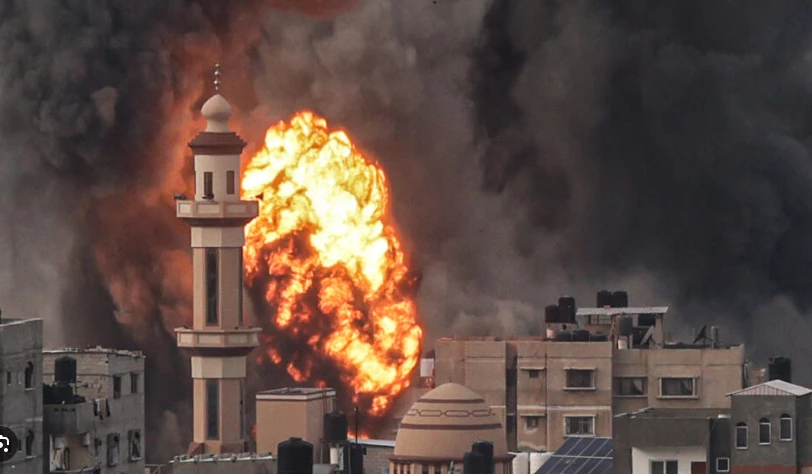

Hopes rose Wednesday that Israel and Hamas may be inching toward another truce and hostage-release deal in the Gaza war, following talks in Europe and a visit to Egypt by the head of the Palestinian militant group.
While some talked of a truce, fighting raged and Gaza's Hamas government said the death toll in the Palestinian territory reached 20,000.
Right-wing Israeli Prime Minister Benjamin Netanyahu said there can be no Gaza ceasefire until Hamas militants are destroyed, but Washington expressed hope the truce talks can bring results.
"These are very serious discussions and negotiations and we hope that they lead somewhere," National Security Council spokesman John Kirby said.
US Secretary of State Antony Blinken also voiced hope for a new pause in fighting.
"We remain very actively engaged in seeing if we can get a pause back on and hostages moving out again," he said.
https://twitter.com/jakeshieldsajj/status/1737582292137119887
The comments came after Netanyahu, under pressure from Washington and other allies over civilian casualties, said fighting would not stop until all objectives are achieved: "the elimination of Hamas, the release of our hostages and the end of the threat from Gaza."
Late Tuesday he had told relatives of some of the remaining 129 captives held in Gaza that he had sent the head of the Mossad spy agency "to Europe twice to promote a process to free our hostages".
The bloodiest-ever Gaza war began when Hamas attacked Israel on October 7, killing around 1,140 people, mostly civilians, and abducting about 250, according to an AFP tally based on Israeli figures.
In response, Israel began a relentless bombardment alongside a ground invasion. Hamas says most of those killed in Gaza have been women and children.
No, this isn’t Hiroshima or Nagasaki.
— sarah (@sahouraxo) December 20, 2023
It’s Gaza after being annihilated by Israel.
This is what American taxpayer money bankrolls. pic.twitter.com/rUTMDm5BKB
- Protests -
Netanyahu has faced protests from hostage relatives seeking an urgent deal to free the captives.
"Every moment the hostages are there, is danger. They have no time," said Ofir Engel, 17, a Dutch-Israeli former captive.
Mossad director David Barnea held a "positive meeting" in Warsaw this week with CIA chief Bill Burns and Qatari Prime Minister Sheikh Mohammed bin Abdulrahman Al Thani, a source familiar with the talks told AFP, asking not to be named.
Talks were ongoing "with the aim of reaching an agreement around the release of the remaining hostages in Gaza in exchange for a truce and the potential release of Palestinians held in Israeli prisons," said the source.
Qatar, backed by Egypt and the United States, last month helped broker a first week-long truce that saw 80 Israeli hostages freed in exchange for 240 Palestinian prisoners.
The Qatar-based chief of Hamas, Ismail Haniyeh, arrived in Egypt for talks with that country's intelligence chief Abbas Kamel.
https://twitter.com/search?q=gaza&src=typed_query
A Hamas official, speaking Wednesday on condition of anonymity, told AFP in Gaza that "a total ceasefire and a retreat of the Israeli occupation army from the Gaza Strip are a precondition for any serious negotiation" on a hostage-prisoner swap.
The Egypt talks would focus on proposals including a week-long truce that would see the release of 40 Israeli hostages, a source close to Hamas said earlier.
Before leaving Qatar, Haniyeh met Iranian Foreign Minister Hossein Amir-Abdollahian but no details were released.
In Rafah, where fireballs and smoke rose after explosions, residents expressed hope that talks would succeed.
"I wish for a complete ceasefire, and to put an end to the series of death and suffering. It's been more than 75 days," said Kassem Shurrab, 25.
Bassil Khoder, 63, said a ceasefire would allow displaced Palestinians like him to return home but it would be good for Israelis too.
"The Jews are also our neighbours," he said. "We won't give up on them."
🔊 Listen closely to hear echoes of the final cries of innocent civilians being annihilated,an entire neighborhood in #Gaza erased over the heads of residents today
— Nour Naim| نُور (@NourNaim88) December 20, 2023
Yet,not a single entity in this world,at the very least,condemns it
The Israeli army’s brutality is beyond words! pic.twitter.com/fW6K8YU2FN
- 'Enough' -
An AFPTV live camera on Wednesday filmed two bombs hitting Rafah, in southern Gaza where many of the territory's estimated 1.9 million displaced have fled.
The Hamas health ministry said Israeli strikes killed at least 12 Palestinians when houses and a mosque in Rafah "were targeted". It said later at least 30 more people were killed in an Israeli strike that hit two houses east of Khan Yunis.
Crowds swarmed the rubble, digging with shovels and a backhoe to try to free the victims. One blackened body lay under a blue blanket on the blood-soaked ground.
The army reported close-quarter combat and more than 300 strikes over the past day, while the death toll among its own forces rose to 134 inside Gaza.
It said troops had uncovered a tunnel network used by Hamas leaders including Yahya Sinwar, the Islamist movement's Gaza chief. The military released footage it said showed the "large network" around Gaza City's Palestine Square linking hideouts and residences.
The UN Security Council again delayed a vote on a resolution calling for a pause to the war after members wrangled over wording. The vote is now scheduled for Thursday morning. The United States vetoed a previous ceasefire resolution.
"Dad please stand up for a while, Dad I can't handle this"
— TIMES OF GAZA (@Timesofgaza) December 20, 2023
A boy struggles to come to come to terms with the loss of his father after he was killed in an Israeli airstrike pic.twitter.com/44rvj5OQKW
Israel, which declared a total siege on Gaza at the start of the war, has since allowed aid trucks through the Rafah border crossing with Egypt and, as of this week, its own Kerem Shalom crossing.
The World Food Progamme said Wednesday it had delivered food through Kerem Shalom in a first direct aid convoy from Jordan and warned of the "risk of starvation".
Fuel, water and medical supplies are also scarce, diseases are spreading, and communications have been repeatedly cut.
An Israeli military agency, COGAT, said it had started laying a pipeline from Egypt to deliver drinking water from a mobile desalination plant in a project led by the United Arab Emirates.
Visiting nearby Cyprus, Israeli Foreign Minister Eli Cohen expressed support for plans to send humanitarian aid to Gaza from the Mediterranean island.
"We aim to create a fast track for humanitarian aid to Gaza through this corridor," he said.
The war has sparked fears of regional escalation, with exchanges of fire over the Lebanon border, and missiles from Iran-backed Yemeni rebels disrupting Red Sea shipping.
https://twitter.com/NotBreathingNow/status/1737578840682098825
More evacuations from Gaza's main southern city ordered
Israel ordered the evacuation Wednesday of large areas of Gaza's main southern city, the United Nations said.
The United Nations Office for the Coordination of Humanitarian Affairs (OCHA) said Israel had released maps showing new areas covering about 20 percent of the Khan Yunis city that had been marked for evacuation.
Before fighting broke out, the area was home to more than 110,000 people, OCHA said.
The area also includes 32 shelters that housed more than 140,000 internally displaced persons, the vast majority of whom were previously displaced from the north, it added.
The Israeli army said Wednesday that "ground, aerial and naval operations were carried out on dozens of terrorists and terrorist infrastructure" on military command and control centres in Khan Yunis.
The war between Israel and Hamas, which rules the Gaza Strip, began after the Islamist group carried out a bloody attack on southern Israel on October 7 which killed around 1,140 people, according to an AFP tally based on the latest official Israeli figures.
Israel's ensuing military campaign in Gaza has so far killed at least 20,000 people, the majority of them children and women, according to the Hamas government.
🔴 UNRWA: The levels of hunger in Gaza are unprecedented, and water, food and medicine are used as weapons of war, and the continuous bombing prevents aid from reaching those in need.
— 🇵🇸🇮🇪🇿🇦 🇪🇸 (@AntiZionistB) December 20, 2023
Tell me again, how is this not a collective punishment war crime ⁉️
#GazaMassacre pic.twitter.com/68aWWZjabS
UNSC resolution again stalled
The UN Security Council on Thursday will try once again to pass a resolution calling for a halt in fighting between Israel and Hamas after previous efforts to win Washington's backing fell short.
Diplomatic wrangling at United Nations headquarters in Manhattan headquarters -- which caused the vote to be postponed again Wednesday -- has come against a backdrop of deteriorating conditions in Gaza and a mounting death toll.
The United Arab Emirates is sponsoring a draft resolution on the conflict which has already been watered down to secure compromise, according to a draft version seen by AFP.
It calls for "the urgent suspension of hostilities to allow safe and unhindered humanitarian access, and for urgent steps towards a sustainable cessation of hostilities."
Countries "are engaging at the highest level of diplomacy to reach a text that will have impact on the ground. Diplomacy takes time," said the UAE's ambassador Lana Zaki Nusseibeh.
"If this fails, then we will continue to keep trying... There is too much suffering on the ground for the council to continue to fail on this."
Members of the 15-member council have been grappling for days to find common ground on the resolution, a vote on which was pushed back several times since Monday.
Houthis:
— Globe Eye News (@GlobeEyeNews) December 21, 2023
If we had borders with Palestine, we would enter Gaza by land to end the occupation completely. pic.twitter.com/WrZP9yD51Q
- 'Final decision' -
Israel, backed by its ally the United States, a veto-wielding permanent Security Council member, has opposed the term "ceasefire," and Washington has used its veto twice to thwart resolutions opposed by Israel since the start of the war.
The latest delay was at the request of the United States, a diplomatic source said.
Israeli Prime Minister Benjamin Netanyahu said Wednesday there would be no ceasefire in Gaza until the "elimination" of Hamas.
"Everyone in New York is still waiting on the White House. There is a strong sense that (US President Joe) Biden will make the final decision on this," said International Crisis Group analyst Richard Gowan.
https://twitter.com/KKhanabadosh/status/1737577589760286972
Washington's UN ambassador Linda Thomas-Greenfield "has pitched hard within the US system for a deal," Gowan said.
"But if the Israelis continue to oppose the resolution, Biden could still decide to block it."
Secretary of State Antony Blinken would not be drawn on Washington's next move at the Security Council, telling reporters Wednesday that the US was engaging "constructively... to try to resolve some of the issues."
He said Washington wanted "to make sure that the resolution, in what it calls for and requires, actually advances (humanitarian) effort and doesn't do anything that could actually hurt the delivery of humanitarian assistance."
The spokesman for UN Secretary-General Antonio Guterres said it is "not for us to interfere with those discussions, which I understand are fairly intense."
"The secretary-general's own position is unchanged -- he's been calling for a humanitarian ceasefire," said the spokesman, Stephane Dujarric.
In search of a drop of water in #Gaza . For the record, #Israel has cut off Gaza's water supply because Israel is a war criminal. pic.twitter.com/rqhCO1VQG9
— Rania (@umyaznemo) December 21, 2023