
Petrol price raised to Rs320.74, diesel to Rs367.21 per litre under daily pricing mechanism
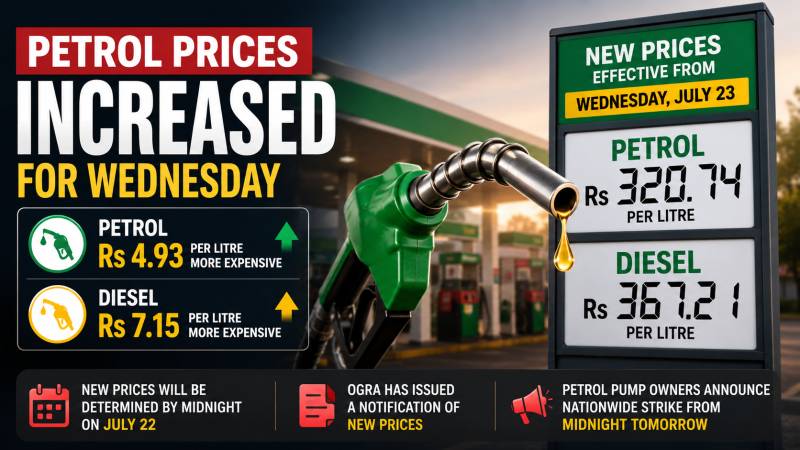

The federal government on Tuesday significantly increased the prices of petroleum products under the newly introduced daily pricing mechanism, raising the price of petrol by Rs4.93 per litre and high-speed diesel by Rs7.15 per litre.
According to a notification issued by the Oil and Gas Regulatory Authority (OGRA), the new prices will take effect from Wednesday, July 23, following the government's approval.
Under the revised rates, the price of petrol has been increased from Rs315.80 to Rs320.74 per litre, while high-speed diesel has risen from Rs360.06 to Rs367.21 per litre.
The revised prices will remain in force until the next review at midnight on July 22-23 under the government's daily petroleum pricing regime.
The latest revision comes just a day after the government had reduced the price of petrol by 35 paisas per litre while increasing the price of high-speed diesel by Rs5.71 per litre.
The move also coincided with growing opposition from petroleum retailers over the government's decision to introduce daily fuel price revisions.
Earlier on Tuesday, the All Pakistan Petrol Pump Owners Association announced a nationwide strike from midnight after negotiations with Petroleum Minister Ali Pervaiz Malik failed to resolve differences over dealers' commissions and the new pricing mechanism.
Speaking at a press conference, Association Chairman Humayun Khan said petrol pump owners had rejected the daily pricing system, arguing that it created uncertainty for dealers and consumers alike.
He said the association was demanding that dealers' commissions be linked to petroleum prices and revised on a monthly basis to reflect increasing operational costs.
Khan criticised the daily pricing mechanism as impractical, saying it would complicate inventory management, accounting and business operations for fuel stations across the country.
He also accused the government of formulating the policy without consulting petrol pump owners, adding that retailers' concerns had been ignored despite repeated requests for dialogue.
"It is unfortunate that business stakeholders are not consulted before policies affecting them are introduced," he said.
The association maintained that frequent price revisions would create confusion among consumers and increase operational difficulties for petrol stations.
Petrol pump owners have long demanded that their margins be converted from a fixed per-litre amount into a percentage of the retail price, arguing that their expenses rise whenever fuel prices and operating costs increase.
The government's move to revise petroleum prices on a daily basis is aimed at aligning domestic fuel prices more closely with fluctuations in international oil markets and the exchange rate, although the policy has drawn criticism from fuel retailers and other stakeholders.