
President Erdogan calls for punitive sanctions against Israel
Tells OIC FMs Israel attacks aimed to sabotage Iran nuclear talks: Won’t allow Middle East borders redrawn ‘in blood’: Accuses Western leader of providing ‘unconditional support’ to Israel
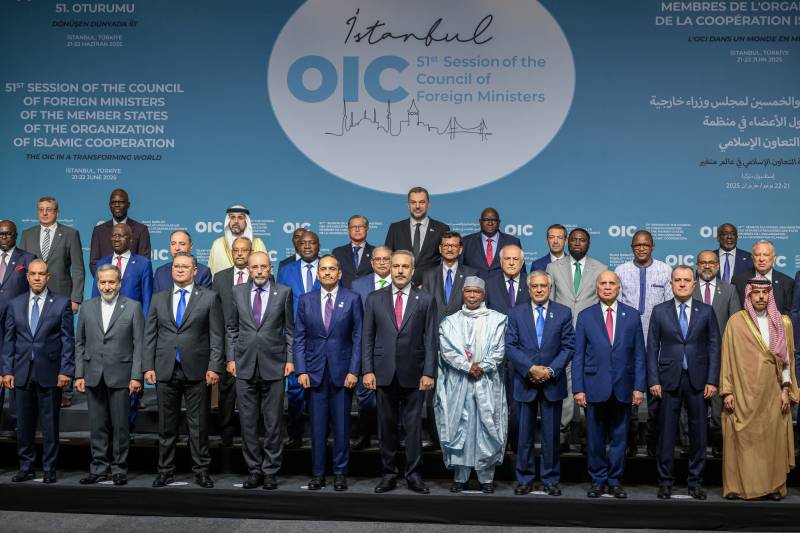

Turkish President Tayyip Erdogan said on Saturday that Israel’s attacks on Iran right before a new round of nuclear talks with the United States aimed to sabotage the negotiations, and it showed Israel did not want to resolve issues through diplomacy while his foreign minister accused Israel of leading the Middle East towards "total disaster" by attacking Iran.
Speaking at a foreign ministers’ meeting of the Organization of Islamic Cooperation (OIC) in Istanbul, Erdogan urged countries with influence over Israel not to listen to its “poison” and to seek a solution to the fighting via dialogue without allowing a wider conflict.
He also called on Muslim countries to increase their efforts to impose punitive measures against Israel on the basis of international law and United Nations’ resolutions.
President Erdogan accused Western leaders of providing "unconditional support" to Israel. He said Turkey would not allow borders in the Middle East to be redrawn "in blood".
"It is vital for us to show more solidarity to end Israel's banditry -- not only in Palestine but also in Syria, in Lebanon and in Iran," he told the OIC's 57 member countries.
Iran’s foreign minister Abbas Araghchi earlier arrived in Istanbul on Saturday, Tasnim news agency reported, for a meeting with diplomats to discuss Tehran’s escalating conflict with Israel.
Around 40 diplomats were expected to join the weekend gathering of the Organization of Islamic Cooperation (OIC), as Israel and Iran continue to exchange missile strikes.
“The Foreign Minister arrived in Istanbul this morning to participate in the Organization of Islamic Cooperation Foreign Ministers’ meeting,” Tasnim reported.
Araghchi met with his counterparts from Britain, France and Germany in Geneva on Friday.
“At this meeting, at the suggestion of Iran, the issue of the Zionist regime’s attack on our country will be specifically addressed,” said Araghchi, according to the news agency.
Earlier, Turkish Foreign Minister Hakan Fidan accused Israel of leading the Middle East towards "total disaster" by attacking Iran on June 13.
"Israel is now leading the region to the brink of total disaster by attacking Iran, our neighbour," he told a summit of the Organization of Islamic Cooperation (OIC) in Istanbul.
"There is no Palestinian, Lebanese, Syrian, Yemeni or Iranian problem but there is clearly an Israeli problem," Fidan said.
He called for an end to the "unlimited aggression" against Iran.
"We must prevent the situation from deteriorating into a spiral of violence that would further jeopardise regional and global security," he added.
Israel strikes Isfahan nuclear site again
Israel targeted "two centrifuge production sites" at Iran's Isfahan nuclear facility overnight in a second wave of strikes on the location since the start of the war, a military official said on Saturday.
"Isfahan we targeted in the first 24 hours of our operation, but we carried out a second wave of strikes there overnight, deepening our achievements and advancing the damage to the facility," the military official told reporters during a briefing on condition of anonymity.
He added that the targeting of two centrifuge production sites in Isfahan was "in addition to a couple more centrifuge production sites that we have been able to strike successfully in recent days".
The repeated raids by the Israeli air force have "dealt a severe blow to Iran's centrifuge production capabilities," the official added.
Centrifuges are used to enrich uranium, both for civilian and military use, with the radioactive metal needing to be enriched to high levels for use in atomic weapons.
Isfahan, in central Iran, is known to have a uranium conversion facility which processes raw, mined uranium. It also holds a nuclear fuel fabrication facility, which was inaugurated in 2009 and produces low-enriched fuel for use in power plants.
In July 2022, Iran announced plans to construct a new research reactor there.
On the first day of Israel's strikes on June 13, the Israeli military said it had struck "a facility for producing metallic uranium, infrastructure for reconverting enriched uranium, laboratories, and additional infrastructure" in Isfahan.
Iran's atomic energy agency said afterwards that the damage was "not extensive" and there was no cause for concern about radiation.
Israel has also targeted Iran's two main underground nuclear sites, Natanz and Fordo.
Three Iranian commanders killed
Israel said Saturday it had killed three Iranian commanders in its unprecedented bombing campaign across the Islamic republic.
Israel's military said its fighter jets successfully targeted top Iranian official Saeed Izadi, in charge of coordination with Palestinian militant group Hamas, in Qom south of Tehran and announced the deaths of two other commanders from Iran's Revolutionary Guards.
As Israel continued to strike Iran's nuclear facilities and military targets, in an interview published Saturday, Israeli foreign minister Gideon Saar said by the country's own assessment it had "already delayed for at least two or three years the possibility for them to have a nuclear bomb".
"We will do everything that we can do there in order to remove this threat," Saar told German newspaper Bild, asserting Israel's onslaught would continue.
Israel and Iran have traded wave after wave of devastating strikes, after Israel launched its aerial campaign on June 13, fearing Tehran was on the verge of developing a nuclear weapon -- an ambition Iran has denied.
Israel said it had attacked Iran's Isfahan nuclear site for a second time after its air force said it had also launched salvos against missile storage and launch sites in central Iran.
US President Donald Trump warned a day earlier Tehran has a "maximum" of two weeks to avoid possible American air strikes, as Washington weighs whether to join the Israel's unprecedented bombing campaign.
- 'Aggression continues' -
Top diplomats from Britain, France and Germany met their Iranian counterpart Abbas Araghchi in Geneva on Friday, and urged him to resume talks with the United States that had been derailed by Israel's attacks.
French Foreign Minister Jean-Noel Barrot said "we invited the Iranian minister to consider negotiations with all sides, including the United States, without awaiting the cessation of strikes, which we also hope for."
But Araghchi told NBC News after the meeting that "we're not prepared to negotiate with them (the United States) anymore, as long as the aggression continues."
Trump was dismissive of European diplomatic efforts, telling reporters, "Iran doesn't want to speak to Europe. They want to speak to us. Europe is not going to be able to help in this."
Trump also said he is unlikely to ask Israel to stop its attacks to get Iran back to the table.
"If somebody's winning, it's a little bit harder to do," he said.
Any US involvement would likely feature powerful bunker-busting bombs that no other country possesses to destroy an underground uranium enrichment facility in Fordo.
On the streets of Tehran, many shops were closed and normally bustling markets largely abandoned on Friday.
A US-based NGO, the Human Rights Activists News Agency, said on Friday that based on its sources and media reports at least 657 people have been killed in Iran, including 263 civilians.
Iran's health ministry said on Saturday at least 350 people had been killed in the Israeli strikes including military commanders, nuclear scientists and civilians.
-'Perilous moment'-
Iran has responded with barrages which Israeli authorities say have killed at least 25 people. Overnight, Iran said, in an eighteenth wave of strikes, it targeted central Israel with drones and missiles.
A hospital in the Israeli port of Haifa reported 19 wounded, including one person in a serious condition, after the latest Iranian salvo.
Israel's National Public Diplomacy Directorate said more than 450 missiles have been fired at the country so far, along with about 400 drones.
Iran's Revolutionary Guards said they had targeted military sites and air force bases.
Western powers have repeatedly expressed concerns about the rapid expansion of Iran's nuclear programme, questioning in particular the country's accelerated uranium enrichment.
The International Atomic Energy Agency's chief Rafael Grossi has said that Iran is the only country without nuclear weapons to enrich uranium to 60 percent.
However, it added that there was no evidence Tehran had all the components to make a functioning nuclear warhead.
Grossi told CNN it was "pure speculation" to say how long it would take Iran to develop weapons.
Britain's Foreign Secretary David Lammy said the conflict was at a "perilous moment" and it was "hugely important that we don't see regional escalation".
Araghchi arrived in Istanbul on Saturday, according to the Tasnim news agency, for a meeting of the Organisation of Islamic Cooperation (OIC) to discuss the Iran-Israel conflict.