
At UN Security Council, Pakistan exposes India as terror sponsor, aggressor, occupier
Pakistan envoy says Indian-sponsored proxies like TTP, BLA, Majeed Brigade have killed thousands of civilians
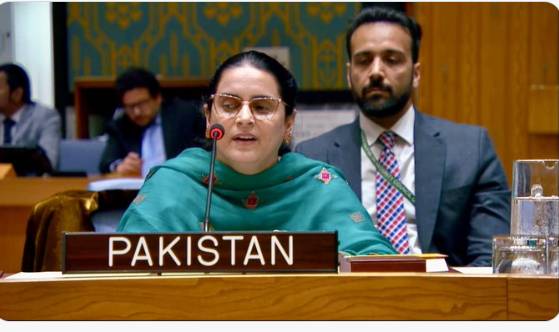

Pakistan has exposed India at United Nations Security Council, saying India is a country that exports terrorism abroad, occupies people by force, persecutes minorities at home, weaponizes water, commits aggression in the region, and then tries to lecture others on the protection of civilians, reported 24NewsHD TV channel on Thursday.
Responding to remarks of the Indian representative during the Security Council Annual Debate on the Protection of Civilians on Wednesday, Counsellor at Pakistan Mission Saima Saleem said in contrast Pakistan stands for peace, dialogue, peaceful settlement of disputes and adherence to international law while India stands exposed by terrorism, occupation, aggression, repression and disregard for international law.
Following is the text of Saima Saleem’s right to reply:
“Mr President, Today, India once again came to this Council wearing the mask of a victim — but the world can see the face behind that mask.
It is the face of a State that exports terrorism abroad, occupies people by force, persecutes minorities at home, weaponizes water, commits aggression in the region, and then tries to lecture others on the protection of civilians.
India’s state sponsorship of terrorism against Pakistan is not abstract; it has a human cost. Its terrorist proxies — including the TTP, BLA and Majeed Brigade have killed thousands of civilians, including women and children in our mosques, markets, schools and streets, through networks financed, facilitated and operated from Afghan soil.
With regard to Afghanistan, based on credible intelligence, Pakistan carried out precise, deliberate and professional counter-terrorism operations against terrorist hideouts, training camps, ammunition storage sites, and support networks used to plan and launch attacks against Pakistani civilians, security forces and infrastructure. These operations were directed solely against terrorist and their infrastructure, not against the brotherly people of Afghanistan or civilian facilities. Allegations advanced by the Taliban regime and echoed by their Indian patrons are part of a familiar disinformation campaign to hide their crimes against innocent civilians in Pakistan. We can sense India’s disappointment, as its investments in the use of Afghan terrorist franchise against Pakistan are going to waste due to our effective counter-terrorism operations.
India can neither conceal nor deny its occupation of Jammu and Kashmir — an internationally recognized dispute that remains on the agenda of this Council. In the occupied territory, civilians are killed, detained, dispossessed and silenced; homes are demolished, freedoms are crushed, and an entire people are denied their right to self-determination, as corroborated by facts presented by international community, including the Special Procedures and highlighted in our statement today.
India’s treatment of its minorities should alarm the conscience of the world specially genocide of Muslims. Under state-sponsored Hindutva extremism, Islamophobia has been normalized as policy, hate speech rewarded in politics, mob violence met with impunity, and discrimination turned into a daily reality for Muslims and other minorities, including Sikhs, Dalits and Christians.
India’s disregard for international law is also evident in holding of the Indus Waters Treaty in abeyance. A State that threatens the water, food security and livelihoods of millions of Pakistanis cannot certainly speak of civilian protection.
Pakistan stands for peace, dialogue, peaceful settlement of disputes and adherence to international law. India stands exposed by terrorism, occupation, aggression, repression and disregard for international law.
Pakistan remains a peace-loving and international law-abiding nation that seeks harmonious relations with all countries in its neighbourhood and beyond - based on mutual respect and sovereign equality, addressing all disputes in a peaceful manner in accordance with the UN Charter and Security Council resolutions.
I thank you.”
India is a country that exports terrorism abroad, occupies people by force, persecutes minorities at home, weaponizes water, commits aggression in the region, and then tries to lecture others on the protection of civilians.
— Permanent Mission of Pakistan to the UN (@PakistanUN_NY) May 21, 2026
While Pakistan stands for peace, dialogue, peaceful… pic.twitter.com/vMPmALtNO4