
S&P upgrades Pakistan's sovereign rating to 'B', cites IMF reforms and stronger institutions

S&P Global Ratings has upgraded Pakistan's long-term sovereign credit rating to 'B' from 'B-' while maintaining a stable outlook, citing improved institutional stability, successful implementation of International Monetary Fund-backed reforms and stronger fiscal management.
In its latest sovereign ratings report, the global ratings agency said Pakistan had strengthened its institutional capacity over the past two years, enabling the government to implement key economic reforms that have improved fiscal discipline, rebuilt foreign exchange reserves and eased pressure on the country's external financing position.
S&P said the stable outlook reflected expectations that continued economic reforms and sustained official financing would help Pakistan meet its external obligations while maintaining access to commercial financing over the next 12 months.
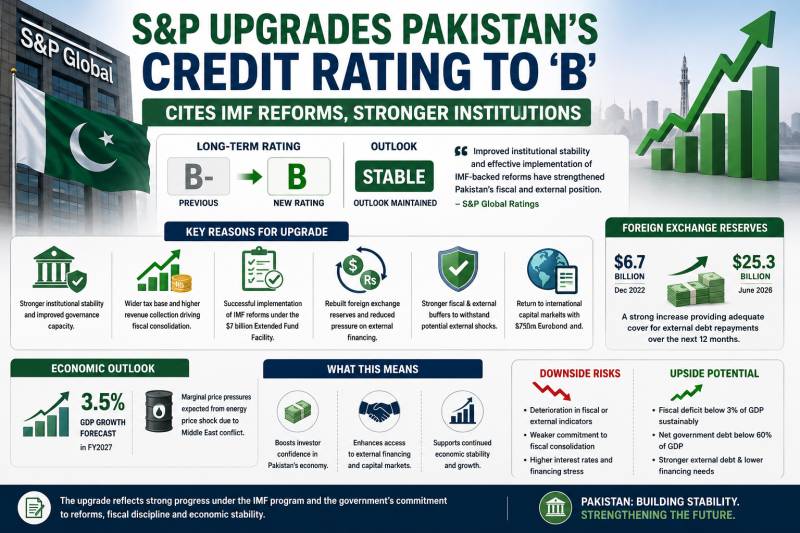
The ratings agency said the government's efforts to broaden the tax base had significantly increased revenue collection, accelerated fiscal consolidation and placed public debt on a gradual downward trajectory. Tax reforms and continued foreign inflows have also strengthened Pakistan's fiscal and external buffers against potential external shocks.
According to S&P, the IMF's $7 billion Extended Fund Facility, approved in September 2024, has played a key role in restoring macroeconomic stability. Pakistan has met most programme targets, allowing timely IMF disbursements and contributing to a significant rebuilding of foreign exchange reserves.
The agency noted that Pakistan's foreign exchange reserves, including the State Bank's gold holdings, had risen to $25.3 billion by the end of June 2026, compared with $6.7 billion in December 2022, providing sufficient cover for the country's external debt repayments over the coming year.
S&P also highlighted Pakistan's return to international capital markets in April 2026 through a $750 million Eurobond and an inaugural Chinese yuan-denominated Panda Bond, saying these developments had diversified the country's external financing sources.
The agency forecast Pakistan's economy would grow 3.5% in fiscal year 2027, supported by continued reform momentum despite marginal inflationary pressures stemming from higher energy prices linked to conflict in the Middle East.
S&P said political stability since the 2024 general elections had strengthened the government's ability to implement reforms, expand the tax base and maintain expenditure controls, helping improve investor confidence and economic management.
The ratings agency, however, warned that Pakistan remained exposed to domestic and external security risks, while high debt-servicing costs and substantial external financing requirements continued to constrain the country's credit profile. It said continued commitment to fiscal consolidation and structural reforms would be essential for any future rating upgrade.
S&P said Pakistan's rating could be upgraded further if fiscal deficits continue to narrow, government debt falls below 60% of GDP on a sustained basis, revenue collection improves further and external debt indicators strengthen significantly. Conversely, weakening commitment to reforms or deterioration in fiscal or external indicators could result in a downgrade.