
Fazl calls for parliamentary supremacy, condemns proposed new provinces
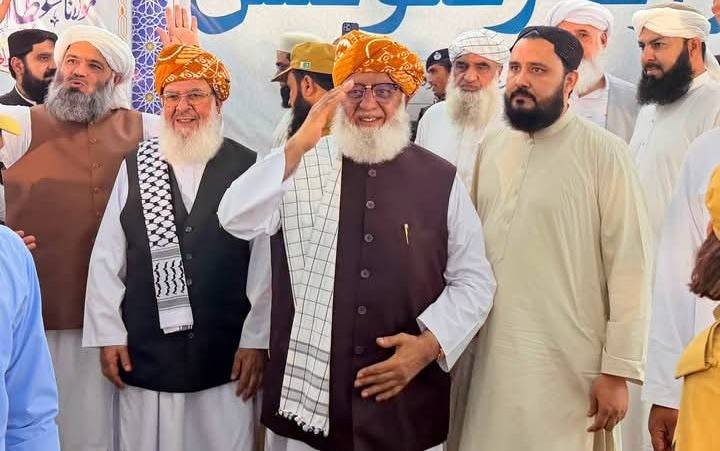

Jamiat Ulema-e-Islam (JUI-F) chief Maulana Fazlur Rehman has called for the supremacy of Parliament and criticised what he described as the concentration of constitutional powers in the hands of an individual.
Addressing a workers' convention in Peshawar, Fazlur Rehman said Islam's purpose was to establish justice in society and stressed the need for people to understand and follow the teachings of the Holy Quran. He said the Constitution clearly stated that no law could be enacted in the country contrary to the Holy Quran and Sunnah, adding that it was regrettable that the constitutional principle was not being fully implemented.
Fazl said his party had no objection to administrative changes within state institutions, but opposed transferring powers belonging to Parliament to an individual. "The powers that belong to Parliament have been given to a person in power," he said, adding that command and control powers had previously rested with the federal government.
He said his differences were based on principles and were not aimed at abusing or targeting individuals. He added that he had met the opposition leader and stressed the need for opposition parties to develop a common position on issues inside Parliament. The JUI-F chief said it would not work for someone to consider themselves powerful and act as they wished, stressing that the Constitution must be respected.
He also criticised recent legislation, saying the direction in which legislation was moving appeared to conflict with the Constitution. He argued that any law contrary to the Constitution should be considered ineffective.
On the role of the armed forces, Fazl said his party recognised the need for defensive strength against external threats. However, he maintained that the military should not interfere in politics, just as political workers could not interfere in military affairs beyond their constitutional limits. Turning to the security situation, he expressed concern over worsening law and order in Khyber Pakhtunkhwa and Balochistan.
He claimed that the police chain of command in Khyber Pakhtunkhwa had been weakened, alleging that police personnel had formed peace committees and were operating without uniforms. He also referred to the security situation in Bannu and incidents involving police officials in Balochistan.
Fazl said the government's writ had weakened in Balochistan and that major highways, including the Karachi-Quetta route, were no longer safe. He also criticised the security situation in Baloch and Pashtun areas, saying people were facing violence while a sit-in had continued in Kashmir for three months without adequate attention.
The JUI-F chief strongly opposed proposals for creating new provinces, arguing that the country was already facing serious security problems. "The house is on fire and you are talking about partition," he said, questioning the rationale for dividing provinces when parts of the country were facing violence.
Fazl alleged that the push for new provinces was linked to control over provincial resources and future distribution of revenues under the National Finance Commission (NFC) Award. He said the 18th Amendment had increased the provinces' share in national revenue and argued that attempts to divide provinces could facilitate changes to the NFC arrangement. He said that mineral resources within provinces belonged to the people of those areas and warned against attempts to take control of them.
Referring to the merger of the former Federally Administered Tribal Areas (FATA) with Khyber Pakhtunkhwa, Fazl said his party had opposed the decision at the time and claimed subsequent developments had vindicated its position. He criticised the treatment of political and tribal figures from Balochistan, alleging that respected people were being humiliated while individuals without public support were being imposed on the people.
On foreign policy, Fazl welcomed closer cooperation among Pakistan, Saudi Arabia and Türkiye, describing the emergence of an Islamic bloc as a possible step towards reducing the Muslim world's dependence on the United States. He criticised Western calls for moderation while, according to him, Israel's actions against Palestinians continued without effective international intervention. He also recalled the US military presence in Afghanistan, saying Washington had continued its campaign there for two decades without being stopped.
Fazl said Pakistan was facing an "atmosphere of oppression" and stressed that Islam did not permit people to impose their will through force. He called for unity among opposition parties on common issues and urged political forces to protect the constitutional role of Parliament and address the country's security and political challenges through dialogue and democratic institutions.