
Trump announces 'massive' Japan trade deal
US president agrees to small reduction in Philippine tariffs
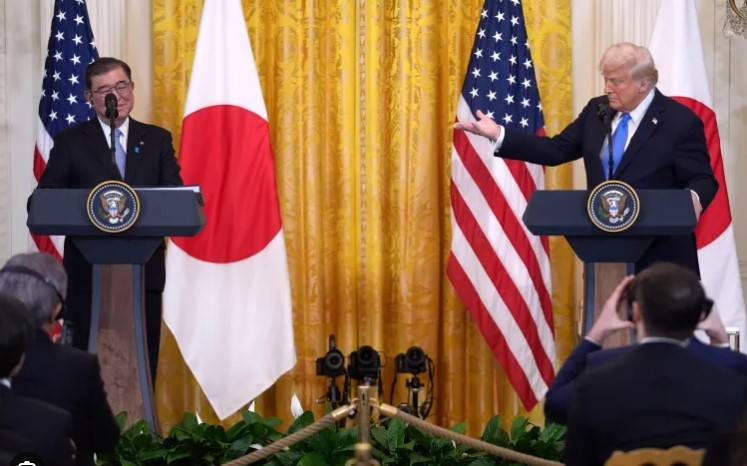

Donald Trump announced Tuesday a "massive" trade deal with Japan, marking a key breakthrough for major US trade partners as they scramble to strike agreements before the end of the month.
In an attempt to slash his country's colossal trade deficit, the US president has vowed to hit dozens of countries with punitive "reciprocal" tariffs if they do not hammer out a pact with Washington by August 1.
The breakthrough makes Japan one of five countries to have signed an agreement -- along with Britain, Vietnam, Indonesia and the Philippines -- after Trump promised in April he would get "90 deals in 90 days".
"We just completed a massive Deal with Japan, perhaps the largest Deal ever made," he wrote on his Truth Social platform.
He said that under the deal, "Japan will invest, at my direction, $550 Billion Dollars into the United States, which will receive 90% of the Profits".
He did not provide further details on the unusual investment plan, but said it "will create Hundreds of Thousands of Jobs".
Japanese exports to the United States were already subject to a 10 percent tariff, which would have risen to 25 percent on August 1 without a deal.
Duties of 25 percent on Japanese autos -- an industry accounting for eight percent of Japanese jobs -- were also already in place, plus 50 percent on steel and aluminium.
Japanese Prime Minister Shigeru Ishiba said that the autos levy had now been cut to 15 percent, sending Japanese car stocks soaring, with Toyota and Mitsubishi up around 14 percent each.
"We are the first (country) in the world to reduce tariffs on automobiles and auto parts, with no limits on volume," he told reporters.
"By protecting what needs to be protected, we continued the negotiations with an aim to reach an agreement that meets the national interest of both Japan and the United States," Ishiba added.
"In this agreement with President Trump, I think we were able to realise such an agreement."
- Rice imports -
However, Japan's trade envoy Ryosei Akazawa, who secured the deal on his eighth visit to Washington, said the 50 percent tariffs on steel and aluminium would remain.
Akazawa also said that increased defence spending by Japan -- something Trump has pressed for -- was not part of the agreement.
Trump said Tuesday that Japan has also agreed to "open their Country to Trade including Cars and Trucks, Rice and certain other Agricultural Products, and other things".
Rice imports are a sensitive issue in Japan, and Ishiba's government -- which lost its upper house majority in elections on Sunday -- had previously ruled out any concessions.
Japan currently imports 770,000 tonnes of rice tariff-free under its World Trade Organization commitments, and Ishiba said it would import more US grain within this.
Ishiba said Wednesday that the deal does not "sacrifice" Japan's agricultural sector.
Tatsuo Yasunaga, the chair of Japan Foreign Trade Council welcomed the trade deal announcement but said the business community needed to see details to assess its impact.
"I highly commend the fact that this major milestone has been achieved and dispelled the uncertainty that private companies had been concerned about," Yasunaga said.
Naomi Omura, an 80-year-old voter, said it was "disappointing that Japan cannot act more strongly" towards the United States.
Tetsuo Momiyama, 81, said that Ishiba "is finished... It's good timing for him to go."
Reports claimed Wednesday that he aims to step down soon following the election debacle.
- China talks -
Trump has been under pressure to wrap up trade pacts after promising a flurry of deals ahead of his deadline.
The White House on Tuesday also laid out details of a deal with Indonesia, which would see it ease critical mineral export restrictions and also face a 19 percent tariff, down from a threatened 32 percent.
Trump also said that levies on the Philippines, another close strategic US ally, would be cut by one percentage point to 19 percent after hosting President Ferdinand Marcos.
But negotiations are still ongoing with much larger US trading partners China, Canada, Mexico and the European Union.
US Treasury Secretary Scott Bessent said Tuesday that he would meet his Chinese counterparts in Stockholm next week.
Leaders of the world's two biggest economies imposed escalating, tit-for-tat levies on each other's exports earlier this year, reaching triple-digit levels.
But in talks in Geneva in May they agreed to lower them temporarily until August 12.
Philippine tariffs
US President Donald Trump agreed Tuesday to reduce threatened tariffs on the Philippines, but only by one percentage point, after what he termed a successful meeting with his counterpart Ferdinand Marcos.
Welcoming Marcos to the White House, Trump called him a "very tough negotiator" and said: "We're very close to finishing a trade deal -- a big trade deal, actually."
In a social media post shortly afterward, Trump said that while the Philippines would open up completely to US goods, he would still impose a 19 percent tariff on products from the Southeast Asian country, a major exporter of high-tech items and apparel.
"It was a beautiful visit, and we concluded our Trade Deal, whereby The Philippines is going OPEN MARKET with the United States, and ZERO Tariffs," Trump wrote on his Truth Social platform.
The Philippines was among two dozen economies confronted by Trump with letters this month warning of 20 percent tariffs on all goods coming into the United States as of August 1.
The 19 percent rate is still above the 17 percent threatened by Trump in April, when he threatened sweeping global tariffs.
Speaking at a press briefing Wednesday in Manila, Marcos's press secretary Claire Castro said the Philippine president had confirmed Trump's zero tariffs statement but only for "certain markets," without elaborating.
She also downplayed the potential effects of a tariff regime, noting that just 16 percent of the country's exports go to the United States, with about two-thirds being electronic components not subject to the levies.
"To put it plainly, it has an impact on the country, but not that much," she told reporters.
Speaking to reporters following the meeting, Marcos described the tariff situation as a "living thing" that could potentially be revisited as global markets adjusted.
The trade rift comes despite increasingly close defense relations between the United States and the Philippines, a former US colony and treaty-bound ally that has seen high tensions with China.
The United States deployed ground-launched missiles in the Philippines last year, and has also eyed ammunition manufacturing there, despite the closure in 1992 of the US naval base at Subic Bay due to heavy public pressure.
"All of what we consider part of the modernization of the Philippine military is really a response to the circumstances that surround the situation in the South China Sea," Marcos said next to Trump.
"We are essentially concerned with the defense of our territory and the exercise of our sovereign rights," said Marcos.
"Our strongest, closest, most reliable ally has always been the United States."
- Trump eyes China visit -
China and the Philippines have engaged in a series of confrontations in the contested waters of the South China Sea, which Beijing claims almost entirely, despite an international ruling that the assertion has no legal basis.
Trump has frequently questioned allies in Europe over their military spending, but voiced fewer doubts about the Philippines.
Both Defense Secretary Pete Hegseth and Secretary of State Marco Rubio in meetings with Marcos on Monday vowed to honor the 1951 Mutual Defense Treaty with the Southeast Asian nation.
The Trump administration has identified China as the top US adversary but the president has also boasted of his relationship with Chinese counterpart Xi Jinping.
Speaking alongside Marcos, Trump said he would "probably" visit China at Xi's invitation "in the not-too-distant future."
He said of Marcos: "I don't mind if he gets along with China very well, because we're getting along with China very well."
Trump added the Philippines had been "maybe tilting toward China" and "we untilted it very, very quickly."
"I just don't think that would have been good for you," Trump said.
He credited himself with the shift, although the turn towards Washington began after the 2022 election of Marcos, before Trump returned to power.
Marcos's predecessor Rodrigo Duterte had flirted with closer relations with China and bristled at US criticism over human rights under Joe Biden and Barack Obama.