
Crude oil prices up following Trump’s ultimatum on Iran
Gulf countries targeted in fresh attacks by Iran: Indian national injured by falling debris in Abu Dhabi

Benchmark US oil contract WTI was up Monday after US President Donald Trump gave Iran a 48-hour ultimatum to open the Strait of Hormuz or face decimation of its energy infrastructure and Israel warned the war would continue for several more weeks.
At 0015 GMT, the price of West Texas Intermediate (WTI) was up 0.44 percent to $98.66 per barrel. It had climbed to just over $100 a barrel earlier Monday.
South Korea's benchmark Kospi index and Japan's Nikkei sharply dropped in early trade.
The Kospi was down 4.69 percent at 5,509.88 points. The Nikkei 225 was down 3.54 percent at 51,483.91 points.
The price of North Sea Brent crude, the global market benchmark, was down 0.02 at $112.17 per barrel.
On February 27, the day before the US-Israeli attacks began on Iran, WTI had stood at $67.02 and Brent was at $72.48 per barrel.
Trump and Tehran have issued tit-for-tat threats as the war entered its fourth week, with the US president demanding the Islamic republic reopen the blocked Strait of Hormuz, through which around 20 percent of the world's oil and gas shipments transit.
The bottleneck has nearly halted all petroleum shipments through the narrow waterway, and oil prices have spiked.
Trump posted late Saturday on Truth Social that US forces would "hit and obliterate" Iranian power plants -- "starting with the biggest one first" -- if Tehran did not fully reopen the strait within 48 hours, or 23:44 GMT on Monday, according to the time of his post.
In response, Iran's army said it will target energy and desalination infrastructure "belonging to the US and the regime in the region," according to the Fars news agency.
Meanwhile Israel's military chief, Lieutenant General Eyal Zamir, said Sunday his forces were expanding their ground campaign against Iran-backed Hezbollah in Lebanon, and warned of a lengthy operation.
"We are now preparing to advance the targeted ground operations and strikes according to an organised plan," he said.
In retaliation for the US and Israeli military operation, Iran is carrying out missile and drone strikes against infrastructure -- particularly energy targets -- as well as against ships in the Gulf, specifically threatening those venturing into the strait.
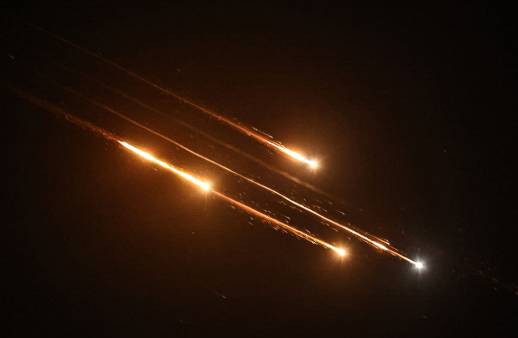
Iran has launched a barrage of missiles and cluster warheads onto southern and central Israel, a day after striking two Israeli towns in retaliation for attacks on Iran.
— Al Jazeera English (@AJEnglish) March 23, 2026
The US and Israel had claimed Iran’s missile capabilities were severely degraded. pic.twitter.com/GR6StLHzcb
Gulf countries targeted in fresh attacks by Iran
Saudi Arabia and the United Arab Emirates reported coming under fresh attacks on Monday morning, with explosions and sirens sounding over the oil-rich Gulf.
The Saudi Ministry of Defence said it had detected two incoming ballistic missiles targeting the capital on Monday, "one of which was intercepted and the other fell in an uninhabited area".
The UAE defence ministry said it was "currently responding to incoming missile and drone threats from Iran", explaining "the sounds heard are the result of the Air Defence Systems intercepting missiles and drones".
Hours earlier, Abu Dhabi authorities reported an Indian national had been wounded by falling debris from an intercepted ballistic missile.
And sirens were sounding in Bahrain, with residents instructed to seek shelter.
"Citizens and residents are urged to remain calm and head to the nearest safe place," the interior ministry posted on social media.
Gulf nations that have long billed themselves as oases of safety and stability in the region have been drawn into the Middle East war as Iran retaliates against US-Israeli strikes.
The Islamic republic has taken aim at US assets as well as civilian infrastructure, including landmarks, airports, ports and oil facilities around the Gulf.
- IEA chief warns of crisis -
International Energy Agency chief Fatih Birol said "the global economy is facing a major, major threat" and compared the current energy crisis to those of the 1970s and the impact of Russia's 2022 invasion of Ukraine.
"This crisis as things stand is now two oil crises and one gas crash put all together," Birol said, adding that no country will be immune to its effects.
- Macron affirms France's backing of Saudi Arabia -
French President Emmanuel Macron wrote on X that he spoke with Saudi Crown Prince Mohammed bin Salman to express "solidarity" with the kingdom and reiterate France's commitment to contributing to air defences against Iranian missiles and drones.
- One dead in attack on Iranian broadcaster -
One person was killed in an overnight US-Israeli attack on a broadcaster in the coastal area of Bandar Abbas, Iranian state-run television reported.
- 'Weeks' more war -
Israeli military spokesman Brigadier General Effie Defrin said in a televised briefing that the country faces "weeks" more fighting against both Iran and Hezbollah.
Blasts in Tehran after Israel strikes
Explosions rang out in Tehran early Monday morning, Iranian media reported, as Israel announced it launched a fresh wave of strikes.
"Explosion heard in Tehran," local media Mehr posted on Telegram, while Fars news agency said airstrikes had targeted five areas of the Iranian capital and that "terrible sounds of explosions have been reported".
"More details on the extent of damage and possible casualties will be announced later," Fars posted.
In its own statement, Israel's military announced it had "begun a wide-scale wave of strikes targeting Iranian terror regime infrastructure in Tehran".
Videos show the aftermath of strikes in Iran, as search teams recover bodies from rubble.
— Al Jazeera English (@AJEnglish) March 23, 2026
Residents use torches to search for loved ones amid power outages.
Iran’s health ministry says the death toll from the US-Israeli war has surpassed 1,500. pic.twitter.com/pqhxUd4AJC
- Iraqi group extends pause in US embassy attacks -
Kataeb Hezbollah -- an Iran-backed armed group in Iraq -- says it will extend its five-day pause on attacking the US embassy in Baghdad, announced Thursday.
Since the start of the war in the Middle East, pro-Iran armed groups have claimed responsibility for near-daily attacks on US interests in Iraq and across the region, while strikes have also targeted these groups.
- Lebanon says Iran commanding Hezbollah operations -
Lebanese Prime Minister Nawaf Salam said members of Iran's Revolutionary Guards are commanding Hezbollah's operations in the group's war against Israel.
In an interview with the Al Hadath network, Salam once again lashed out at Hezbollah for dragging Lebanon into the Middle East war by firing rockets on Israel.
- Israel to expand Lebanon ground ops -
Israel's military will expand its ground operations in Lebanon against Iran-backed militant group Hezbollah, its army chief said, warning that the offensive "has only (just) begun".
"We are now preparing to advance the targeted ground operations and strikes according to an organised plan," Lieutenant General Eyal Zamir said in a statement.
- 'Weeks' more war -
Israeli military spokesman Brigadier General Effie Defrin said the country faces "weeks" more fighting against both Iran and Hezbollah, in a televised briefing.
- Iraq strikes -
Three strikes targeted an influential pro-Iranian armed group in its stronghold south of Baghdad, Iraqi authorities said.
The group is a former paramilitary coalition called Hashed al-Shaabi, also known as the Popular Mobilisation Forces (PMF). It is part of Iraq's regular armed forces, but also includes some pro-Iranian groups.
The strikes came after an attack targeted a US diplomatic and logistics centre at Baghdad International Airport, Iraqi officials told AFP.
- Israel probes civilian death -
Israel's military said it was investigating whether its own fire killed an Israeli civilian near the Lebanese border, in an area where Hezbollah claimed an attack.
Israeli emergency workers said earlier a man was killed in a "direct hit" on his car by a rocket from Lebanon, making him the first fatality in the country's north since the latest round of fighting with Hezbollah broke out.
But the Israeli army later said it was "conducting a comprehensive investigation", including "the possibility that the incident involved fire originating from IDF soldiers".
A video released by Iran's official IRIB News outlet shows rows of missiles stored in an underground facility.
— Al Jazeera English (@AJEnglish) March 23, 2026
The broadcaster describes the arsenal as 'the tip of the iceberg'. pic.twitter.com/8nxc52sWwu
- West Bank arson -
Palestinian residents said Israeli settlers had torched buildings and cars in attacks on several villages in the occupied West Bank, the latest violence after a spate of killings of Palestinians by Israelis in the area since the start of the war.
- Lebanon condemns Israeli strikes -
Lebanon's President Joseph Aoun slammed Israeli strikes on bridges and other infrastructure in the country's south, calling such attacks a "prelude to a ground invasion".
Israel's defence minister said he ordered bridges in the area to be hit after alleging they were used by Iran-backed Hezbollah.
- Iran threatens Hormuz -
If Trump acts on his threats to target Iran's power plants, the Strait of Hormuz "will be completely closed", the Iranian military's operational command Khatam Al-Anbiya said in a statement on state television.
Families forcibly displaced by Israeli strikes are sheltering in tents across Beirut, as rain falls, with residents describing difficult conditions, limited aid and uncertainty over when they can return home. pic.twitter.com/jwRV2m1afQ
— Al Jazeera English (@AJEnglish) March 22, 2026
- Netanyahu vow -
Israeli Prime Minister Benjamin Netanyahu vowed to pursue senior commanders of Iran's Revolutionary Guards "personally", during a visit to an Israeli town struck by an Iranian missile the previous day.
"We're going after the regime. We're going after the IRGC, this criminal gang," Netanyahu said as he inspected the damage in the southern town of Arad.
- WHO warning -
The World Health Organization warned that strikes around nuclear sites in Iran and Israel had pushed the Middle East war to a "perilous stage".
"I urgently call on all parties to exercise maximum military restraint and avoid any actions that could trigger nuclear incidents," WHO chief Tedros Adhanom Ghebreyesus said on X.