
Russian Ambassador praises Pakistan’s neutral stance on Ukraine war
Says President Putin’s potential visit to Pakistan not linked to ongoing situation
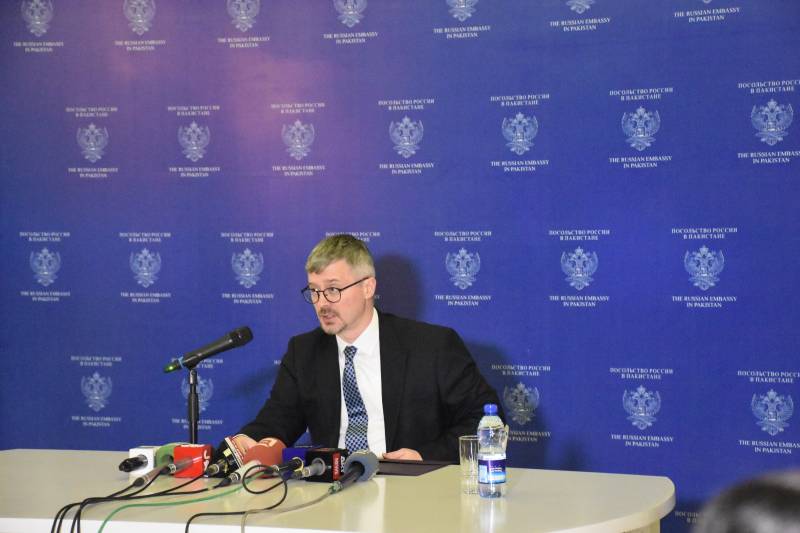

Russian Ambassador to Pakistan, Albert P. Khorev, Tuesday expressed appreciation for Pakistan’s political and military leadership for maintaining a consistent policy of non-interference in the Ukraine conflict.
Speaking at a press conference at the Russian Embassy, he reiterated that President Vladimir Putin’s potential visit to Pakistan is not linked to the ongoing situation in Ukraine.
"We want any visit by the Russian President to be well-prepared, with a strong foundation of mutual cooperation," Khorev stated. He emphasized that once solid groundwork is established, President Putin will visit Pakistan to strengthen bilateral relations.
Discussing the Ukraine conflict, Khorev accused Western countries of deliberately ignoring Russian security concerns, citing NATO's eastward expansion and the encouragement of Ukraine to join an "anti-Russian camp."
He alleged that the 2014 uprising in Ukraine led to an ultra-nationalist government in Kyiv, which he claimed systematically targeted ethnic Russians and Russian-speaking communities.
The ambassador justified Russia’s military actions, stating that after failed negotiations with Western nations, Russia launched its "special operation" three years ago. He provided updates on the situation, claiming that Russian forces now control 75% of Zaporizhzhia Oblast, 99% of Luhansk, and 67% of Krasnoyarsk. He accused Ukraine’s military of committing atrocities in Russian-occupied regions and asserted that Russian forces continue to make territorial gains.
Regarding peace talks, Khorev said President Putin proposed an end to the war in June 2024, but Ukraine and its Western allies refused. He accused Western nations of using a potential ceasefire as a means to rearm Ukraine.
He reiterated Putin’s demands for peace, which include recognition of the new borders of Donetsk, Kherson, Luhansk, and Zaporizhzhia as part of Russia, Ukraine’s rejection of NATO membership, and an end to Western sanctions on Russia.
“The West accepted Kosovo’s independence from Serbia but refuses to recognize the referendums in Donetsk, Kherson, Luhansk, and Zaporizhzhia,” he argued, criticizing what he called the "double standards" of Western countries.
Reporter: Anwer Abbas
The author is a FO and Diplomatic activities correspondent for 24 News, Islamabad