
SC questions ECP’s security demand for election duty
CJP warns delaying elections will make room for ‘negative elements’: Asks how long will democracy be sacrificed by extending polls: Says ECP lawyer ‘talking about politics’: Swati says SC rules do not trim constitutional authority
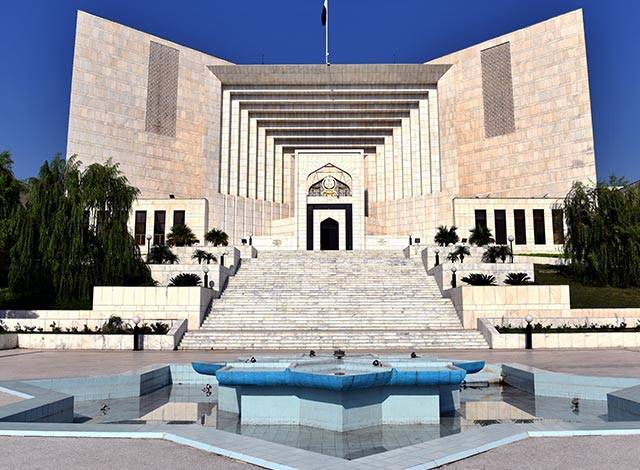

The Supreme Court of Pakistan on Thursday questioned the Election Commission of Pakistan’s (ECP) demand for heavy security for conducting elections, reported 24NewsHD TV channel.
A three-judge bench led by Chief Justice of Pakistan Justice Umar Ata Bandial heard the ECP’s review petition against top court’s April 4 order to hold elections in Punjab. Justice Munib Akhtar and Justice Ijazul Ahsan are the other members of the bench.
During proceedings, Chief Justice Bandial recalled that the ECP had sought 450,000 security personnel for poll duty. “Our operational Army in total has strength of 450,000,” the CJP remarked, adding the ECP would have given it a deep thought before putting up the demand for security personnel.
Justice Bandial asked what is the need for security by Army. “The Army is there for security symbolically. Even one soldier calmly asks people to stop and they obey him,” he said and added “Voting can be deferred at sensitive polling stations.”
The CJP said on several occasions in the country’s history, democracy was sacrificed. “And the nation had to pay a price for that for years to come,” he added.
He wondered as to when the ECP would say that enough was enough, and it was time to hold elections. “For how long the court will continue to act like a silent spectator,” he questioned.
“The turnout in the local bodies’ elections held in Balochistan was 60 percent,” he said, adding, “This was despite the fact that there were security concerns in the province.”
CJP Bandial said this was the third consecutive day that the court was listening to the ECP lawyer Sajeel Swati’s arguments. “Please keep your arguments brief and to the point,” he asked him.
The CJP asked ECP’s lawyer Sajeel Swati to do your homework before coming to the court so “We can know what’s the problem the ECP is facing”.
ECP’s counsel Sajeel Swati argued that top court rules did not reduce constitutional authority of the Supreme Court, arguing that a full court has declared in various cases that the scope of a review is not limited.
Justice Akhtar remarked that if this argument was accepted then the Supreme Court rules would become void.
Swati said in certain cases, parliament’s lawmaking authority is also limited, and added that a review plea is essentially a continuation of the main case.
Justice Akhtar said the lawyer had expanded the scope of the review more than the original case.
Swati argued that a caretaker government must be in place for elections.
At this, Justice Ahsan questioned that if a provincial assembly was dissolved in six months, will a caretaker set-up remain for four and half years in that province? To which, the counsel responded in the affirmative.
He further said Article 254 can provide legal cover to any extension to the 90-day deadline to hold elections to an assembly that has been dissolved. He added that elections can be delayed beyond 90 days.
The SC judge remarked that it can also be treated in such a way that an elected government stays for four and a half years and a caretaker for six months. He added that the 90-day period is also given in the Constitution. “Where is it mentioned that a caretaker government’s duration can be extended?” Justice Ahsan asked, adding any extension to the caretaker set-up’s duration is against the spirit of the Constitution.
The lawyer agreed to the court’s observation. The counsel, however, contended that only an elected government can run the country, adding there can be no breaks in democracy.
Justice Ahsan commented that caretaker governments were included into the Constitution only to facilitate the ECP, adding it is the responsibility of the ECP to conduct fair elections.
The ECP commission cannot express inability to conduct fair polls, the counsel said. To this, Justice Akhtar remarked that the ECP would say give it funds and security, and it will organize the polls. Those talking about the constitutional rule are running away from it, he added.
The ECP counsel said the October 8 date for elections was given based on facts. To this, Justice Akhtar asked what if the ECP tells the court in September that elections cannot be held in October? He further remarked that conducting elections was the ECP’s duty and not a prerogative.
The CJP asked how long will democracy be sacrificed by extending elections, adding democracy has been sacrificed several times in history and its results have been faced for years. He further said the ECP is now making political statements.
He further said the local government polls in Balochistan were held despite security concerns, adding if elections are delayed, negative elements exert their force. “As caretakers of the Constitution, how long will the Supreme Court stay silent?” the CJP asked.
The counsel responded that the May 9 incidents have validated the fears of the ECP.
Justice Ahsan asked if a caretaker government can stay for as long as it wants. The ECP counsel said the duration of a caretaker set-up will be determined as per the circumstances.
Justice Akhtar said the ECP had told the court that only funds were required for polls, and now it says that the polls are not possible under the rules of the Constitution.
The CJP asked which articles of the Constitution will become ineffective if elections are held simultaneously across the country. If the system was strong, it will probably be possible to hold separate elections, he remarked.
The ECP counsel said separate elections to all assemblies are not possible in the current circumstances. If there is an elected government in Punjab, how the National Assembly polls will be fair, he asked.
The CJP responded that the provincial assembly’s interference can be stopped in the NA elections, adding if the ECP is strong and fair, there can be no interference.
This issue can be solved administratively, CJP Bandial remarked.
The CJP said the ECP should not accept the Finance Ministry’s excuses, and seek solid explanation from the government. Yesterday, Rs20 billion were issued for lawmakers’ development schemes, he added.
The ECP is itself inactive, the CJP remarked. It demanded 450,000 security personnel, which is as much as the total operational army’s strength.
The army offered its quick response force to the election commission, CJP Bandial said, adding it was enough. Apparently, the October 8 has been given because of the National Assembly, he observed.
The ECP counsel said there was no reason to doubt the government institutions’ report, adding the October date was suggested over terrorism threats.
When asked how will the situation improve by October and what does the commission think now that when can the elections be held, the counsel said after the May 9 incidents, the situation will have to be reviewed afresh.
The CJP remarked that the ECP has still not clarified how much delay in the elections is tolerable.
The hearing was then adjourned till May 29 when ECP counsel will continue his arguments.
Reporter Amanat Gishkori