
Punjab CM orders wide-ranging reforms in education, environment, sports, housing and cultural policy
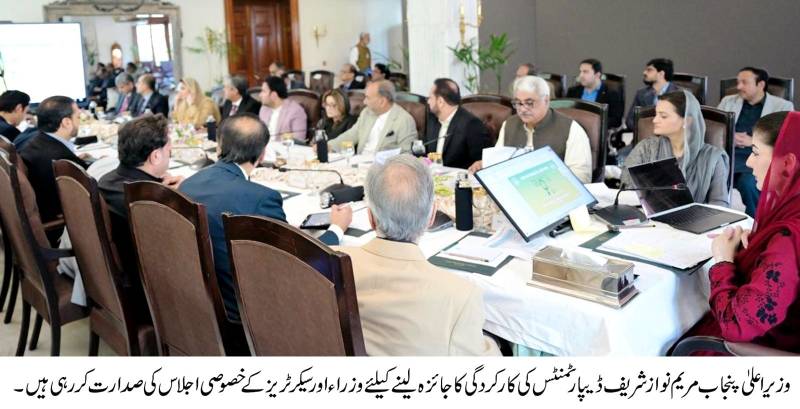

Punjab Chief Minister Maryam Nawaz Sharif Tuesday chaired a six-hour accountability session reviewing the performance of Punjab’s departments and ordered sweeping initiatives across education, environment, tourism, fisheries, sports, language preservation and social welfare.
In a major cultural step, the Chief Minister directed that the Punjabi language be given central importance in education, cultural expression and public life.
The meeting was informed that the scheme to provide 3-marla residential plots to 20,000 workers in Jhang and Kamalia has been finalised, with workers to receive loans under the Apni Chhat, Apna Ghar program. The Chief Minister ordered immediate action for early completion of the housing initiative.
Maryam Nawaz Sharif also issued directions for tree plantation along railway tracks, roadways and canal banks, and approved a modern forest fire alarm system capable of issuing alerts 20 minutes before a fire outbreak. A special sensing mechanism will also monitor and prevent illegal logging across Punjab’s forests.
The Chief Minister ordered monthly championship events to develop sports culture and youth talent, and directed that school grounds across the province be opened to the public during evenings for recreational activities.
The meeting noted that Punjab’s pilot shrimp farming program has proven successful, generating exports worth crores of rupees. Shrimp farming on 5,000 acres will begin in February 2026, and the Chief Minister requested a feasibility plan for expanding shrimp farming to 50,000 acres.
Tourism has been digitized through the development of the Magnificent Punjab mobile app, intended to provide easy access to tourism information. The Chief Minister instructed the creation of comprehensive development packages for every tourist destination.
The Chief Minister also reviewed education initiatives, including opening school grounds, beginning character-building sessions in schools, and launching a pilot “Education on Well” project in Lahore to expand learning access. She requested proposals for setting laptop quotas for private higher education institutions and called for a draft structure of the College Management Council. Plans were also approved to provide 44 buses to girls’ colleges across Punjab.
The briefing revealed a 47% increase in school enrollment due to the provision of milk packs, with 23,000 furniture sets and 1,643 water tanks supplied to schools. A major infrastructure upgrade is underway — 1,600 classrooms are ready and 22,000 more will be completed within three months. Repairs include 500 classrooms, 3,036 roofs and 4,377 toilets. Enrollment in universities has risen by 72%.
Under the Honahar Scholarship Scheme, 140,000 students have received scholarships and 110,000 have been provided laptops.
The Chief Minister also reviewed environment and wildlife protection measures. Amendments to the Punjab Wildlife Act 1974 have enabled crackdowns against keeping wild animals in private homes. The Wildlife Department has rescued 35,000 birds and 7,000 animals, and rehabilitation centres are operational in Lahore, Khanewal and Rawalpindi, with more planned.
Punjab’s environmental monitoring network has expanded with 41 air quality stations in 18 districts and a target of 100 stations by next year. Efforts against industrial pollution include CCTV-based nighttime monitoring, drone surveillance, eight night inspection squads, and shifting 31 tanneries to a controlled industrial zone in Sialkot. Crop burning in Lahore and surrounding districts has decreased by 66%.
The province has also established Pakistan’s first eco-chatbot and activated a 660-member Environment Protection Force, along with 300,000 completed tests through the emission detection system and the creation of a centralized smog monitoring system within Safe City.
Chief Minister Maryam Nawaz Sharif also expressed satisfaction with UET’s development of a local smog-reducing machine and emphasized the importance of character-building, environmental preservation and equitable education access in shaping Punjab’s future.