
Road to Middle East peace has many 'turns', says Pakistan
FO Spokesperson Andrabi says Islamabad to 'move forward' in coordination with Saudi leadership: Peace remains ultimate goal despite challenges in ME war diplomacy: Islamabad and Ankara engage on key regional developments: PM engages Saudi and Iranian leadership as mediation efforts intensify: Ishaq Dar also maintains active diplomatic outreach: FO reiterates stance on Indian water aggression, Kashmir, Afghan Taliban and Islamophobia
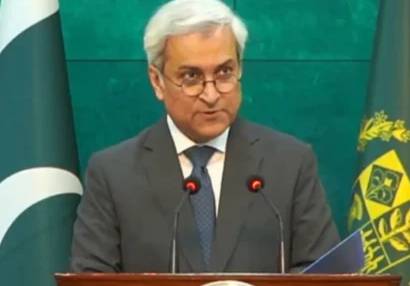

Pakistan may encounter obstacles and challenges in its diplomatic efforts aimed at easing tensions in the Middle East but remains committed to achieving peace, Foreign Office spokesperson Tahir Hussain Andrabi said on Thursday.
Addressing a weekly news briefing in Islamabad on Thursday, Andrabi said Pakistan was actively playing its role for regional peace and remained in contact with countries across the region to support de-escalation efforts.
According to the 24NewsHD TV channel, the FO spokesperson added that Islamabad and Ankara were both engaged on key regional developments.
The spokesperson noted that Prime Minister Shehbaz Sharif had been reaching out to world leaders as part of ongoing diplomatic engagement.
In this context, the prime minister recently held talks with Saudi Crown Prince Mohammed bin Salman and also discussed the regional situation in detail with Iranian President Ebrahim Raisi.
During his conversation with the Saudi crown prince, the prime minister condemned attacks on Saudi Arabia and appreciated the kingdom’s restraint.
Andrabi said Saudi Arabia remained a key stakeholder in the Middle East, adding that Pakistan continued its peace efforts in coordination with Riyadh.
He emphasised that Pakistan’s ultimate objective was peace, whether achieved through facilitation or mediation, and noted that diplomatic efforts often involved challenges that must be navigated. He added that maintaining optimism in diplomacy and international relations was essential.
Responding to a query, the spokesperson said he could not comment on reports regarding proposals allegedly offered by former US president Donald Trump to Iran for negotiations.
Meanwhile, Deputy Prime Minister Ishaq Dar has also remained engaged on the diplomatic front, maintaining important contacts with various countries during the week.
Answering another question, Andrabi described the events of 1971 as complex, stating that Pakistan sought to build relations with the people of Bangladesh on the basis of mutual respect and constructive engagement.
The Foreign Office also noted that the International Day to Combat Islamophobia was observed on March 15, reaffirming Pakistan’s commitment to raising awareness about the issue.
The spokesperson reiterated Pakistan’s condemnation of the continued closure of the Jamia Masjid Srinagar over the past seven years and accused India of misusing its position as an upper riparian state, asserting that Pakistan would not allow water to be used as a weapon.
Replying to questions regarding Afghanistan, Andrabi referred to a United Nations report that linked certain militant groups – Fitna al Hindustan and Fitan al Khawarij – to Afghan territory but maintained that channels of dialogue with Kabul remained open.
He said an ammunition depot recently destroyed had been used by these elements. Concluding the briefing, the spokesperson asserted that Pakistan remained a fully secure country.
LIVE: Spokesperson's Weekly Press Briefing 26-03-2026 at Ministry of Foreign Affairs, Islamabad https://t.co/1Tbivcyaee
— Ministry of Foreign Affairs - Pakistan (@ForeignOfficePk) March 26, 2026
Reporter: Anwer Abbas