
Ishaq Dar calls for stronger multilateralism, peaceful dispute resolution at UN Security Council
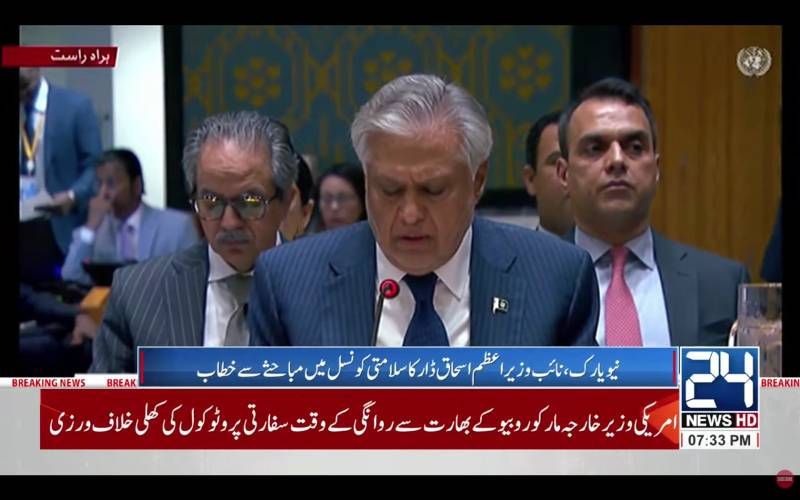

Ishaq Dar addressed the United Nations Security Council during a debate on international peace and security, reaffirming Pakistan’s commitment to the principles of the UN Charter, peaceful diplomacy and multilateral cooperation.
According to the Foreign Office spokesperson, Ishaq Dar thanked Wang Yi for organizing what he described as an important debate, saying China’s leadership reflected a strong commitment to the United Nations Charter and the multilateral international system.
Addressing the council, Dar said the protection of international law and the UN system had become indispensable in the current global environment. He noted that the UN Charter emerged after the devastation of World War II with the aim of saving future generations from the scourge of war.
“The UN Charter is not merely a legal document but the moral foundation of the international system,” he said, adding that it guarantees state sovereignty, prohibits the use of force, promotes peaceful dispute resolution and upholds the right to self-determination.
The deputy prime minister said these principles form the basis of Pakistan’s foreign policy and global engagement. He highlighted Pakistan’s contributions to UN peacekeeping missions and its longstanding support for decolonization, peaceful dispute settlement and international cooperation.
Dar said Pakistan had played a constructive role in strengthening diplomatic mechanisms for peaceful conflict resolution in July 2025, emphasizing that diplomacy should not be viewed as weakness but as the primary responsibility of states in maintaining global peace.
Referring to regional tensions, he said Pakistan joined Iran, Gulf countries, the United States and China in supporting de-escalation and diplomatic solutions in the Middle East. He also recalled that Pakistan and China jointly announced a five-point initiative in Beijing on March 31 aimed at restoring peace and stability in the Gulf and Middle East region.
Dar warned that another prolonged conflict in the region could endanger global peace, energy supplies and humanitarian conditions, adding that Pakistan would continue efforts to ensure sustainable peace, regional stability and secure maritime routes. He also appreciated the cooperation of partner countries including Saudi Arabia, Egypt, Turkey, Qatar and China.
On South Asia, Dar reiterated Pakistan’s position that the Jammu and Kashmir dispute must be resolved in accordance with UN resolutions and stressed that Kashmiris should be granted their right to self-determination. He said sustainable peace in South Asia could not be achieved through unilateral actions, coercion or denial of rights.
The deputy prime minister also described the Indus Waters Treaty as vital for regional stability and emphasized that water should never be used as a weapon. He called for respect for all international agreements.
Discussing the Middle East situation, Dar said peace could not be achieved through occupation, forced displacement, collective punishment or illegal settlements. He expressed concern over the worsening humanitarian situation in Gaza and the West Bank and reiterated Pakistan’s support for a two-state solution based on pre-1967 borders with Jerusalem as the capital of an independent Palestinian state.
He further said the current crisis in the global system stems not from a lack of principles but from their selective application. “When powerful countries transcend international law, the credibility of the United Nations suffers,” he remarked.
Dar reaffirmed Pakistan’s support for comprehensive reforms in the UN Security Council, calling for the body to become more representative, transparent, democratic and effective. However, he opposed an increase in permanent seats and instead supported expanding elected non-permanent seats to improve representation for developing countries.
He also stressed the need to address poverty, racism, gender inequality, xenophobia, Islamophobia, climate injustice, debt crises and underdevelopment as essential elements for achieving lasting global peace.
Concluding his address, Dar described peace as not merely the absence of war but the presence of justice, human dignity, development and equal rights. He termed the United Nations an indispensable institution and called for renewed commitment to the UN Charter, effective diplomacy and non-discriminatory justice.
Pakistan, he said, would continue working with all member states to uphold the principles of the UN Charter and promote global justice, dialogue and the rule of law.