
Gaza: Our age of witnessed betrayal
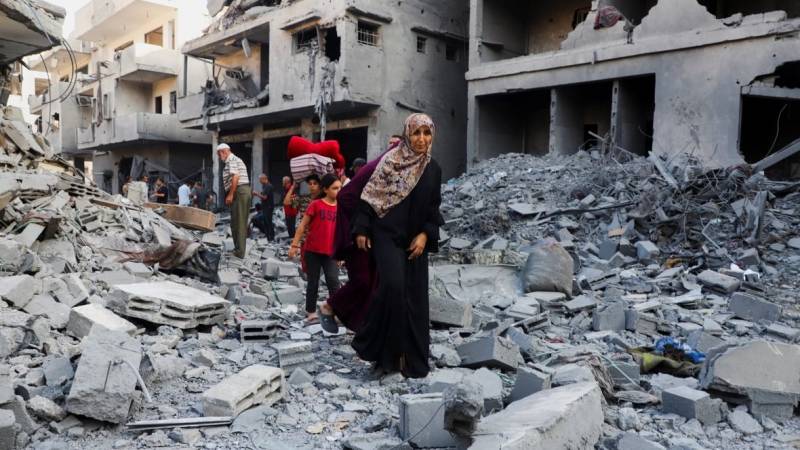

History now streams in real time, pixel by pixel, into our palms. We do not read about Gaza in the footnotes of dusty tomes; we watch it unfold in high definition. Families fleeing into despair’s jaws. Mothers clawing through rubble with bleeding hands. Children, their eyes wide with famine’s fire, collapsing on streets where hunger itself dances.
This is not silence. This is betrayal with the volume turned up.
Since October 2023, more than 65,400 Palestinians have been killed, including 25,000 children [Gaza Health Ministry, UNICEF 2025]. The flour massacre in February 2024, when 118 civilians were killed and 760 wounded while waiting for bread [Al Jazeera 2024], was not an isolated eruption of cruelty but the symptom of a system: starvation wielded as a weapon. The United Nations has now confirmed famine in Gaza [UN OCHA 2025], yet convoys are throttled, aid denied, and the world averts its gaze.
The International Court of Justice has already ruled that Israel’s actions present a “plausible risk of genocide” [ICJ 2024]. South Africa carried that charge to The Hague, joined by Brazil in 2025 [Reuters 2025]. And still, as in Rwanda, as in Bosnia, the machinery of the so called international community groans and stalls. The same powers that froze Russian assets overnight for Ukraine, the same governments that shattered apartheid with sanctions, suddenly find no will, no means, no urgency.
The excuse of “complex conflict” is paraded like a shield, but it is a lie. Complexity does not bury 25,000 children. Complexity does not turn food into contraband. Complexity does not bomb bakeries and hospitals. When complexity is invoked, it is not nuance but anesthesia, a way to dull the conscience until complicity feels like reason.
And here is where the indictment grows heavier: we are not innocent witnesses. We are complicit voyeurs. We stream the carnage, we share the clips, we scroll on. We explain to ourselves that it is politics, that it is complicated, that someone else will act. We say we are more articulate, not more human.
I cannot forget the day I stood in the dungeons of Cape Coast Castle in Ghana, where Africans were shackled before being shipped into centuries of bondage. My colleagues spoke with outrage at the cruelty of those centuries past. Yet today, in Gaza, cruelty happens not in the shadows of history but in the glare of livestreams, and our outrage is softer, more diluted. The stone walls of that castle smelled of betrayal. Gaza smells of it still.
To say nothing is not neutrality. It is collaboration.
Israel invokes “security” to justify its onslaught. But does security require the starvation of two million people? Does security demand the pulverization of refugee camps, the silencing of journalists, the erasure of hospitals? These are not defensive acts, they are instruments of domination. And every veto at the United Nations, every hesitant editorial, every “both sides” analysis, sharpens those instruments.
So what do we do with this storm? Outrage without direction dissipates. Lightning must strike. There are paths, clear and proven. Sanctions on arms sales and trade. Boycotts of complicit corporations. Protests that disrupt the comfortable rhythms of indifferent capitals. Legal pressure through the International Criminal Court and International Court of Justice, amplifying the genocide case until it cannot be buried. Voices raised, not only in lament but in demand, so that governments cannot pretend silence equals consent.
We stand in an age where humanity itself is being tested, not by whether we can see, for the screens show us all, but by whether we can act. To remain still is to let the tide of betrayal rise until it swallows us too.
The images are live. The choice is present. The time is now.