
Supreme Court approves review petitions on reserved seats case
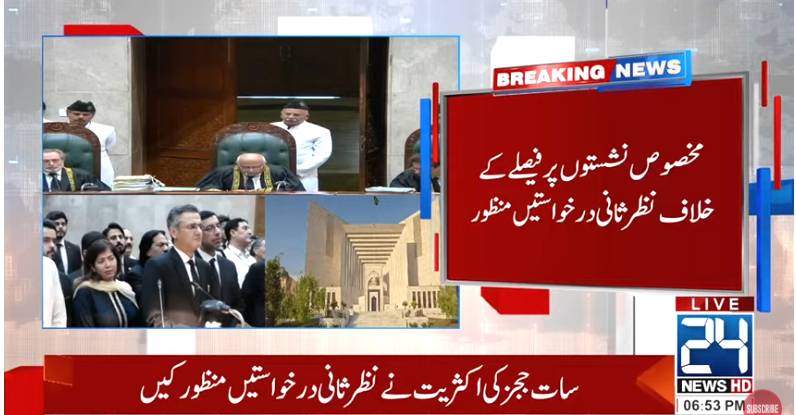

Supreme Court on Friday accepted the review petitions in the reserved seats case, setting aside its July 12 verdict and upholding the Peshawar High Court’s decision, which had denied reserved seats to the PTI-backed Sunni Ittehad Council (SIC), reported 24NewsHd TV channel.
A 10-member larger constitutional bench, headed by Justice Aminuddin Khan, heard the matter after Justice Salahuddin Panhwar recused himself from the originally constituted 11-member bench.
The verdict was delivered by a seven-member majority, allowing the review petitions and reinstating the March 12 decision of the Peshawar High Court. The high court had dismissed the SIC’s challenge to the Election Commission of Pakistan’s decision, which had refused to allocate reserved seats to the party. Earlier, in its short order on July 12, 2024, eight out of 13 judges concluded that 39 out of 80 MNAs on the list were elected candidates of the PTI, positioning it as the largest party in the National Assembly.
However, the National Assembly has not yet implemented the ruling, and the Election Commission of Pakistan (ECP) has raised several objections. The Pakistan Muslim League-Nawaz (PML-N), Pakistan Peoples Party (PPP), and the ECP have submitted review petitions challenging the Supreme Court's July 12 decision from last year.
Following the verdict, the decision of the Peshawar High Court (PHC) was upheld, while the apex court’s July 2024 judgment was set aside. Accordingly, the PTI’s petitions were dismissed, making the party ineligible for the 39 reserved seats.
“On the first date of hearing … have dismissed all the usual petitions for detailed reasons to be recorded later subject to amplification or elucidation as will be deemed appropriate, by a majority of seven,” Justice Khan said while reading the short order.
“All review petitions are allowed. An impugned majority judgment dated July 12, 2024, is set aside. Petitions filed by the SIC are dismissed, and the judgment rendered by the Peshawar High Court is reinstated.”
Meanwhile, Justice Jamal Khan Mandokhail allowed review petitions and maintained his original order regarding 39 seats, but reviewed the majority judgment to the extent of 41 seats, according to the short order.
The reserved seats will now be allocated to other political parties, including PML-N, PPP, JUI-F, and other parties.
Earlier, Supreme Court Friday reserved its judgment on the high-stakes review petitions related to reserved seats for women and minorities, while tensions flared in the courtroom as one judge recused himself and others sharply criticised the conduct of senior counsel Hamid Khan.
An 11-member full court, headed by Justice Aminuddin Khan, resumed hearing the review petitions filed by the PML-N, PPP, and the Election Commission of Pakistan (ECP) against the apex court’s July 12, 2024 judgment, which had declared 39 of 80 MNAs as returned candidates of the PTI, making it the largest party in the National Assembly.
Justice Panhwar recuses amid objections
Justice Salahuddin Panhwar withdrew from the bench after Hamid Khan, counsel for the Sunni Ittehad Council (SIC), raised objections regarding the inclusion of judges who took oath under the 26th Constitutional Amendment. Justice Panhwar, expressing disappointment over the allegation of bias, said: “Public trust in the judiciary is essential… I cannot sit on this bench.”
Hamid Khan welcomed the recusal, prompting an irked Justice Aminuddin to remark that this was “not a matter to be welcomed.” Justice Jamal Mandokhel added that Hamid Khan’s behaviour was inappropriate and accused him of turning the proceedings into a personal campaign.
Bench composition contested again
Hamid Khan then challenged the jurisdiction of the 10-member bench, arguing that a 12-judge bench cannot review a judgment passed by 13 judges. The court rejected the objection, affirming that the review would proceed with the available judges.
Lawyer Makhdoom Ali Khan, representing women candidates, argued in favour of the bench’s authority, stating:
“The full court consists of all available judges… There are numerous precedents where not all judges were included.”
He also asserted that Rule 94 of the Election Act—which governs party list submissions—was not declared unconstitutional in the short order and could not be deemed so in the detailed judgment.
Judges spar over summary vs detailed orders
The hearing featured sharp exchanges over the legitimacy of detailed reasons contradicting short verdicts. Justice Mandokhel questioned: “If everything is in the short order, what is the need for the detailed order?”
Makhdoom replied that the law doesn't permit contradictions between short and detailed rulings, citing the Ghulam Ahmed case as precedent.
Justice Mandokhel, visibly frustrated, said the tradition and decorum of the court had deteriorated and criticised those trying to “say whatever they want to the Supreme Court.”
The judges also dissected the role—or lack thereof—of the PTI in the case. Justice Naeem Akhtar Afghan noted: “PTI has kept the entire nation in a state of excitement… Their lawyers made serious mistakes.”
Multiple judges questioned why PTI didn’t approach the court for reserved seats or clarify the status of independent candidates. Justice Aamir Farooq pointed out that only 14 out of 80 candidates had submitted PTI certificates, while many identified themselves as independents.
Justice Jamal Mandokhel added: “We gave relief to a party that wasn’t even before us… and are being criticised for it.”
Attorney General challenges invalidation of Rule 94
The Attorney General challenged the invalidation of Rule 94, arguing it was never pleaded or debated in the original case.
“Rule 94 was not challenged, nor were arguments made against it… check the record,” he said.
Justice Naeem Akhtar Afghan corroborated, recalling that Faisal Siddiqui had also stated he was not challenging Rule 94.
The Attorney General urged the court to delete the paragraph nullifying Rule 94 from the detailed decision, which he said would otherwise unjustly strip the ECP of legal cover.
Tempers flared repeatedly throughout the session, with Justice Jamal Mandokhel exchanging sarcastic remarks with other judges. Referencing a Pashto proverb, he likened the PTI’s behaviour to a man who lent his bull only to be abused upon retrieving it.
“We gave what was not asked for, so now we’re being abused,” he quipped.
Justice Hashim Kakar retorted humorously: “With apologies, Jamal Sahib, every mess is created because of you.”
The comment drew laughter in the courtroom, momentarily easing the tension.
The Case
The case centres on whether MNAs backed by the PTI but elected as independents can be retroactively considered party candidates eligible for reserved seats. The Supreme Court’s earlier ruling in favour of the PTI was hailed by its supporters as a landmark verdict, but has since come under fire from rival parties and constitutional experts.
The review petitions argue that the majority decision went beyond the original scope of the applications and offered relief to a political party that had neither filed a petition nor participated in the proceedings.
As arguments concluded, Justice Aminuddin Khan announced that a short verdict will be announced later, leaving political circles and constitutional analysts awaiting the final outcome of a case that could reshape the balance of power in Parliament.