
Australia-Pakistan partnership helps cut blindness rate, expand eye care access
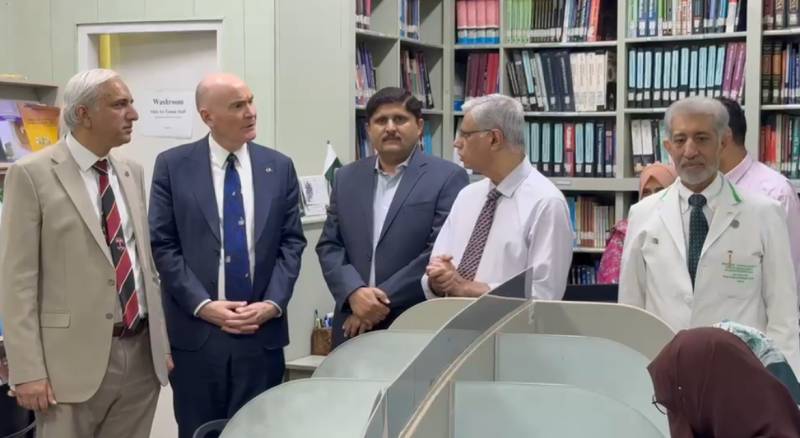

The Australian High Commissioner to Pakistan, Timothy Kane, visited the College of Ophthalmology and Allied Vision Sciences at King Edward Medical University and Mayo Hospital to review the impact of Australia’s long-standing support in eye health and observe Australian-funded clinical, teaching, and training facilities.
He was received by Vice Chancellor Prof. Dr. Mahmood Ayaz, Principal COAVS Prof. Muhammad Moin, Professor Emeritus and Provincial Coordinator for Prevention of Blindness Prof. Dr. Asad Aslam Khan, Registrar Prof. Asghar Naqi, along with senior faculty members and representatives of the Fred Hollows Foundation.
The visit highlighted a decades-long partnership between the Australian Government, the Fred Hollows Foundation, and COAVS, working in coordination with federal and provincial health departments to prevent avoidable blindness and strengthen Pakistan’s eye care system.
Launched in 1998, the collaboration has contributed to a significant decline in Pakistan’s blindness rate—from approximately 1.8 percent in the 1990s to around 0.5 percent today—helping restore sight to millions. Nearly six million people have benefited from initiatives supported under the programme.
According to figures shared during the visit, in 2024 alone, over two million people were screened, more than 30,000 cataract surgeries were performed, thousands of patients received treatment for diabetic retinopathy, over 66,000 eyeglasses were distributed, and more than 7,500 medical professionals and community workers were trained.
Speaking on the occasion, Timothy Kane said Australia takes pride in partnering with Pakistan to reduce preventable blindness and improve access to quality eye care. He noted that the collaboration is not only restoring sight but also strengthening healthcare systems across communities.
Fred Hollows Foundation Pakistan Country Manager Farooq Awan said the 27-year partnership has brought eye care services closer to underserved populations, particularly benefiting women and marginalized groups through sustainable healthcare strategies.
Principal COAVS Prof. Muhammad Moin termed Australian support vital in developing advanced medical facilities and training skilled professionals, adding that the joint efforts aim to ensure that financial constraints do not deprive individuals of sight-saving treatment.
Prof. Dr. Asad Aslam Khan highlighted the role of the partnership in expanding outreach to remote areas of Punjab and strengthening grassroots-level healthcare systems for blindness prevention.
Vice Chancellor Prof. Dr. Mahmood Ayaz said infrastructure developed through Australian cooperation has enhanced patient care while opening new avenues for research and higher education in ophthalmology, expressing interest in further expanding the collaboration.