
Iran targets US base in retaliation for airstrikes as Trump threatens to blow up Oman
Iranian forces fire at four ships attempting to cross Hormuz: US Treasury sanctions Iran officials overseeing Strait of Hormuz
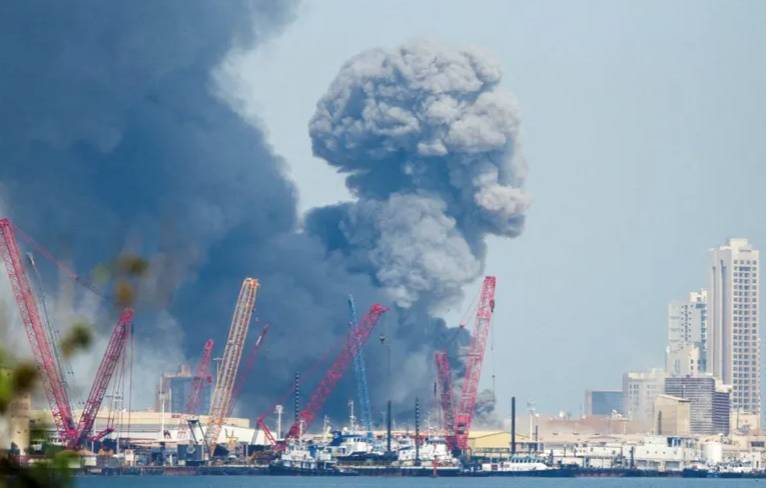

The Iranian Revolutionary Guards targeted an American base on Thursday in retaliation for US strikes on the country's south, Iran's state broadcaster IRIB reported, while President Donald Trump has threatened to blow up Oman, a mediator in the conflict.
"Following this morning's aggression by the invading US military against a location on the outskirts of Bandar Abbas Airport using aerial projectiles, the American air base that served as the source of the attack was targeted at 4:50 am (0120 GMT)," the Guards said, according to IRIB.
It did not provide details of the location of the base, though Kuwait, a US ally, said it was responding to missile and drone attacks on Thursday morning.
Kuwait's military said it was responding to missile and drone attacks, after the United States carried out fresh strikes on Iran and Tehran said it had fired at ships in the Strait of Hormuz.
"Kuwaiti air defences are currently engaging hostile missile and drone attacks," the Kuwaiti army posted on X.
Iran forces fire at ships in Hormuz
Iranian forces fired at four ships attempting to cross the Strait of Hormuz, state broadcaster IRIB reported on Thursday, the same day Washington carried out fresh strikes on southern Iran.
"Four vessels attempted to cross the Strait of Hormuz and enter the Persian Gulf without coordination with the security forces," IRIB posted on Telegram, saying the incident took place at around 12:35 am local time (2105 GMT Wednesday) but without providing details on the ships.
"They were warned, but after they ignored the warning, warning shots were fired at them, forcing them to return," it added.
US carries out new strikes on Iran
The United States carried out new strikes on southern Iran on Thursday, after President Donald Trump threatened to "finish the job" if Tehran did not agree to a peace deal.
Iranian media reported three loud explosions rang out in the port city of Bandar Abbas in the early hours of Thursday morning, following US strikes earlier in the week that underscored the fragile state of a diplomatic push to get a provisional peace agreement across the finish line.
"Today, US Central Command Forces shot down four Iranian one-way attack drones that posed a threat around the Strait of Hormuz," a US official, speaking on condition of anonymity, said in a statement to AFP.
"US forces also struck an Iranian ground control station in Bandar Abbas that was about to launch a fifth drone," the official said.
Even after earlier strikes on Monday night, Iran said on Wednesday a return to war was unlikely but that its military was nonetheless "lying in wait".
The mixed signals have thrown into question talks aimed at formally ending the war that began on February 28 with US-Israeli strikes on Iran.
"Iran is very much intent, they want very much to make a deal. So far they haven't gotten there. We're not satisfied with it, but we will be," Trump said at a televised White House cabinet meeting on Wednesday.
"Either that or we'll have to just finish the job."
A key focus of the deal has also been restoring full traffic to the Strait of Hormuz, which Tehran has effectively closed, leaving global energy markets grappling with curbed supplies of the huge amounts of oil and gas that normally pass through it.
On another front of the war, in Lebanon, Israel issued fresh evacuation orders to residents of the southern city of Tyre, warning it would take action against Iran-backed Hezbollah after declaring all areas south of the Zahrani River, which lies roughly 40 kilometres (25 miles) from the border, as "combat zones".
Trump separately also appeared to direct a warning to Oman, a US ally and mediator in the conflict, when asked about a possible short-term arrangement allowing Iran and Oman to control the Strait of Hormuz.
"No, the strait is going to be open to everybody," Trump said. "It's international waters and Oman will behave just like everybody else or we'll have to blow them up. They understand that, they'll be fine."
The White House did not immediately clarify whether Trump had misspoken. Oman has played a mediation role in the war and has itself come under attack from Tehran.
Earlier on Wednesday, Iranian Revolutionary Guards official Mohammad Akbarzadeh said the likelihood of "war is low because of the enemy's weakness", but warned the military was "lying in wait with full magazines" if attacked, the Tasnim news agency reported.
Trump, who said at the weekend a deal was close, also told the cabinet meeting he was in no rush.
Iran condemns US ceasefire violations
Iran's foreign ministry condemned on Thursday what it called violations by the United States after its strikes on the southern port city of Bandar Abbas and expressed solidarity with Oman after President Donald Trump threatened to "blow them up".
The ministry's spokesman Esmaeil Baqaei said Iran would "take all necessary measures to defend its national sovereignty" and condemned what he called "the threatening rhetoric of American officials against Iran and several regional countries."
Iran supreme leader says US, Israel seek to 'bring nation to its knees'
Iran's supreme leader Ayatollah Mojtaba Khamenei said on Thursday that the United States and Israel were seeking to destabilise the Islamic republic in a written message read on state television.
"The enemy's blind plan, after the imposed war, the economic pressure, and the political and propaganda siege, is to create divisions and disintegration in order to compensate for military defeats and bring the nation to its knees," said Khamenei, who has not appeared in public since before he took office in March.
Kuwait calls Iran attack 'dangerous escalation'
Kuwait condemned on Thursday a drone-and-missile attack it blamed on Iran, as the Islamic republic's renewed exchanges with US forces heaped pressure on the Middle East war's fragile ceasefire.
A foreign ministry statement voiced Kuwait's "strongest condemnation and denunciation of the criminal Iranian attacks that targeted the territory of the State of Kuwait with missiles and drones, in a dangerous escalation".
- Lebanon operations -
Iran and the United States have traded threats for weeks while negotiating through Pakistani mediation. Neither side appears ready to compromise on the main sticking points: Hormuz and Iran's nuclear programme.
On Wednesday, the Guards' navy said only ships "willing to abide by Iranian order" could pass through Hormuz.
US Secretary of State Marco Rubio said Tuesday that a deal remained within reach, but that the Hormuz would be reopened "one way or the other".
Iran has also insisted any peace accord must apply to Lebanon, where an April 17 ceasefire has done little to halt fighting between Israel and Hezbollah, which drew the country into the war by attacking Israel in early March in retaliation for the death of Iran's supreme leader.
Israeli Prime Minister Benjamin Netanyahu vowed Monday to "crush" Hezbollah, while army chief Lieutenant Colonel Eyal Zamir said Wednesday that Israel was "intensifying our operations" against the group.
After the warning to evacuate large areas in southern Lebanon, many residents fled to Tyre, according to AFP journalists -- the city subject to new Israeli evacuation orders on Thursday.
US Treasury sanctions Iran authorities
The United States Treasury announced sanctions Wednesday against Iran's Persian Gulf Strait Authority, Tehran's new agency that collects fees for traveling through the strategic Strait of Hormuz.
"The Iranian military's latest attempt to extort global maritime trade is proof that Economic Fury has left the regime desperate for cash," said Treasury Secretary Scott Bessent in a statement.
The statement extended the threat of sanctions to anyone paying the fees, because they "may be providing support to and receiving services from" Iran's Revolutionary Guards, and therefore may "be exposed to sanctions risk."
"Treasury has deprived the Iranian regime of revenue for their weapons programs, terrorist proxies, and nuclear ambitions," Bessent said.
The statement said the US has succeeded in disrupting "tens of billions of dollars' worth of revenue from being accessible" to Tehran.
In a post to X on May 20, the Persian Gulf Strait Authority issued a map to define its "regulatory jurisdiction," demarcating red lines on both sides of the Strait of Hormuz that require Iran's authorization for passage.
US and Iranian forces have observed a ceasefire since April 8 while diplomats push for a negotiated settlement, but Iran's controls have tightened on Gulf shipping through the Strait of Hormuz and the US has launched strikes on Iranian targets in recent days.
Iran's foreign ministry spokesman Esmaeil Baqaei said Monday that Tehran will continue to manage traffic through the strategic Strait fo Hormuz -- through which 20 percent of the world's oil and natural gas transits -- and insisted Iran is collecting fees for "navigational services," rather than imposing tolls.
The war began after the United States and Israel attacked the Islamic republic on February 28, and saw Iran respond with missile and drone attacks across the region.
South Korea summons Iran envoy
Seoul has summoned Iran's ambassador to protest after a probe concluded it was "highly likely" that an Iranian-made missile was to blame for a strike on a South Korean ship in the Strait of Hormuz.
In remarks carried by Iranian state media, Tehran's envoy to Seoul denied his country had anything to do with the incident.
The South Korean cargo ship was hit by unidentified projectiles on May 4 in the strait, a key waterway virtually closed since the United States and Israel launched a war against Iran on February 28.
US President Donald Trump claimed Iran had "taken some shots" at the Panama-flagged vessel, while Tehran had denied responsibility for the attack.
Following a weeks-long investigation, the South Korean government said technical analysis concluded that the unidentified projectile that struck the vessel was "highly likely" an alternative version of the "Noor series developed in Iran".
Seoul summoned the Iranian envoy to "explain the investigation results, convey a strong protest regarding the attack on our vessel, and demand responsible measures, including steps to prevent a recurrence," first vice foreign minister Park Yoon-joo said during a briefing.
Park said the HMM Namu was attacked by two warheads, adding the first was incinerated while the second detonated.
"The engine resembled an Iranian turbojet engine, and parts were found to bear markings presumed to be from an Iranian manufacturer," he said.
Following his meeting at the foreign ministry in Seoul, Iranian ambassador Saeed Koozechi said his country "rejects all allegations made in this regard and has had absolutely no involvement in this matter", according to the official IRNA news agency.
South Korea's Yonhap news agency said Koozechi had expressed regret over the damage to the ship, which had 24 crew members on board.
That damage was about "five metres (16.5 feet) wide and extended roughly seven metres (23 feet) into the hull" on the port-side stern, according to the South Korean government.