
Harvard to hold graduation in shadow of Trump 'retribution'
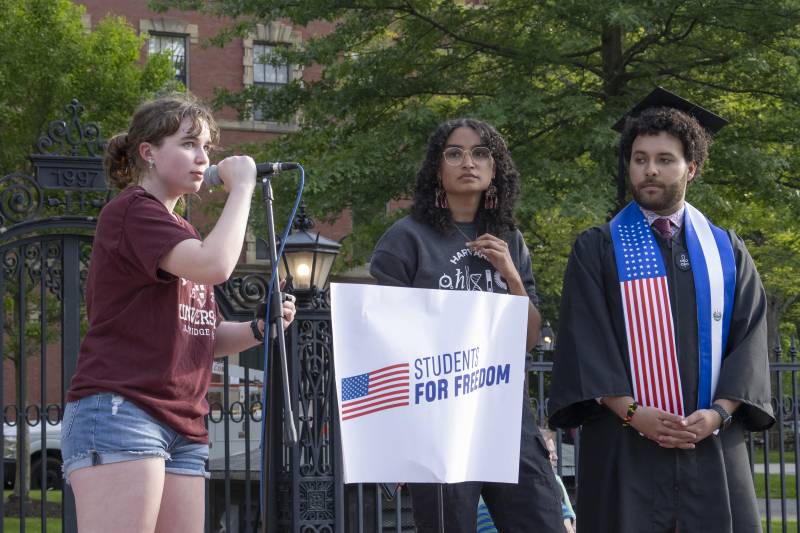

Harvard is due to hold its annual graduation ceremony Thursday as a federal judge considers the legality of punitive measures taken against the university by President Donald Trump that threaten to overshadow festivities.
Thursday's commencement comes as Trump piles unprecedented pressure on Harvard, seeking to ban it from having foreign students, shredding its contracts with the federal government, slashing its multi-billion dollar grants, and challenging its tax-free status.
Harvard is challenging all of the measures in court.
The Ivy League institution has continually drawn Trump's ire while publicly rejecting his administration's repeated demands to give up control of recruitment, curricula and research choices. The government claims Harvard tolerates anti-Semitism and liberal bias.
"Harvard is treating our country with great disrespect, and all they're doing is getting in deeper and deeper," Trump said Wednesday.
Harvard president Alan Garber, who told National Public Radio Tuesday that "sometimes they don't like what we represent," may speak to address the ceremony.
Garber has acknowledged that Harvard does have issues with anti-Semitism, and has struggled to ensure that a variety of viewpoints can be safely heard on campus.
"What is perplexing is the measures that they have taken to address these (issues) don't even hit the same people that they believe are causing the problems," Garber told NPR.
Basketball star and human rights campaigner Kareem Abdul-Jabbar addressed the class of 2025 for Class Day on Wednesday.
"When a tyrannical administration tried to bully and threaten Harvard to give up their academic freedom and destroy free speech, Dr. Alan Garber rejected the illegal and immoral pressures the way Rosa Parks declined--" he said to applause.
Civil rights icon Parks refused to give up her seat on a bus in Montgomery, Alabama sparking a boycott that ultimately led to the desegregation of services, spurring on the Civil Rights movement in what is widely seen as a watershed moment.
Madeleine Riskin-Kutz, 22, a Franco-American classics and linguistics student at Harvard said some students were planning individual acts of protest against the Trump policies.
"The atmosphere (is) that just continuing on joyfully with the processions and the fanfare is in itself an act of resistance," she said.
- Legal fightback -
Garber has led the fight-back in US academia after Trump targeted several prestigious universities including Columbia which made sweeping concessions to the administration in an effort to restore $400 million of withdrawn federal grants.
A federal judge in Boston will on Thursday hear arguments over Trump's effort to exclude Harvard from the main system for sponsoring and hosting foreign students.
Judge Allison Burroughs quickly paused the policy which would have ended Harvard's ability to bring students from abroad who currently make up 27 percent of its student body.
Retired immigration judge Patricia Sheppard protested outside Harvard Yard Wednesday, sporting a black judicial robe and brandishing a sign reading "for the rule of law."
"We have to look at why some of these actions have been filed, and it does not seem to me seemly that a president would engage in certain actions as retribution," she told AFP.
Ahead of the ceremony, members of the Harvard band sporting distinctive crimson blazers and brandishing their instruments filed through the narrow streets of Cambridge, Massachusetts that is home to America's oldest university ahead of the graduation ceremony.
A huge stage had been erected and hundreds of chairs laid out in a grassy precinct that was closed off to the public for the occasion.
Students braved sunny conditions to wear black academic gowns, touring through Cambridge with photo-taking family members, AFP correspondents saw.
Harvard settles lawsuit over enslaved ancestor images
Harvard University has agreed to settle a deeply emotional dispute over who has the rights to images of enslaved Africans taken in 1850 by a professor who sought to support a racist theory.
The daguerrotypes, a precursor to modern photographs, are considered to be the earliest known images of Black American slaves, who were posed nude and semi-nude "without consent, dignity or compensation," a 2019 lawsuit stated.
The Cambridge institution has agreed to relinquish the images and has offered plaintiff Tamara Lanier a confidential monetary settlement.
Lanier says she is a descendant of a slave known only by his first name, Renty, who was photographed nude, and his daughter Delia, who was photographed nude from the waist up, in images commissioned by Harvard biologist Louis Agassiz as supposed evidence of Black inferiority.
The images were taken in South Carolina, and Lanier is advocating for them to be transferred to the International African American Museum there.
Lanier accused the university of using them for advertising and commercial purposes, and denounced the use of Renty's image on a cover of a $40 anthropology book it published in 2017.
"Since Black Americans were first brought to this country in chains, our pain and trauma have been exploited for capitalistic gain," said Lanier.
Lanier claimed rights to the images 15 years ago, but Harvard has long-disputed the claim that she is Renty's great-great-great-granddaughter.
"As descendants of slaves, familial history and well-documented genealogy are a luxury that many Black Americans do not have," Lanier said, who relied on her family's oral history to determine the connection in lineage.
In a statement on the settlement, Harvard said they have "long been eager" to steward "the daguerrotypes in a responsible manner."
In his time Agassiz, a Swiss-born biologist, was a renowned scientist who worked in geology.
But Lanier's attorney Ben Crump said Agassiz also supported polygenism, which was "used to justify both the ongoing enslavement of Black people prior to the Civil War and their segregation afterward."
The daguerrotypes were in the possession of Harvard's Peabody Museum of Archaeology and Ethnology to date.
"Harvard played a role in the darkest chapter in American history," Lanier said. "This is a small step in the right direction towards fully acknowledging that history and working to rectify it."
The stain of Agassiz's work has been controversial elsewhere, too.
He had an elementary school named after him near Harvard -- but local residents successfully demanded the name be changed to honor a long-serving Black principal Maria Louise Baldwin in 2002, citing his scientific racism.