
Gulf to see a ‘future without America’, says Mojtaba Khamenei as oil prices soar to $126 barrel
President Pezeshkian says any blockage contrary to international law is doomed to fail: US pushing for new coalition to restart Hormuz traffic: Trump says naval blockage may last months: Asks Iran to get smart and sign nuclear deal
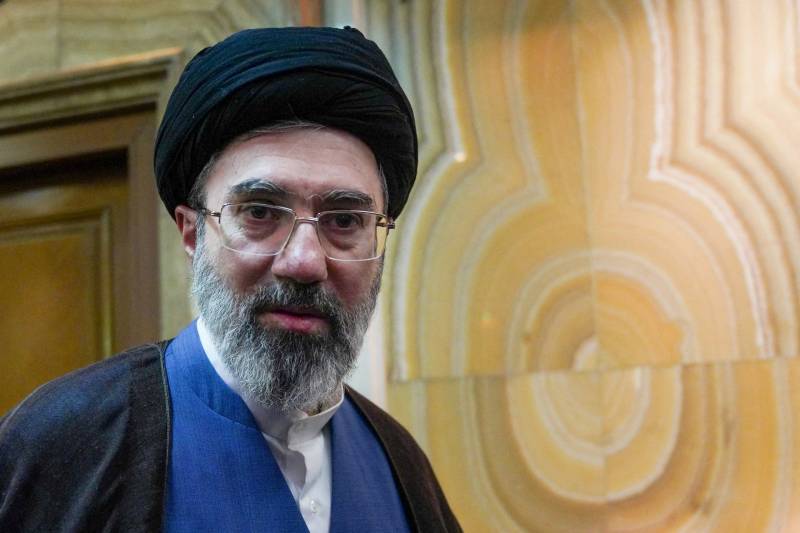

Iran’s Supreme Leader Ayatollah Mojtaba Khamenei also said in his written message that the United States had been defeated in its war on Iran, according to AFP. “Today, two months after the largest military deployment and aggression by the world’s bullies in the region, and the United States’ disgraceful defeat in its plans, a new chapter is unfolding for the Persian Gulf and the Strait of Hormuz,” said Khamenei in the message read on state television.
In his message, Supreme Leader Ayatollah Mojtaba Khamenei further said that Iran will closely guard its nuclear and missile capabilities, an apparent response to the US’s desire to dismantle them, Al Jazeera reports.
Iranians view the country’s nuclear and missile capabilities “as their national capital and will guard them like water, land and air borders”, Khamenei said. The Strait of Hormuz has “stirred the greed of many devils in past centuries”, Iran’s Supreme Leader Ayatollah Mojtaba Khamenei has said, Al Jazeera reports.
But since the US-Israel war on Iran started in late February, Iranians “have witnessed with their own eyes … the beautiful manifestations of the steadfastness, vigilance, and courageous struggle” of Iranian forces.
The leader claimed that “the bright future of the Persian Gulf region will be a future without America and in the service of the progress, comfort, and prosperity of its peoples”.
Iran warned the United States on Thursday that its naval blockade was doomed to fail, after President Donald Trump signalled it could be enforced for months to come, in a confrontation wreaking havoc on global energy markets.
Oil prices soared to a four-year high, with Brent crude for June delivery up 7.1 percent to more than $126 dollars a barrel, and Iran's President Masoud Pezeshkian responded with a warning that the action would only further destabilise the region.
The United States imposed a blockade on Iran's ports, while the Islamic republic has maintained its stranglehold over the strategic Strait of Hormuz since the start of the Middle East war in February.
"Any attempt to impose a maritime blockade or restrictions is contrary to international law... and is doomed to fail," Pezeshkian said, in a statement that warned the blockade that began on April 13 would be "a disruption to lasting stability in the Persian Gulf".
Trump is expected to receive a briefing on Thursday on new plans for potential military action in Iran from Admiral Brad Cooper, the head of US Central Command, two sources with knowledge of US planning told news platform Axios.
This week Trump has reportedly told oil executives and national security officials to prepare for a long US blockade designed to force Tehran to surrender its nuclear programme, and, speaking to Axios, said: "They are choking like a stuffed pig. And it is going to be worse for them."
US Central Command (CENTCOM) said Wednesday in a social media post that it had reached a "significant milestone after successfully redirecting the 42nd commercial vessel attempting to violate the blockade".
It said there are "41 tankers with 69 million barrels of oil that the Iranian regime can't sell", estimating the value at more than $6 billion.
Trump faces domestic political pressure to end the war, which is unpopular even with much of his base, has increased costs for American consumers and has unnerved US allies.
Iran's economy is also suffering and the rial has fallen to historic lows against the dollar.
Iran has sought to extract a price for being attacked by exerting control over the Strait of Hormuz, the narrow waterway through which about one-fifth of global oil typically transits.
- 'The issue is always nuclear' -
Top US officials, including Vice President JD Vance, twice turned back last week from trips to Pakistan to negotiate with Iran.
US officials contend they do not know who is speaking for Iran, whether it is the hardline and increasingly empowered Revolutionary Guards or diplomats, after Israeli strikes killed a series of top leaders.
Iran proposed easing its chokehold over the Strait of Hormuz if Washington lifts its blockade and broader negotiations take place. But the Trump administration has insisted that Iran's nuclear programme be on the table.
Iran's parliament speaker Mohammad Bagher Ghalibaf, who has emerged as a key figure since the start of the war, said Wednesday the US naval blockade of the country aimed to create division and "make us collapse from within".
Violence has continued on the war's Lebanese front, despite a recently extended ceasefire between Israel and Hezbollah, the Iran-backed armed group that drew Lebanon into the war by firing rockets at Israel. Israel responded with strikes and a ground invasion.
For the first time since the ceasefire began, the Lebanese army said on Tuesday that an Israeli strike had targeted its troops, wounding two soldiers in the south. Another strike on Wednesday killed a Lebanese soldier, it said.
"Israel must finally realise that the only path to security is through negotiations, but it must first fully implement the ceasefire in order to move on to negotiations," Lebanese President Joseph Aoun said.
A UN-backed report said Wednesday more than 1.2 million people in Lebanon were expected to face acute hunger due to the latest war.
Blockade 'doomed to fail'
Iran's President Masoud Pezeshkian on Thursday said a US naval blockade of Iranian ports would deepen disruptions in the Gulf and fail to achieve its objectives.
"Any attempt to impose a maritime blockade or restrictions is contrary to international law... and is doomed to fail," Pezeshkian said in a statement.
He added that such measures would "not only fail to enhance regional security, but are in fact a source of tension and a disruption to lasting stability in the Persian Gulf".
On Wednesday, the military adviser to Iran's supreme leader Mojtaba Khamenei reiterated the warning against US blockade. "We will not tolerate the naval blockade. If it continues, Iran will respond," Mohsen Rezaei, a former commander-in-chief of Iran's Revolutionary Guards who was named as a military adviser by Khamenei in March told state TV.
He also warned against a new round of fighting between the US and Iran, saying it could possibly see US ships sunk and "its soldiers will be killed."
"If the US starts another war, it should expect that we take a large number of them prisoner," he added.
Oil Minister Mohsen Paknejad said the US "will not gain any results" from its blockade, dismissing any concerns over oil supply and distribution.
"Oil industry employees are working around the clock to ensure that there is no problem in providing services," he told state TV.
Also on Wednesday, Iran's army navy commander Shahram Irani signalled that Iran will deploy "in the very near future" naval weaponry which it has recently developed.
‘New coalition’ to restart Hormuz traffic
The United States is pushing for a new international coalition to restart commercial shipping in the Strait of Hormuz as talks with Tehran stall, according to US news outlets.
The State Department sent an internal cable to US embassies calling on diplomats to convince governments around the world to join the "Maritime Freedom Construct," a US-led bloc to share information, coordinate diplomatically, and enforce sanctions, the Wall Street Journal reported on Wednesday.
Iran has sought to extract a price for being attacked by exerting control over the Strait of Hormuz, the narrow waterway through which one-fifth of global oil typically transits.
As oil prices remain elevated for weeks, Trump has called on allies to unblock the strait, saying last month that "this should have always been a team effort."
The coalition will see the State Department serving as a "diplomatic operations hub" and the US Central Command providing "real-time maritime domain awareness," the Journal reported, citing the cable sent on Tuesday.
"Your participation will strengthen our collective ability to restore freedom of navigation and protect the global economy," the cable reportedly said.
"Collective action is essential to demonstrate unified resolve and impose meaningful costs on Iranian obstruction of transit through the Strait."
A senior Trump administration official confirmed to the Journal that the idea was one of the many diplomatic and policy resources at the president's disposal.
Trump has repeatedly lashed out at NATO allies over their response to his war with Iran and suggested he could quit the 77-year-old military alliance.
Efforts to end the war have stalled, with the Iranian side reportedly proposing this week to ease its chokehold on the strait in exchange for Washington lifting its retaliatory blockade while broader negotiations continue.
Oil prices shoot up
Oil prices soared more than seven percent to a fresh four-year high Thursday while stocks fell after Donald Trump warned the US blockade of Iranian ports could last months and a report said he would be briefed on potential fresh military strikes.
While Tehran submitted a fresh proposal this week to reopen the crucial Strait of Hormuz, the US president reportedly did not believe it was negotiating in good faith.
The Wall Street Journal said he had told national security officials to prepare for a long blockade to compel the Islamic republic to give up its nuclear programme.
At a meeting of oil executives Tuesday, he discussed efforts "to alleviate global oil markets and steps we could take to continue the current blockade for months if needed and minimise impact on American consumers", a White House official said on condition of anonymity.
It came as Axios cited two unnamed sources with knowledge as saying Admiral Brad Cooper, commander of US Central Command (CENTCOM), would brief Trump on potential military action.
The briefing signals the president is seriously considering resuming major combat operations -- which were ended more than three weeks ago for talks -- to try to break the logjam in negotiations or deliver a final blow before ending the war, Axios reported.
The outlet had earlier reported Trump as saying the blockade was "somewhat more effective than the bombing. They are choking like a stuffed pig. And it is going to be worse for them. They can't have a nuclear weapon".
He added that the naval action would not end until he had secured a deal with Tehran to address its nuclear programme, it said.
In a post on his Truth Social platform, Trump wrote: "Iran can't get their act together. They don't know how to sign a nonnuclear deal. They better get smart soon!"
He posted an illustration of himself holding an assault rifle alongside the caption "NO MORE MR. NICE GUY!"
Still, Michael Brown at Pepperstone said: "It must be said that the heated rhetoric here doesn't really tally up with Trump's actions, which largely continue to point away from any sort of re-escalation at this stage.
"That said, while the broader direction of travel is one that continues to point towards a deal of some sort being done, it remains the case that negotiations do appear to be bogged down in a form of stalemate for the time being.
"In light of that, it seems that markets are slowly but surely moving from a 'no news is good news' mantra, to a 'no news is bad news' one."
The prospect of the strait -- through which a fifth of world oil and gas passes -- being closed for months more sent crude surging to the highest level since 2022, after Russia invaded Ukraine.
Brent for June delivery surged 7.1 percent to $126.41 per barrel in Asian trade, while West Texas Intermediate climbed 3.4 percent to $110.31. Both later pared the gains.
Analysts said traders were beginning to shift to the view that the crisis will not be as short as initially hoped.
Stock markets fell, with Tokyo, Hong Kong, Sydney, Seoul, Taipei, Mumbai, Bangkok, Manila and Jakarta all down. There were gains in Singapore and Wellington, while Shanghai was flat.
The dollar, seen as a safe haven during the crisis, rose against its peers.
Equity traders had been relatively upbeat in recent weeks thanks to a revival of the AI trade, which has helped push Seoul's Kospi index to multiple record highs.
- Key figures at 0515 GMT -
West Texas Intermediate: UP 2.7 percent at $109.78 a barrel
Brent North Sea Crude: UP 4.8 percent to $123.71 a barrel
Tokyo - Nikkei 225: DOWN 1.2 percent at 59,176.33
Hong Kong - Hang Seng Index: DOWN 1.3 percent at 25,766.11
Shanghai - Composite: FLAT at 4,106.17
Euro/dollar: DOWN at $1.1661 from $1.1695 on Wednesday
Pound/dollar: DOWN at $1.3465 from $1.3489
Dollar/yen: UP at 160.51 yen from 160.23 yen
Euro/pound: DOWN at 86.60 pence from 86.71 pence
New York - Dow: DOWN 0.6 percent at 48,861.81 (close)
London - FTSE 100: DOWN 1.2 percent at 10,213.11
- 'Collapse' -
Iran has proposed easing its chokehold over the Strait of Hormuz as Washington lifts its blockade and broader negotiations take place. The Trump administration has been skeptical of the proposal.
Iran's speaker of parliament Mohammad Bagher Ghalibaf, who has emerged as a key figure since the start of the war, said Wednesday the US naval blockade of the country aimed to create division and "make us collapse from within."
Violence has continued on the war's Lebanese front, despite a recently extended ceasefire between Israel and Hezbollah, the Iran-backed armed group that drew Lebanon into the war by firing rockets at Israel. Israel responded with strikes and a ground invasion.
For the first time since the ceasefire began, the Lebanese army said on Tuesday that an Israeli strike had targeted its troops, wounding two soldiers in the south. Another strike on Wednesday killed a Lebanese soldier, it said.
"Israel must finally realise that the only path to security is through negotiations, but it must first fully implement the ceasefire in order to move on to negotiations," "Israeli attacks cannot continue as they are," Lebanese President Joseph Aoun said in a statement.
A UN-backed report said Wednesday that more than 1.2 million people in Lebanon were expected to face acute hunger due to the latest war.
- US Central Command says 42nd vessel redirected -
US Central Command (CENTCOM) said Wednesday on X that it had reached a "significant milestone after successfully redirecting the 42nd commercial vessel attempting to violate the blockade".
It said there are "41 tankers with 69 million barrels of oil that the Iranian regime can't sell," estimating the value to more than $6 billion.
- US-Germany tensions grow -
President Donald Trump said Wednesday that the United States is considering reducing its troops in Germany over Chancellor Friedrich Merz's refusal to join Washington's war against Iran -- a force estimated between 35,000 and 50,000 troops.
The threats to slash US troop numbers echo Trump's longstanding criticisms of the NATO alliance, but Merz drew Trump's fresh ire earlier this week after saying Tehran is "humiliating" Washington at the negotiating table.
- Putin-Trump talks -
Russian President Vladimir Putin warned his US counterpart not to resume attacks on Iran.
In a phone call between the two leaders, Putin said Trump's decision to extend the ceasefire was "the right one", Kremlin aide Yuri Ushakov told reporters, including from AFP.
But he said there would be "inevitable and extremely damaging consequences" for the region and wider world if military action restarted.
Trump called the conversation "very good" and said Russian help to end the US-Israeli war on Iran was contingent on Putin ending the war in Ukraine.
- $25 billion -
US Defense Secretary Pete Hegseth was asked during a fiery exchange in Congress about the cost of 60 days of conflict, and replied that it was estimated at less than $25 billion so far.
But he hit back at concerns that the United States has used up "alarming" levels of critical munitions that could deplete reserves, accusing critics of "handing propaganda to our enemies".
- Long blockade -
Trump has told national security officials to prepare for a long blockade of Iran's ports in order to compel Tehran to give up its nuclear programme, according to the Wall Street Journal.
Trump, according to the report, does not believe that Iran is negotiating in good faith and hopes it can be forced to suspend uranium enrichment for 20 years and accept tight restrictions thereafter.
A White House official said Trump told oil executives the blockade could be extended for months more.
- 'Inappropriate behaviour' -
Top Iranian football officials left World Cup co-hosts Canada before the start of the FIFA Congress because of "inappropriate behaviour" by immigration officials at Toronto airport, Iranian media said.
The federation's president and deputy secretary general returned to Turkey on the first flight, several outlets reported, without giving further details.
- Record profits -
French fossil fuel giant TotalEnergies said net profit rose 51 percent in the first quarter to $5.8 billion, boosted by higher oil prices linked to the war in the Middle East.
Growth in its oil and gas production in Brazil and Libya allowed the group to offset losses in the Gulf region, which is normally equivalent to 15 percent of its total oil and gas business, the company said in a statement, while also highlighting its "ability to capitalize on rising prices".
- Refinery restarts -
TotalEnergies also said it had restarted its Satorp refinery in Saudi Arabia in mid-April, after the facility, jointly owned with the kingdom's Aramco, had been shut down following damage sustained in airstrikes.
"Following the events of April 8, which affected three units at the Satorp site and led to its shutdown as a safety precaution, the undamaged units were able to be restarted, and the refinery has been operating at a capacity of 230,000 b/d (barrels per day) since April 14," the company said.
- Lebanon ceasefire -
Lebanon's President Joseph Aoun urged Israel to fully implement a ceasefire before beginning direct talks, after Israeli strikes killed more than 20 people in the last two days.
Israel has been fighting Hezbollah since early March, sending troops into south Lebanon to battle the Iran-backed militant group, with the violence ongoing despite a shaky April 17 truce.
Military chief General Eyal Zamir vowed to strike targets of the Iran-backed group north of Lebanon's Litani River if threatened.