
Naqvi urges political consensus, systemic reforms to address Pakistan’s economic and governance challenges
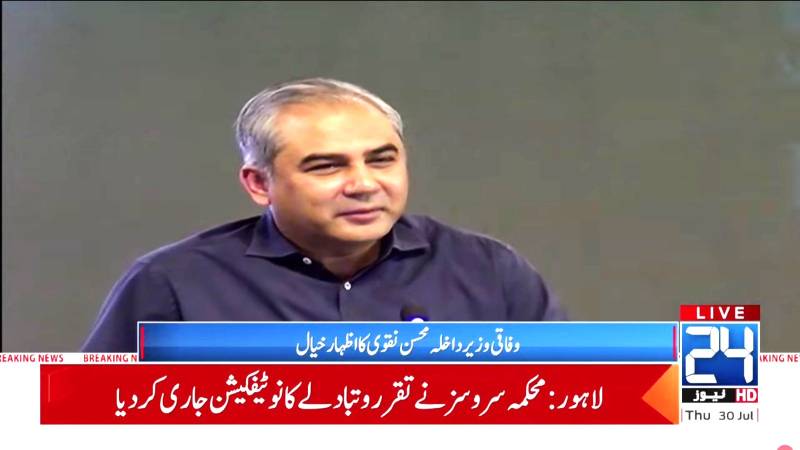

Interior Minister Mohsin Naqvi Thursday called for broad political and institutional consensus to reform Pakistan’s administrative and governance system, warning that continued political confrontation and temporary measures would not resolve the country’s deep-rooted economic and public-service problems.
Speaking at the Pakistan Economic Summit 2026 in Islamabad, Naqvi said he did not want to dismantle the existing system but sought to make it more effective, transparent and responsive to the needs of ordinary citizens.
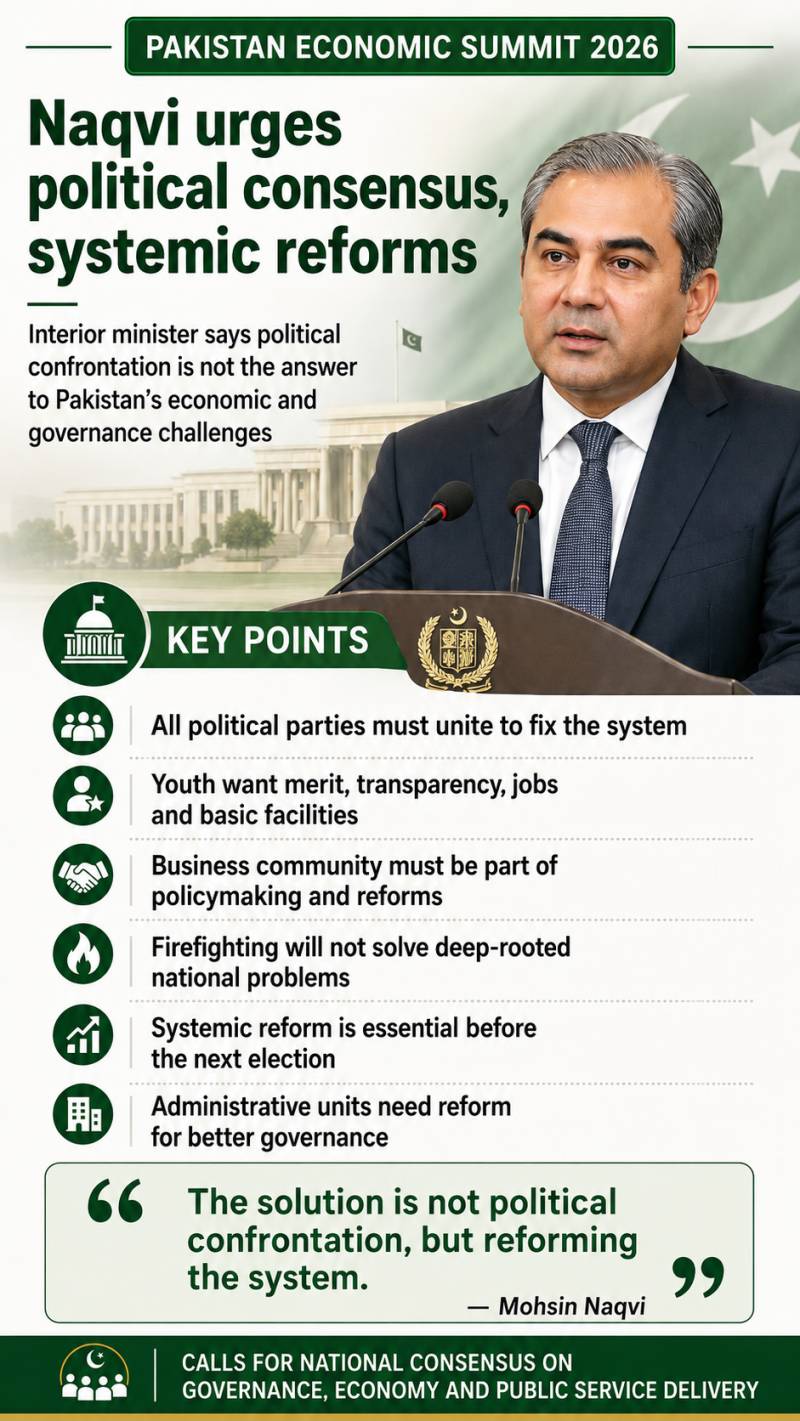
“The solution to the problems facing the country does not lie in political confrontation. It lies in reforming the system,” he said, urging political parties, the business community, young people and other stakeholders to work together.
Naqvi appealed to all political parties to set aside their differences and agree on reforms before the next general election. He said repeated seminars and discussions would produce little unless political leaders were prepared to sit together and take practical decisions.
“All political parties will have to put their differences aside and come together on this issue,” he said. “We have to decide how to run our own house.”
The interior minister said Pakistan had been dealing with crises through short-term interventions rather than addressing their underlying causes.
“We are only doing firefighting,” he said, adding that even a prime minister working 20 hours a day would be unable to deliver lasting results unless the broader system was restructured.
Naqvi said Pakistan’s debt continued to increase because successive governments relied on borrowing without correcting structural weaknesses.
“We all know that we will take loans, but we will not fix the system,” he said, comparing the country’s financial management to a heavily indebted household that continued preparing routine budgets without addressing its liabilities.
He said the existing administrative framework had become ineffective in many areas and required major repair. Drawing an analogy, Naqvi said even a house needed renovation after several decades.
“Not everything in this system is bad,” he said. “But the common person wants a relationship with the government and access to facilities, and those are not being provided.”
The minister said poor planning and weak accountability resulted in public resources being repeatedly spent on the same projects. He cited the example of a street being reconstructed several times because the underlying system remained defective.
“If the system is bad and one street has to be built 10 times, we will continue building it 10 times unless we fix the system,” he said.
Naqvi also called for a serious national discussion on creating additional administrative units, arguing that Pakistan’s population and governance needs had grown significantly.
He referred to India’s administrative development, saying it had 14 states at the time of its formation and later increased the number substantially. Pakistan, he said, needed to examine whether smaller and more effective administrative units could improve governance and public-service delivery.
“The mission of administrative units will have to be taken forward,” he said, adding that new structures could also create opportunities for new political and administrative leadership.
Naqvi criticised provincial governments for approaching population and administrative matters primarily through the lens of financial and political interests. He said reforms should be designed around the needs of citizens rather than the protection of existing power structures.
The minister placed particular emphasis on the concerns of young Pakistanis, saying they were not merely asking the government for cash assistance, tablets or temporary schemes.
“Young people want merit, a transparent system, employment opportunities and basic facilities,” he said.
He said the youth wanted to obtain education, employment, justice and government services through legitimate and transparent means rather than through personal connections or influence.
Naqvi urged policymakers to listen seriously to young people and provide them with meaningful opportunities before frustration and disillusionment deepened.
“Their voices must be heard in parliament, universities and at the national level,” he said. “We will have to begin a serious discussion on this issue.”
He warned that failure to respond to the aspirations of the younger generation could produce serious social and political consequences. The government, he said, must provide facilities, merit-based opportunities and a sense of participation in national decision-making.
Naqvi also highlighted the difficulties faced by ordinary citizens in obtaining justice and basic public services.
“Even today, the common man has to travel miles to obtain justice,” he said, adding that the purpose of reform should be to bring the state closer to citizens.
Turning to the economy, the interior minister said the business community had the knowledge and capacity to generate wealth but had not been sufficiently involved in policy formulation and institutional reform.
“The business community knows how to turn Rs10 into Rs100,” he said. “Unless the business community is made part of the reform process, these problems will not be solved.”
Naqvi said business leaders could play a decisive role in improving the country’s economic and governance structures if they acted collectively.
“You businesspeople may contribute Rs28 trillion, but even that will not be enough unless the system is corrected,” he said. “If the entire business community comes together, then everything can happen.”
He urged business leaders not to remain focused solely on their individual commercial interests and instead take a stand for wider reforms.
“Businesspeople will have to stand up, not only for themselves but for the country,” he said.
Naqvi also suggested that business figures and other influential members of society had a responsibility because many of them financed political activities and maintained close links with political leaders.
“The people who run this system are sitting here, and those who fund political people are also sitting here,” he said. “The day you decide that the system has to be fixed, it will be fixed.”
The minister said responsibility for Pakistan’s present condition could not be placed on one political party, institution or section of society.
“I believe everyone is responsible for reaching this state,” he said.
Naqvi said he had been involved in politics for about three and a half years and had concluded that the existing system could continue producing the same outcomes for another decade unless fundamental reforms were introduced.
He said he supported democracy but argued that democratic governance could be organised through different administrative arrangements. Pakistan, he added, should not treat one particular structure as the only possible form of democracy.
“I also want democracy, but democracy can operate through more than one system,” he said. “We keep dragging everything towards only one model.”
Naqvi said Pakistan had gained international respect and diplomatic recognition but needed to improve its internal governance to sustain that position.
“One person may be making the country respectable at the global level, but we have to fix our internal situation,” he said.
He invited political parties, business leaders, academics, journalists and young people to develop a national reform agenda. He specifically called for continued discussion by journalists and public intellectuals, including Sohail Warraich and his colleagues, to build public understanding of the issue.
Naqvi assured participants that he would support serious efforts aimed at improving the system.
“I can promise that I will give you full support,” he said. “I will go forward with you because such opportunities do not come again and again.”
The interior minister said Pakistan had been blessed with significant human, geographic and economic potential, but meaningful progress required collective action rather than reliance on individual leaders.
“We should not look only towards politicians,” he said. “All sections of society must decide that the system has to be repaired.”
He reiterated that political parties must reach an understanding on reforms before the next election so that future governments could focus on implementation rather than restarting the debate.
“Unless all political parties sit together, no matter how many seminars are held, nothing will be achieved,” Naqvi said.