
Indus Waters Treaty vital for regional peace, stability: DPM
Pakistan to give India befitting response if it tries to divert water, warns Tarar, Indus Water commissioner says India cannot use water as a weapon: Musadik Malik says water shortage driving growers to quit farming: Russian expert Dr Roxolana Zigon says India is violating int’l law
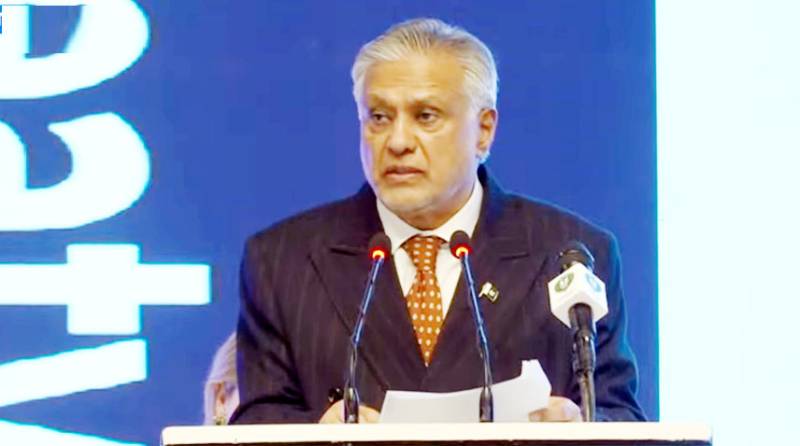

Deputy Prime Minister Ishaq Dar has said the Indus Waters Treaty is not merely a water-sharing arrangement, but a vital instrument of regional peace, stability and cooperation.
He was addressing a seminar on the Indus Waters Treaty in Islamabad today.
Ishaq Dar said the shared waters must remain a bridge between nations, guided by cooperation, dialogue and respect for international law for the benefit of the present and future generations.
The Deputy Prime Minister recalled that Pakistan and India concluded the Indus Waters Treaty in 1960 under the auspices of the World Bank. The treaty established a durable and carefully negotiated framework, allocating three eastern rivers to India and three western rivers to Pakistan.
Ishaq Dar underscored that the treaty justified that confidence for more than six decades, including periods of war and political tension. It has rightly been regarded as one of the most successful examples of trans-boundary water cooperation anywhere in the world. He said it is regrettable that this landmark treaty now faces its gravest challenge. He said India's unilateral decision to place the treaty in abeyance has no basis in the treaty itself or in international law.
Ishaq Dar said Pakistan rejects India's unilateral and illegal announcement. He added that the Indus Waters Treaty remains valid, binding and operative. No party can unilaterally suspend or terminate its obligations under a treaty that contains no such provision.
The Deputy Prime Minister stressed the need to promote peace in South Asia by addressing all outstanding issues. He said Pakistan has consistently sought to resolve differences through dialogue, diplomacy and the treaty-based mechanisms agreed by both parties.
Ishaq Dar made it clear that any attempt to deprive Pakistan of the waters rightfully allocated to Pakistan under the treaty would have profound consequences for regional peace and security.
The Deputy Prime Minister said Pakistan would safeguard and defend its rights and interests under international law through all available means.
Earlier, asserting that water was a matter of life and death for 240 million people of Pakistan, Federal Information Minister Attaullah Tarar said on Tuesday that the Indus Waters Treaty (IWT) could neither be unilaterally held in abeyance nor delayed, reported 24NewsHD TV channel.
Addressing an international conference, titled “Indus Waters Treaty as an Enduring Legal and Institutional Framework” at Islamabad’s Convention Centre, the minister said that although Pakistan believed in constructive dialogue and implementation on the treaty with complete sincerity, it would give India a befitting response, if the latter tried to stop the flow of water.
He said categorically that any change in the treaty could only be made with the consent of Pakistan. “The government has made it clear time and again that Pakistan has complete right over the River Indus, on which the entire population of Pakistan is dependent, and which is the lifeline of the country’s agriculture.”
Tarar said that the treaty signed in 1960 held an important position in international relations. He said that Pakistan would defend the agreement come what may.
Tarar said 240 million people of Pakistan had an “inalienable right” to water from the Indus River System. “When we say that Indus is our lifeline and our people, the 240m people of Pakistan, have an inalienable right to the water of Indus, we mean it, from the core of our heart,” he added.
Tarar describes the IWT as “an instrument of peace and regional stability”. “Today, we are not merely discussing the treaty. We are discussing the lifeline of nearly 240 million people of Pakistan.”
The minister maintained “When we identify ourselves as Pakistanis, we ask a question as to who we are. And if you go back into history, the Indus water civilisation defines us as a people. Whenever I go abroad, I always tell my counterparts that we are the people of the Indus Valley civilisation. Our identification is that we are people based on the banks and tributaries of the mighty Indus River.”
Tarar said water was life, and the “Indus has given life to Pakistan”. He said the Indus River system had nurtured one of the world’s oldest civilisations for thousands of years. “From the towering peaks of Gilgit-Baltistan to the fertile plains of Punjab and Sindh, these waters have connected our people across geography and history.”
He added that the story of Pakistan was, in many ways, the story of the Indus. It was for this reason that the Indus Waters Treaty of 1960 occupied such a “unique place in international relations”, he said and added the treaty was signed under the auspices of the World Bank and had endured wars, political upheavals and prolonged periods of tension.
“Its resilience, for more than six decades, demonstrates an enduring truth that cooperation, dialogue and adherence to international commitments remain the only sustainable path to peace,” Tarar said.
The minister said the IWT stood as a “remarkable example” of the rule-based international order. “It embodies the principle of good faith, the sanctity of agreements and peaceful dispute resolutions. These are not merely legal concepts, but foundations upon which trust is built.”
سندھ طاس معاہدے سے متعلق بین الاقوامی سیمینار
— PTV News (@PTVNewsOfficial) June 30, 2026
وفاقی وزیراطلاعات و نشریات عطاء اللہ تارڑکاسیمینارسے خطاب pic.twitter.com/SZuQmUMb9w
Then, turning his attention to tensions between Pakistan and India over the IWT, he asserted that Pakistan’s civilian and military leadership had made it clear that the people of Pakistan had a right to the water of the Indus and the treaty could not be amended, revoked, suspended or held in abeyance unilaterally.
Tarar pointed out that the treaty came into being after mutual consensus between Pakistan and India and could only be amended or revised with the mutual consensus of the two sides. “India’s failed attempt at unilaterally holding this treaty in abeyance has led to international embarrassment for India at various forums, including legal forums,” he said.
Moreover, he contended that the “moral, social and legal foundations” of any one-sided attempt to hold the IWT in abeyance. “And any structure which has weak foundations will fall flat on its face,” he remarked.
Tarar stressed the need to protect the IWT, especially at a time when climate change was accelerating, glaciers were melting at an unprecedented rate and water scarcity was becoming the defining challenge of the present times.
Tarar said South Asia was home to nearly a quarter of humanity, adding “our collective future depends upon transforming water from a source of contention into a catalyst for cooperation”.
Any attempt to block or stop water, he said, would always fail because water would always find a way. “The weaponization of water or attempts to unilaterally alter established arrangements undermine not only regional peace and stability but also the broader framework of international law. International agreements, as I said, cannot be suspended or disregarded at convenience. Respect for treaties is indispensable for maintaining confidence among nations and preserving the global order,” he emphasised.
The minister said Pakistan had consistently demonstrated its commitment to peaceful engagement and constructive dialogue and the faithful implementation of the treaty. But, he warned, if an attempt was made to stop the water of Pakistan, the country’s leadership stood resolved to respond effectively to restore the water for the people of Pakistan.
India cannot use water as a weapon, says Indus Water commissioner
Indus Water Commissioner Syed Mehr Ali Shah said that Pakistan could not allow the diversion of the River Chenab by India.
Speaking at the seminar, he made it clear that water could not be used as a weapon.
He said that India had not been implementing the treaty since August 2023.
He said that the construction of Chenab-Beas Link was illegal. “Diverting the flow of River Chenab means diverting 1.9 million cubic feet of water,” he said, adding, “The Arbitration Court has clearly told India not to impede the flow of water in western rivers.”
Shah went on to say that under the treaty, India simply could not divert water from the River Chenab to the River Beas.
The treaty, he said, was meant to end tensions between two nuclear nations and ensure peace.
He said that Pakistan’s agriculture, food, and economy relied on the treaty.
اسلام آباد:کمشنر انڈس واٹر ٹریٹی سید مہر علی شاہ کا سندھ طاس معاہدے سے متعلق بین الاقوامی سیمینارسے خطاب pic.twitter.com/0p4p82nBIS
— PTV News (@PTVNewsOfficial) June 30, 2026
Musadik Malik says water shortage driving growers to quit farming
Speaking on the occasion, Federal Minister for Climate Change Musadik Malik said that the non-availability of water in Pakistan had prompted growers to leave the profession of farming.
He further said that the shortage of water not only had an impact on Pakistanis, but also on Bangladeshis.
He, however, said that the real issue was not the non-availability or excessive water, but the question, “who controls it.”
The minister said that at times there was flood-like situation in Head Marala due to the discharge of water by India. “And there have been times, when there is a shortage of water,” he added.
Malik said that not only India controlled the flow of water towards Pakistan, but was also the third largest contributor to climate change.
It was due to India, he went on to say, that 6,000 Pakistanis had so far died while thousand others had been injured.
He noted that the treaty remained unchanged even during the three wars fought between India and Pakistan.
The minister made it clear that no country could be allowed to hold regional as well as world peace hostage.
He went on to say that an international arbitration court had given a clear verdict on the treaty. “As per the verdict, no state, India or Pakistan, can unilaterally suspend or walk away from the treaty,” he said, adding, “The court has ruled that India cannot build dams on Pakistan’s share in water.”
Malik lamented that India was not willing to accept the decisions given by the court.
He said that if the treaty failed, it would give a license to the countries situated upstream to release water at their will. “If looked at from this point of view, this is not Pakistan’s issue, but a global issue.”
#Live: Minister for Climate Change Dr. Musadik Masood Malik is addressing international seminar on the Indus Waters Treaty in Islamabad @MoIB_Official @ForeignOfficePk @ClimateChangePK #News #RadioPakistan https://t.co/d4U7HDK6Ra
— Radio Pakistan (@RadioPakistan) June 30, 2026
Int’l law expert stresses dialogue between Pakistan, India
Ahmer Bilal Soofi, international law expert, said that water, wind and food had been recognized as basic human needs. “The fact that India has held the treaty in abeyance is totally ‘illegal’,” he added.
He said it was unfortunate that India was linking the treaty to other issues.
Soofi said that following the Pahalgam terror attack, India ought to have written to Pakistan to seek its cooperation in the investigation. “But instead of choosing peace, India opted for war and confrontation with Pakistan,” he lamented.
He said that Kashmir was an internationally recognized dispute.
“The government has already raised the issue of India holding the treaty in abeyance at the United Nations,” Soofi said.
He pointed out that there was also a legal aspect of every dispute between India and Pakistan.
He opined there was a need for a dialogue between the legal experts of both countries.
Russian expert says India is violating int’l law
Russia’s Dr Roxolana Zigon, a geopolitical analyst and an expert in international relations and diplomacy, also the director of the Scientific Centre for International and Strategic Research at the University of World Civilisation, Russia, expressed serious reservations regarding India’s stance on Indus Waters Treaty.
Addressing the conference, Dr Zigon said India's statement to deprive Pakistan of water is a violation of international law. “The Indus Waters Treaty is the foundation for the equitable distribution of water in the region and by altering the flow of water, India can harm Pakistan's agriculture.”
The Russian expert further said the construction of dams in India's upper regions can increase instability in the region. “India is attempting to use water as a weapon while Pakistan has demanded to approach the Security Council on the issue of the treaty's suspension,” Dr Zigon said, adding the Permanent Indus Commission is an important and effective forum for resolving such disputes.
بھارت کا پاکستان کو پانی سے محروم کرنے کا بیان عالمی قانون کی خلاف ورزی ہے۔۔۔سندھ طاس معاہدہ خطے میں پانی کی منصفانہ تقسیم کی بنیاد ہے۔۔۔بھارت پانی کے بہاؤ میں ردوبدل کر کے پاکستان کی زراعت کو نقصان پہنچا سکتا ہے۔۔۔بھارت کے بالائی علاقوں میں ڈیموں کی تعمیر خطے میں عدم استحکام… pic.twitter.com/A7l8rPBDtx
— PTV News (@PTVNewsOfficial) June 30, 2026
India has used water as a weapon, says ex-minister
Speaking on the occasion, former federal minister Khurram Dastgir Khan said his opinion was that India had used water as a weapon. “By doing so, the country has shown complete disregard for international law,” he added.
Quoting India’s home minister, he said that the IWT would never be restored.
He said that India often used such threatening language against Pakistan.
Khan said that there was an extraordinary flexibility in the treaty.
“On April 25, 2025, India had unilaterally suspended the treaty,” he reminisced.