
Bloodbath at Pakistan Stock Exchange as index loses over 7,000 points
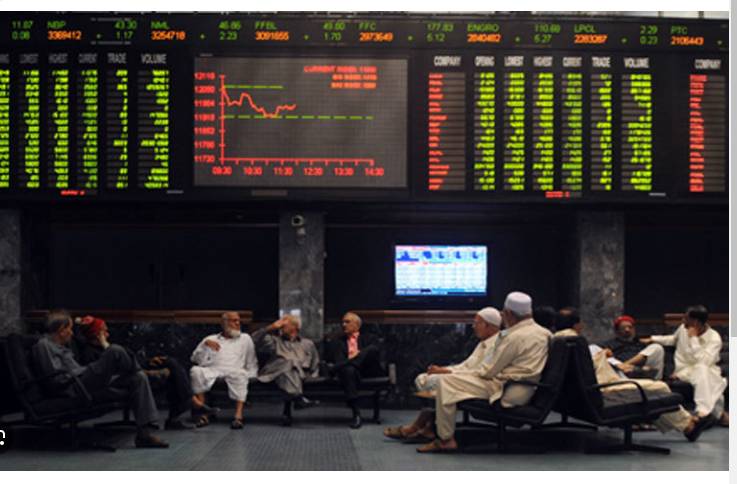

The share prices came down like a house of cards at the Pakistan Stock Exchange (PSX) on Monday with the index at one point losing over 7,000 points but later recovered some loses as the investors remained cautious due to the widening conflict in the Middle East, reported 24NewsHD TV channel.
At about midday, the PSX’s benchmark KSE-100 Index was trading at 146,828.99 points down by 5,424.52 points, marking a negative change of 3.71 percent. However, at the end of the day, the index settled at 4,864.54 points to 146,842.97 points or minus 3.31 percent.
Earlier on Friday, the Pakistan Stock Exchange witnessed a volatile trading session, with the benchmark index ending the day in the red.
At the start of the final trading day of the week, the KSE-100 Index recorded a modest gain, rising by more than 700 points to reach 153,660 points. However, the market failed to sustain the upward momentum as selling pressure emerged during intraday trading. The bearish trend persisted until the close of business.
By the end of the session, the index had dropped by 1,200 points, settling at 151,707 points.
Meanwhile, global oil prices have recorded a sharp increase with Brent crude approaching a record monthly surge as the escalating conflict in the Middle East has intensified concerns over a worldwide energy crisis.
According to international news media, Brent crude rose by $3.09 to reach $115.66 per barrel, while West Texas Intermediate (WTI) climbed to $102.56 per barrel.
Over the past month, Brent has recorded an extraordinary 59% increase, the largest monthly jump since the Gulf War in 1990.
Experts attributed the massive price rise primarily to the closure of the Strait of Hormuz, a critical passage through which roughly one-fifth of the world’s oil and gas supply transits.
The conflict’s impact has now expanded beyond the Gulf, threatening other key trade routes, including the Red Sea and Bab el-Mandeb Strait.
Tensions escalated further when Yemen’s Houthis launched attacks on Israel, extending the conflict across the broader Middle East.
In response, Saudi Arabia has rerouted its oil exports via the Yanbu port, dispatching 4.6 million barrels per day.
Reporter Kavish Memon