
Indian Army Chief’s religious visit sparks regional and global alarm
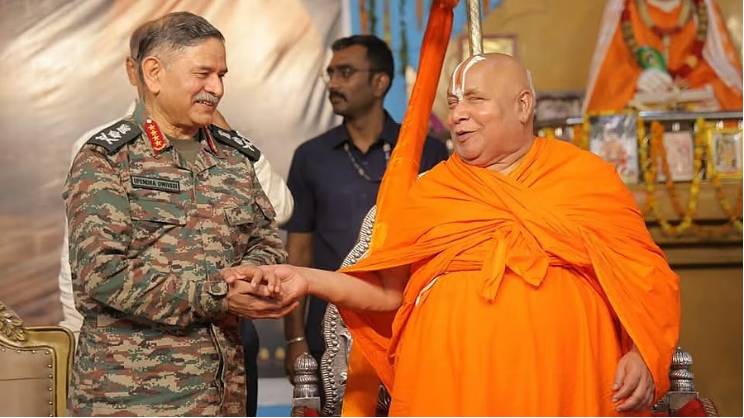

A dangerous fusion of religion and military power is beginning to surface in India as the Indian Army Chief, General Upendra Dwivedi, visited a Hindu ashram in uniform to seek a religious blessing, drawing sharp domestic and international criticism, reported 24NewsHD TV Channel on Friday.
Indian Army Chief General Dwivedi visited the ashram of Hindu spiritual leader Jagadguru Rambhadracharya in Chitrakoot, Madhya Pradesh, last Wednesday. During the visit, the Army Chief requested the “Ram Mantra," a chant believed to bring divine victory.
According to the Indian media, in a controversial turn, the spiritual leader demanded that Azad Jammu and Kashmir (AJK) be captured and offered to him as “dakshina”, or spiritual tribute. Shockingly, he claimed that the army chief accepted this request.
The spiritual leader told the media, “The Indian Army chief came to me. I gave him the Ram Mantra—the same one Hanuman received from Sita and used to win Lanka. When the time for offering came, I said, ‘I want Kashmir as my dakshina.’ He accepted it. We are ready to respond to Pakistan.”
This development has triggered a wave of backlash across India, with many criticising the Army Chief for promoting Hindutva ideology by visiting a religious site in full military uniform.
Analysts are warning that this mix of faith and force poses a direct threat to regional peace.
The incident has also raised serious questions about the impartiality of India’s military leadership, with observers highlighting the increasing religious tilt of the country’s armed forces. Critics argue that the Indian army’s open alignment with religious figures reveals the hollowness of India’s secular identity.
Adding to the concern, Indian spiritual leaders are now seen speaking in the language of aggression and war, further alarming the country’s minority communities. For many, the notion of offering Kashmir as a religious tribute violates international law and illustrates the deepening ideological extremism in India.
This symbolic call for territorial conquest from within a spiritual sanctuary is being perceived as a bold endorsement of militarised religious nationalism.
Experts suggest that the Modi government appears to be manufacturing a spiritual justification for aggressive military action, further fuelling extremism in the region.
Reporter: Ahmad Mansoor