
Historic space leap: Pakistan sends new satellite into orbit
Satellite to monitor floods, earthquakes, and urban growth: SUPARCO broadcasts launch from China to orbit live in Karachi and Islamabad: Ahsan Iqbal attends launch ceremony
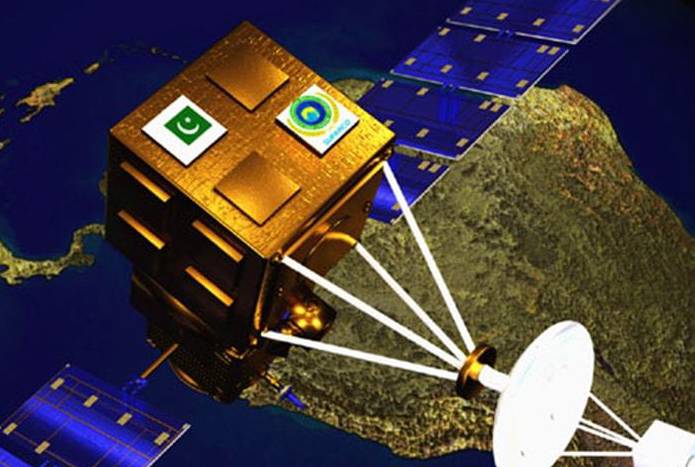

In a landmark development for its space journey, Pakistan has successfully launched a new remote sensing satellite into orbit, marking a significant advancement in its technological and disaster management capabilities.
According to the 24NewsHD TV channel, the satellite was launched from China’s Xichang Satellite Launch Centre, highlighting continued space collaboration between the two countries.
Federal Minister for Planning and Development, Ahsan Iqbal, attended the launch ceremony and hailed the achievement as a defining moment in Pakistan’s scientific and strategic progress.
Equipped with advanced Earth observation technology, the satellite is designed to provide early warnings for natural disasters such as floods, earthquakes, and landslides.
In addition, the satellite will support key sectors such as agriculture by offering valuable data on land usage and crop monitoring.
The satellite will also play a vital role in tracking urban expansion and monitoring infrastructure development across Pakistan, enabling smarter planning and disaster resilience.
To mark the occasion, Pakistan’s national space agency SUPARCO held special live broadcast events in both Karachi and Islamabad, allowing citizens and experts to witness the historic launch in real time.
China - Pakistan 🇨🇳 🛰 🇵🇰
— Pakistan Strategic Forum (@ForumStrategic) July 31, 2025
Pakistan has successfully launched an Advanced Remote Sensing Satellite from Xichang Launch Centre, China.
Satellite has been indigenously developed & designed by The Space & Upper Atmosphere Research Commission [SUPARCO]. pic.twitter.com/jw4cnILWN3
This achievement sets a new benchmark in Pakistan’s space exploration journey and expands the country's capacity for Earth observation, environmental monitoring, and national development.
According to a statement issued by the Foreign Office in Islamabad on Thursday, in a major milestone for space exploration and technological progress, Pakistan today successfully launched its Remote Sensing Satellite from the Xichang Satellite Launch Centre (XSLC) in China.
The satellite will provide high-resolution, round-the-clock imaging, significantly strengthening Pakistan’s capabilities in urban planning, infrastructure development, disaster management and mitigation, agricultural monitoring, food security, environmental protection, deforestation tracking, climate change analysis, and water resource management.
Launched by Pakistan’s national space agency, SUPARCO, in collaboration with the China Electronics Technology Group Corporation (CETC) and MICROSAT China, the satellite represents a cornerstone of an integrated Earth observation system. It is set to support sustainable socio-economic development and improve the quality of life across the country.
With this latest success, Pakistan reaffirms its position among the community of space-faring nations, leveraging innovation to pursue a more secure, sustainable, and prosperous future.
Deputy Prime Minister/Foreign Minister,Senator Mohammad Ishaq Dar, commended the dedication of the engineers, scientists, and technical teams from SUPARCO Pakistan and CETC & MICROSAT China for their exemplary cooperation and unwavering commitment to the mission.
🔊PR NO.2️⃣2️⃣2️⃣/2️⃣0️⃣2️⃣5️⃣
— Ministry of Foreign Affairs - Pakistan (@ForeignOfficePk) July 31, 2025
Pakistan Successfully Launches Remote Sensing Satellite.
🔗⬇️https://t.co/exQ1KGp4R0 pic.twitter.com/cB3wuTjiDV
Satellite launch vision of rising Pakistan in space: Ahsan
Minister for Planning, Development and Special Initiatives Professor Ahsan Iqbal on Thursday said the successful launch of the Remote Sensing Satellite was not merely a technological milestone, but a manifestation of Pakistan’s rising vision in the field of space science and technology.
Addressing the launch ceremony of Pakistan’s 4th Earth Observation Satellite, he described it as a moment that lifted the country’s national spirit and elevated friendship with China higher than the skies, beyond a technological milestone.
“Today, we have not merely launched a satellite, we have launched a vision of rising Pakistan, at the forefront of space science, powered by innovation, strengthened by global partnerships, and driven by an unshakable belief in our destiny,” he added.
Outlining an ambitious space roadmap, the minister reaffirmed Pakistan’s goal to land a spacecraft on the Moon by 2035. “With this bold goal, we aim to inspire our youth, empower our scientists, attract global talent and position Pakistan as a key player in the international space economy.”
He traced Pakistan’s space journey back to the establishment of SUPARCO in 1961, highlighting milestones including the launch of Badr-I in 1990, PakSAT-1R in 2011, PakTES-1A in 2018 and the PakSAT-MMI in 2024.
The new Earth observation satellite, he said, “is the next chapter in a proud legacy of scientific achievement.”
Pakistan’s space programme has long benefitted from strategic cooperation with China, he said adding today’s satellite launch added a new dimension to the China-Pakistan Economic Corridor (CPEC), extending the collaboration from roads and energy to the frontiers of outer space.
“From the mountains of the Karakoram to the coasts of Gwadar, Pakistan and China share a friendship described by our leaders as higher than the Himalayas, deeper than the oceans and sweeter than honey,” he said.
“Today, as we launched this satellite together, we can proudly say that our iron brotherhood now soars above the skies.”
Ahsan Iqbal thanked Chinese friends and partners for their unwavering support. “This project is a G2G success story, executed with remarkable speed and precision, a hallmark of our trusted partnership and brotherhood,” he added.
The newly launched satellite, the minister said, was designed to enhance Pakistan’s imaging and remote sensing capabilities, playing a crucial role in disaster management, food security, water resource planning, and urban development.
It is expected to support a broad range of applications, including advanced geographic information systems (GIS), agriculture optimization, and climate resilience planning.
“Our achievements in space are no longer symbolic. They are functional, practical, and central to our national development strategy. We are creating the digital infrastructure for a smarter Pakistan,” he said.
The minister also highlighted Pakistan’s growing engagement with the global space community, citing cooperation with CNSA, COSMOS International, the Asia-Pacific Space Cooperation Organization (APSCO) and the Islamic World’s Space Science and Technology Network (ISNET).
Ahsan Iqbal reaffirmed the government’s commitment to expanding the national satellite constellation, investing in space research, and advancing STEM education under the “Uraan Pakistan” initiative.
He also confirmed plans for Pakistan’s first astronaut to visit China’s space station in 2026.
“This is only the beginning,” he said, adding the global space economy was projected to exceed $1 trillion by 2040. With China’s support and our own growing expertise, Pakistan will participate in joint missions, culminating in a Pakistani spacecraft reaching the Moon by 2035,” the minister said.
Ahsan Iqbal paid tribute to the engineers, scientists and project teams who made the launch possible, saying “This milestone is your triumph.”
“To the people of Pakistan, this satellite is your symbol of hope and ambition. Great nations don’t just dream of stars, they build the rockets to reach them.”
He concluded by quoting the great national poet Allama Muhammad Iqbal “Sitaron se aage jahan aur bhi hain – There are worlds beyond the stars yet to be conquered.”
Reporters: Aqsa Sheikh, Anwer Abbas and Tayyab Saif