
Petroleum prices challenged in constitutional court, seeking cap on Rs200pl
Petitioner calls price hike unjust and a violation of Articles 3, 9 and 14 of the Constitution: Govt asked to seek cheaper fuel from Gulf states


A petition has been filed in the Federal Constitutional Court (FCC) challenging the recent rise in petroleum prices and seeking a court order to fix petrol and diesel rates at Rs200 per litre.
According to the 24NewsHD TV channel, the plea was submitted by Advocate Zulfiqar Bhutta, who named the Government of Pakistan and the Secretary of the Establishment Division as respondents.
The petition urges the court to direct the government to make efforts to import petroleum products at concessional rates from Gulf countries.
It argues that the sharp increase in fuel prices is unjust in a country already facing economic hardship.
The petitioner stated that petrol and diesel prices nearing Rs400 per litre have placed a severe burden on ordinary citizens.
He claimed that reasons such as war, the situation in the Strait of Hormuz, and commitments to the International Monetary Fund (IMF) are being used to justify the increase.
The plea further argued that the rise in fuel prices is damaging the daily lives of people and violates fundamental constitutional rights, including those related to welfare, life, and dignity.
It further claimed that the latest increase of petroleum prices violates Articles 3, 9 and 14 of the Constitution.
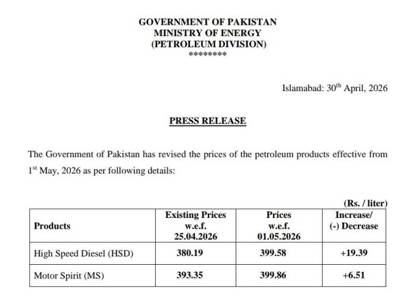
The challenge comes a day after the Ministry of Energy (Petroleum Division) announced an increase in fuel prices, effective from 1 May 2026.
Under the new rates, petrol has risen by Rs6.51 per litre to Rs399.86, while high-speed diesel has increased by Rs19.39 per litre to Rs399.58. The previous prices were Rs393.35 for petrol and Rs380.19 for diesel.
Officials said the revised prices reflect changes in global oil markets and other fiscal factors. The increase in diesel prices is expected to have a wider impact, particularly on transport and agriculture, where the fuel is widely used.
Reporter: Amanat Gishkori