
SC reserves verdict in lifetime disqualification case

The Supreme Court has reserved the verdict in the lifetime disqualification case under Article 62(1)(f) after hearing the arguments of the parties, reported 24NewsHD TV channel.
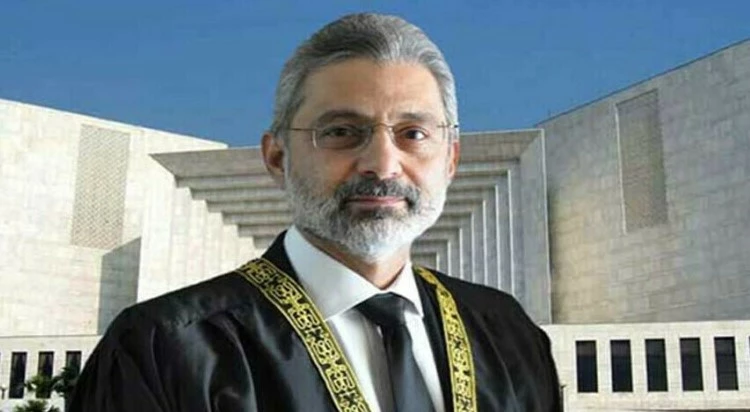
Chief Justice of Pakistan Justice Qazi Faez Isa has remarked during the hearing of the case that we are ignoring fundamental constitutional rights and history.
He expressed these remarks while hearing a set of 15 petitions to determine the period of disqualification under Article 62(1)(f), especially in light of the inconsistencies found between two constitutional provisions — one prescribing a lifetime ban while the other proposing a five-year disqualification period. The court will decide whether the 2018 Samiullah Baloch case, or the 2023 amendments to the Elections Act 2017 that reduced the ineligibility period to five years, will prevail.
The case of interpretation of Article 62(1)(f) of the Constitution was heard by a 7-member bench of the Supreme Court headed by Chief Justice Qazi Faez Isa, and comprising Justice Syed Mansoor Ali Shah, Justice Yahya Afridi, Justice Aminuddin Khan, Justice Jamal Khan Mandokhail, Justice Muhammad Ali Mazhar and Justice Musarrat Hilali.
Proceedings were being broadcast live on SC's website and YouTube channel.
The fate of many politicians, including Pakistan Muslim League-Nawaz (PML-N) supremo Nawaz Sharif and Istehkam-e-Pakistan Party (IPP) founder Jahangir Tareen, hinges on the verdict of the apex court which will determine whether they could participate in the upcoming polls or not.
In its hearing on Jan 2, Chief Justice Isa advised against assuming that a particular party was being favoured.
Today’s hearing
Today, Jehangir Tareen’s lawyer Makhdoom Ali Khan presented his arguments.
At the outset of the hearing, the Chief Justice of Pakistan remarked that we have decided that we would not hear the individual case related to the elections, we would hear the case related to the constitutional interpretation, the individual cases related to the elections would be heard in another bench next week and we would form another bench for those cases.
Chief Justice Isa said that we issued a public notice in the disqualification case, but no political party became a party. He said that nobody cares about the people. “If the country is destroyed, no one cares. One mistake in nomination papers, renders a person disqualified for life.”
The top judge observed why are we limiting ourselves to only one specific part of the constitution and its language? Why are we ignoring constitutional history, fundamental rights? What remaining rights have been taken away by the insertion of certain new clauses? Only one general put the clause of 62(1)(f), then we all became bound?
Presenting his arguments, Makhdoom Ali Khan said that the main case before the Supreme Court is the Samiullah Baloch case of the same court. He said that the Supreme Court Bar Association also raised a question in the Samiullah Baloch case.
Justice Mansoor Ali Shah inquired of the lawyer that according to you the declaration of disqualification would come from the civil court? To which the lawyer said that yes, the declaration would come from the civil court. A civil court decision does not take away any fundamental constitutional right for life. He said he did not find any such example from the common law. One becomes eligible when his outstanding utility bill is paid.
Justice Muhammad Ali Mazhar inquired whether Articles 62 and 63 would be applied after or before the election.
The Chief Justice said that we should not limit ourselves to the provisions of the Constitution. The entire constitution has to be looked at. We are ignoring fundamental constitutional rights, constitutional history. Transparent trial, basic education is also a part of the constitution. We have started to discuss Ayub Khan's intrusion. It should not be ignored what happened. I cannot ignore the history of Pakistan, the top judge said.
The Chief Justice remarked that destroying the country is punishable by five years. A minor mistake in nomination papers carries a life sentence. We are still stuck on the language of the constitutional provision.
Jahangir Tareen's lawyer Makhdoom Ali Khan said that in 1985, Article 62(1)(f) was made a part of the Constitution. Article 62 and 63 are now merged. Article 62 cannot be seen without Article 63.
Justice Jamal Mandokhel inquired whether the civil court could give a declaration of disqualification, to which the lawyer said that the civil court could not give such a declaration. What civil court is there which could tell someone that he is not honest and trustworthy because his dues are outstanding.
Justice Mansoor Ali Shah asked whether the period of disqualification on declaration could be fixed by legislation, to which the lawyer said that there is a court of law in the constitution which includes both civil and criminal courts. Yesterday, Justice Musrat Hilali asked what was the reason for keeping Article 62 and 63 separately. Eligibility and ineligibility are kept separate.
The Chief Justice said that we can do whatever we want. Do you believe that the best parliamentarians in the world are from Pakistan? It's not like I'm not disrespecting anyone. Is there such a qualification for members of assembly anywhere in the world? The lawyer said that there is no such qualification standard anywhere in the world.
Justice Mansoor Ali Shah said that h is looking at the Constitution after the 18th Amendment. The words can be disputed but I do not have the power to ignore every word of the constitution. Every word of the constitution is important, the judge said.
The Chief Justice remarked that the Supreme Court interpreted through the judgment. The constitution has not written what the criteria of disqualification would be. This will be the period determined by the court decision. If a person commits murder, gives blood money (diyat) to the next of kin, he can submit nomination papers, the CJP observed.
The lawyer said that the election tribunal could also declare the entire election null and void. Penalty for corrupt practice in election is two years.
Justice Jamal Mandokhel remarked that if someone commits fraud, his opponent files an FIR. Is the punishment for life?
The Chief Justice said ‘when the constitution itself has determined the disqualification, then it is right. In the NAB law, the punishment was 10 years. Constitution is not for lawyers but for the people of Pakistan. Simplify the constitution. Don't make the constitution so difficult that you lose people's confidence. Talk simply rather than philosophically’.
Justice Jamal Mandokhel said that let the people decide who is true and who is honest. Justice Musrat Hilali said that because of a specific case, why should the people of the constituency be deprived of their representative.
Justice Mansoor Ali Shah said that the issue of fixing the disqualification period of 5 years came to the court, can we read down Article 232 (3). Justice Jamal Mandokhel said that this is a very doubtful theory. Justice Mansoor Ali Shah said that can the court say that the parliament should fix 232 (3) in such a way that if the degree is obtained from the civil court, the punishment would be 5 years.
Lawyer Makhdoom Ali Khan said that the Supreme Court is hearing appeals under Section 185. 232 (3) may be abolished by the next Parliament. The court has to decide whether the Samiullah Baloch case was correct or not. If the Samiullah Baloch case is declared null and void, then the law would apply.
Justice Muhammad Ali Mazhar said that how we should declare Section 232 (2) null and void is not before us, to which the lawyer said that the rule of lifetime disqualification was decided by the court decision. Justice Yahya Afridi remarked that he does not think the judgment mentions life, to which the lawyer said that the judgment said disqualification would remain as long as the declaration remained.
Justice Aminuddin Khan inquired that if the court interprets the declaration itself, would the problem be solved, to which the lawyer said that how could the court review the declaration which has become part of the past? Cases which have become final after litigation cannot be reopened, he added.
Justice Mansoor Ali Shah asked that if the declaration has been finalized, what would be its effects on the election?
Justice Jamal Khan Mandokhel said that what do you think about the Faisal Vawda case? Justice Mansoor Ali Shah said that there was no declaration. The Chief Justice remarked that when the Parliament fixed the period of disqualification, this question became an academic question as to what the period of disqualification would be.
Justice Mansoor Ali Shah said that if the Samiullah Baloch decision is annulled, how much would the punishment be? The Chief Justice said that Parliament has said that the disqualification would be for five years. The CJP inquired if the notice was given to the Attorney General in the Samiullah Baloch case? Order the record, he said.
Justice Mansoor Ali Shah said that according to judicial assistant, the decision of Samiullah Baloch was nullified, on which the lawyer said that the Supreme Court should only look at the decision of the Samiullah Baloch case. Section 232 (3) was not challenged.
Lawyer Makhdoom Ali Khan said that if a law is invalid in America, Congress makes a new law. The US Congress convinces its court to reconsider its decision. The Chief Justice inquired that you want the court to withdraw the decision of lifelong disqualification, to which the lawyer said that the period cannot be reduced until the decision of lifetime disqualification is returned.
Justice Muhammad Ali Mazhar said that the period of declaration has been made 5 years by legislation, to which the lawyer said that the period of disqualification should be for a reasonable time, not for life. If someone challenges the law then the court will see it.
The Chief Justice said that the whole of Pakistan is happy with the 5-year disqualification period law. No one challenged the law.
Lawyer Makhdoom Ali Khan said that the Samiullah Baloch verdict should be cancelled because he was deprived of fundamental rights. Justice Muhammad Ali Mazhar said that can we say that the period of declaration is 5 years, to which the lawyer said that when the law is challenged, the court can see it. Justice Mansoor Ali Shah said whether a constitutional provision can be regulated by common law? The Chief Justice remarked that the practice and procedure case has laid down principles that can be regulated by law.
Lawyer Makhdoom Ali Khan said in his arguments that PTI founder was not disqualified. If you look at the cases of Shakeel Awan, Khawaja Asif, Sheikh Rashid, the judges who wrote the judgment of disqualification kept changing their positions gradually. Justice Jamal Mandokhel inquired if there is anything in Samiullah Baloch case in Sanaullah Baloch case who has been disqualified for life?
The Chief Justice remarked that whether the declaration was abolished? On which the lawyer said that there is no such example. Justice Jamal Mandokhel inquired whether anything was said for Sanaullah Baloch in the Samiullah Baloch case, to which the lawyer said that Nawaz Sharif was disqualified. The Chief Justice remarked that no one should be named. The lawyer said that the disqualification was done by resorting to taking salary.
The Chief Justice said that they should not talk about what is in front of us. A lawyer does not fight a case for which he has not received a fee. Jahangir Tareen's lawyer Makhdoom Ali Khan completed his arguments.
The petitioner's lawyer said that everyone will be righteous and honest till the court decision. One or two mistakes cannot make someone dishonest. Even if there is a mistake, a period of 5 years has been fixed. No such declaration has come till date that one is not honest and trustworthy. Criminals cannot be called honest and trustworthy. Declaration of disqualification can be given only after recording evidence. Supreme Court and High Court cannot disqualify anyone.
Later, the court adjourned for Friday prayers. The Chief Justice said that he will listen to the Attorney General after Friday prayers.
After the prayer break, when the court resumed hearing the case, the attorney general presented his arguments.
After hearing arguments of lawyers, the Supreme Court reserved its verdict on the lifelong disqualification under Article 62(1)(f). The Chief Justice remarked that he would not announce the short order of the verdict today but the court would try to announce it at the earliest.
Reporter Amanat Gishkori