
India fast-tracks four hydropower projects on Chenab River
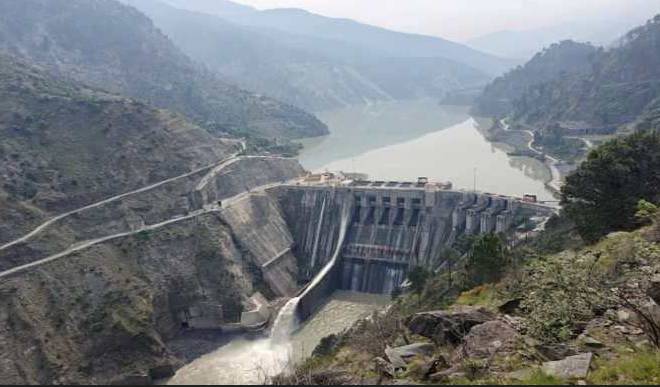

India’s choke on Pakistan’s water lifeline is no longer a distant strategic idea as it is now taking concrete shape with officials have been asked to commission the Pakal Dul and Kiru projects by December 2026, complete the Kwar project by March 2028, and accelerate construction on Ratle dam, reported Indian website news18.com on Tuesday.
In a clear signal of defiance of internationally-recognized Indus Waters Treaty (IWT), the BJP government has issued firm directions to fast-track four major hydropower projects on the Chenab river system.
Indian officials have been asked to commission the Pakal Dul and Kiru projects by December 2026, complete the Kwar project by March 2028, and accelerate construction on the strategically sensitive Ratle dam. The push follows a two-day ground inspection by Power Minister Manohar Lal Khattar, who reviewed progress on multiple dam sites in Occupied Jammu and Kashmir, underlining that deadlines will now be strictly enforced.
This is happening amidst Pakistan seeking clarification from India about the Indus Waters Treaty (IWT).
Addressing a news conference in Islamabad on Thursday last, Foreign Office spokesperson Tahir Hussain Andarabi had said Pakistan has formally sought a response from India on the implementation of the Indus Waters Treaty, as the Pakistani Indus Waters Commissioner has sent a set of questions to his Indian counterpart.
The spokesperson urged all parties to avoid actions that could heighten regional tensions, reiterating Pakistan’s commitment to restraint and dialogue on sensitive regional issues.
Also Read: Pakistan awaits Indian response on Indus Water Treaty queries
According to the Indian website, at stake is far more than electricity generation. The Chenab is part of the Indus basin — Pakistan’s lifeline. Nearly three-fourth of Pakistan’s water originates from the western rivers that flow from India into Pakistan. Over 90 percent of Pakistan’s agriculture depends on this basin, and almost the entire network of its dams and canals is built around it.
The most consequential of the projects is the Pakal Dul hydropower project in Kishtwar. At 1,000 MW, it is the largest project in the Chenab basin and, at 167 metres, the highest dam in India. Crucially, it is India’s first storage project on a western river that flows into Pakistan. Built on a tributary of the Chenab, the project was inaugurated by Prime Minister Narendra Modi in May 2018. With the Indus Waters Treaty effectively in abeyance, the Indian government has now ordered that Pakal Dul be commissioned by December 2026. Once operational, it will give India the ability not just to generate power, but to regulate the timing of water flows — a capability Pakistan has long viewed with concern.
Running parallel is the Kiru project, also located in Kishtwar district. The Kiru dam, rising 135 metres on the Chenab, is a run-of-the-river project, but its strategic value lies in how it fits into a chain of projects upstream and downstream. India has set the same December 2026 deadline for Kiru, making it clear that both projects are expected to come online together.
The third is the Kwar project, another run-of-the-river dam on the Chenab with a height of 109 metres. A major engineering milestone was achieved in January 2024 when the Chenab was successfully diverted to enable construction. That diversion was closely tracked in Pakistan. The Indian government has now directed that Kwar be commissioned by March 2028, locking in a firm timeline.
Then there is the Ratle project, perhaps the most contentious of them all. The 850 MW project involves a 133-metre-high dam on the Chenab and has been opposed by Pakistan for years, particularly over the design of its spillways. During his recent visit, the Power Minister laid the foundation stone for the dam’s concreting works, signalling that Ratle is now being fast-tracked. The Chenab was diverted through tunnels for this project in 2024, and the dam is expected to be ready by 2028.
Beyond these headline projects, India is also moving ahead with Dulhasti Stage-2 on the Chenab. The project received clearance from the Environment Ministry’s panel last December and will come up after Dulhasti-I, which is already operational. Pakistan has recently objected to this clearance as well, arguing it was not informed — an objection India has rejected.