
Armed Forces defeated enemy five times bigger than Pakistan: DG ISPR
Highlights 10 strategic consequences of Marka-e-Haq at joint press conference: Says only a madman thinks of nuclear war between two neighbours: India is the biggest terrorist while Pakistan is the biggest ambassador of security in region: Accuses India of sponsoring terrorism inside Pakistan through Afghanistan: Announces major display of military capability during Aug 14 parade: Says world witnessed not even 10% of our full military strength during Marka-e-Haq: Rear Admiral Shafaat says Indian fleet avoided direct aggression during war: Air Vice Marshal Ghazi highlights multi-domain defence strategy: Claims downing of eight Indian jets during war
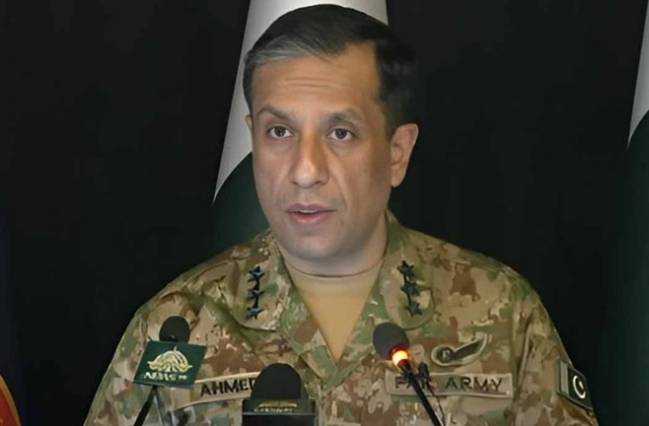

On completion of one year of Marka-e-Haq, Inter-Services Public Relations (ISPR) Director General (DG) Lieutenant General Ahmed Sharif Chaudhry along with senior Air Force and Navy officers address a joint press conference in Rawalpindi on Thursday, reported 24NewsHD TV channel.
Deputy chief of Naval Staff (Operations) Rear Admiral Shafaat Ali and Deputy Chief of Air Staff (Projects) Air Vice Marshal Tariq Ghazi were also present alongside him.
At the start of the presser, the DG ISPR said during Marka-e-Haq the military had defeated an enemy which was five times bigger than Pakistan.
Congratulating the nation on the one-year anniversary of Marka-e-Haq, the DG ISPR said Pakistan’s armed forces had risen to the nation’s expectations and defeated a much larger enemy with multi-domain operations.
He said there were 10 strategic consequences of Marka-e-Haq, the first of which was that the Indian narrative of painting Pakistan as a source of terrorism stood buried. He said an attempt had been made to portray, without evidence, that Pakistan had perpetrated terrorism in India.
The DG ISPR said it had been one year since the Pahalgam incident, yet the questions that Pakistan had asked remain unanswered. “Where is the evidence?” Nobody buys this … you are the biggest terrorist. Nobody listens to them, nobody believes them,” he added.
Chaudhry said the second consequence was the consolidation of Pakistan as the net security stabilizer in the region, saying Marka-e-Haq showed who was controlling and dominating the escalation, adding India escalated the conflict based on a lie.
The DG ISPR said the“biggest ambassador of security in the region” was Pakistan and its leadership.
About the third strategic consequence of Marka-e-Haq, Chaudhry said it was related to “our eastern neighbour, unfortunately”, saying it was the “politicization of Indian military leadership and militarization of Indian political leadership.”
“This is what’s happening over there,” the DG ISPR said, adding India’s military, which used to be professional, had unfortunately been politicized. “You will come across several examples of this,” he added. “You heard their air chief marshal a few months after Marka-e-Haq saying ‘I got to know today that even we downed some planes’ … That is politicization of the military leadership … Why are you trying to make jokers out of your admirals, and generals and marshal? Don’t do that.”
On the other hand, Chaudhry continued, “We have placed the facts as they are.”
Chaudhry said Indian politicians appeared more like “warmongers”, going by their statements. He said the politicization of the military and militarization of politics was “dangerous”.
Moving on to the fourth strategic consequence, the DG ISPR said it was the global acknowledgement of Indian efforts to externalise their internal problems and internalise their external problems while using terrorism as a state tool.

Chaudhry said India’s internal problems included the repression of minorities and Kashmiris. He said India did not want to solve its internal issues, and was externalizing them by levelling allegations that Pakistan was behind terrorism in the neighbouring country. He said these issues needed to be addressed “politically and internally”.
“Kashmir is an internationally recognised dispute,” he said and added “It’s not your internal problem for you to make demographic changes there … you cannot do that.”
The seventh consequence was Pakistan’s proven potential and the resilience to combat multifaceted challenges, he said and added, the eighth was the loud and clear establishment of deterrence.
Chaudhry said “Anyone who thinks there is space for war between two nuclear neighbours is crazy. That is madness. Only a madman can think about. You want to do it, then there should be no doubt about our resolve.”
The DG ISPR said the ninth consequence was that Pakistan was recognised as a geopolitically significant and responsible middle power.
Chaudhry said the last, but most important consequence, was the unshakeable synergy between the people, the government and the armed forces of Pakistan, which they call the Bunyanum Marsoos effect.
Chaudhry accused India of supporting terrorism inside Pakistan through Afghanistan, saying that militant groups were being used to destabilise the country after India’s recent military setbacks. He said the Afghan Taliban regime had developed close ties with those promoting Hindutva ideology.
The DG ISPR stated that individuals associated with “Fitna al-Hindustan” had no connection with the people of Balochistan. He said the armed groups were being supported and directed from outside Pakistan.
Referring to militant violence, he said that outlawed leader Noor Wali was misleading people in the name of Islam in Afghanistan. He added that incidents of terrorism had declined following the launch of Operation Ghazab-ul-Haq.
Lt Gen Chaudhry further claimed that India was angered by its defeat and was therefore relying on militant groups, including “Fitna al-Hindustan” and “Fitna al-Khawarij”, to create unrest in Pakistan.
The military spokesman also announced that a large-scale parade would be held on August 14 to mark Pakistan’s Independence Day. He said the event would provide a demonstration of the country’s military capabilities.
He claimed that what the world witnessed during “Marka-e-Haq” represented “not even 10 percent” of Pakistan’s full military strength.
“Our Army, Air Force and Navy possess far greater potential,” he said, adding that Pakistan’s armed forces were fully prepared to respond to any challenge.
Addressing a joint press conference, the Deputy Chief of Naval Staff Rear Admiral Shafaat Ali said the Indian Navy had attempted several times to position its fleet during the confrontation but did not show the courage to launch any aggressive action.
He stated that Pakistan’s ports remained fully functional throughout the tensions and that all coastal installations stayed secure. He also accused India of issuing unnecessary statements in an effort to overcome embarrassment following the standoff.
PAF claims downing of eight Indian fighter jets during war
Speaking at the same briefing, the Deputy Chief of Air Staff, Air Vice Marshal Tariq Ghazi, said the Pakistan Air Force had closely monitored every movement by the opposing side during the conflict.
He stated that the armed forces had established coordinated guidance under tri-service operational planning involving the Army, Navy and Air Force.
The air force official further claimed that the enemy did not dare approach close to Pakistan’s borders during the confrontation.
He added that the Pakistan Air Force had, for the first time, successfully integrated multi-domain operations as part of its defence strategy during the conflict.
He also claimed that eight Indian fighter aircraft were shot down during recent military tensions, while warning that any future conflict between the two countries would likely take a different form.
Ghazi said the Pakistan Air Force cyberforce had targeted Indian data centres during the confrontation. He also claimed that four Indian Rafale fighter jets attempted to enter the Kashmir region on April 29.
He disclosed Pakistan had also shot down an unmanned Indian aircraft during the Marka-e-Haq, while other aircraft brought down included four Rafale jets, one Sukhoi SU-30, one MiG-29 and one Mirage fighter aircraft.
Referring to the alleged losses, heremarked that Pakistan could now say the “score stands at eight-nil”.
The Deputy Chief of Air Staff also warned that the recent confrontation should not be considered the final war between the two countries.