
War, Pre-War, and After-War Effects

War itself is a burdened plight,
How can it ever make things right?
Today it rains down fire and blood,
Tomorrow comes the hunger flood.
So, O noble hearts, be wise—
Let war be stopped, let peace arise.
In every home, on every night,
Let peaceful lamps keep burning bright.
If I’m not mistaken, it was March 2003 when U.S. forces invaded Iraq with the intention of eliminating weapons of mass destruction and ending Saddam Hussein’s regime. I was a preteen at the time, sitting in a regular classroom, when our English teacher, Ma’am Summaya, suddenly entered and informed us about the outbreak of war. The shock was immediate and unsettling. In those days, social media wasn’t prevalent, so teachers and students alike relied on television for updates. I still remember the anxiety that filled the school corridors as everyone tried to comprehend what was unfolding.
When I returned home that day, I witnessed a different kind of silence—one that spoke louder than words. My father, Rafique Ghouri, was sitting in front of the television, a cigar in his hand. The smoke lingered in the air, creating a thick, eerie atmosphere. He kept changing news channels in a frenzy, hoping to find something reassuring, but in vain. Over the next many years, these headlines remained an essential part of our lives. Saddam Hussein was eventually captured, tried, and executed. Over 4,700 U.S. and allied troops died, and more than 100,000 innocent Iraqi civilians lost their lives. That war, like so many others, left behind a trail of trauma and irreversible damage.
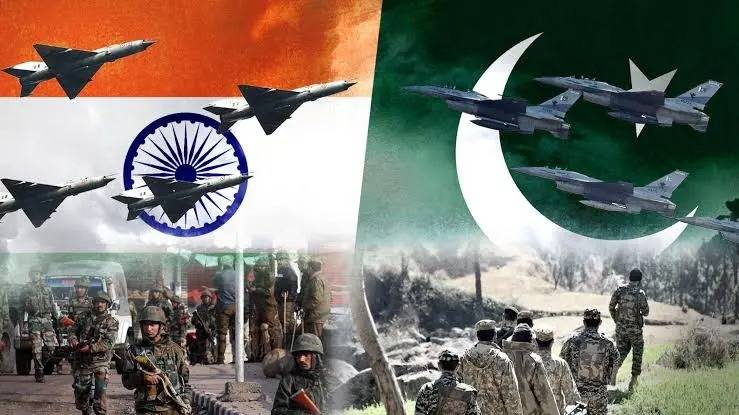
Today, more than two decades later, I found myself reliving that memory. A simple notification in a school parents’ group read: “Please be informed, as per government notification, the school will remain closed on 7 May 2025.” While the message seemed routine on the surface, the tension surrounding rising hostilities and threats of conflict between India and Pakistan sent a chill down my spine. From my own childhood, I’ve come to understand that war doesn’t just destroy buildings or borders—it destroys the minds of children. Exposure to such terror can leave lasting psychological scars, including post-traumatic stress disorder, anxiety, and depression. Children, in their struggle to make sense of violence, may lose their sense of meaning, morality, and safety.
I’ve always had a fascination with history, and at the age of 12, I read Tuzk-e-Timuri, the supposed autobiography of Tamerlane (Timur). He was a military genius, but also one of the most feared conquerors of his time. His invasions across Persia, the Middle East, and Central Asia were brutal and deadly. Despite his cruelty, Timur claimed he would spare women, children, and religious leaders if a city surrendered without resistance. Whether this was a moral code or just a tactic, it showed a contrast to modern warfare, where such distinctions no longer exist. Today, bombs don’t differentiate between soldiers and civilians. Technology has made war even more ruthless.
One only needs to recall Hiroshima and Nagasaki. In 1945, when the atomic bomb exploded over Hiroshima, the temperature rose to 4,000 degrees Celsius in a fraction of a second. Within moments, the entire city was reduced to ash. Nearly 100,000 people were vaporised instantly, their existence erased. The few who survived were left with horrifying injuries and memories that haunted them forever. That is the real face of war—not the glamorised version shown in movies or turned into jokes on social media.
Sadly, in today’s world, war has been reduced to memes and sarcastic phrases—especially on social platforms. Yet today, many treat war like entertainment. Sarcastic phrases and memes are circulated as if conflict is a joke. And these come from people who’ve never even witnessed a minor street riot—let alone the horrors of actual war.
War is not a joke. It is not a meme. It is not content.
Wars turn lands into wastelands. They bury dreams, erase childhoods, and silence futures. Look at Iraq. Syria. Afghanistan. Palestine. Libya.
Ruins. Orphans. Widows. Wounded generations.
A UN report revealed:
Over six million Iraqis were displaced. More than 500,000 lives lost in Syria and Gaza are bleeding before our very eyes.
As Plato once said:
“Only the dead have seen the end of war.”
The purpose of writing this is simple:
To remind everyone that war is destruction, not glory.
It is loss, not laughter.
It is silence, not songs of victory.
Let us not make war a joke.
Let us choose peace before another child loses their innocence forever.