
Army blames governance gaps, NAP non-implementation for rise in terrorism in KP
DG ISPR says nexus behind terrorism in KP has local and political backing: DG ISPR says national institutions will not be influenced by political gimmickry in KP: Warns against politicising terrorism: Says not in Punjab or Sindh, but 70% of recent terror attacks occurred in KP: Facilitators of Khawarij face 3 choices—surrender, help to eliminate terrorism, or be ready for state action: Old status quo will no longer be tolerated: Demands Afghan govt to prevent its territory from becoming a launchpad for terrorists: Keep army out of cheap politics
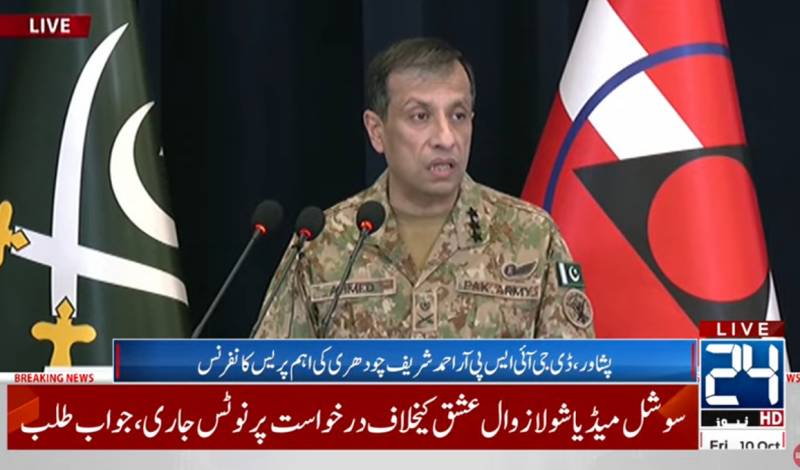

Inter-Services Public Relations (ISPR) Director General Lt-General Ahmed Sharif Chaudhry has declared that the nexus behind the terrorism in Khyber Pakhtunkhwa has the local nad political backing, reported 24NewsHD TV channel.
Addressing a news conference at Corps Headquarters in Peshawar on Friday, the DG ISPR blamed the rise in terrorist incidents in KP due to governance gaps and the lack of implementation on the National Action Plan (NAP).
He also maintained that the solution to every problem does not lie in talks.
The DG ISPR has said that national institutions will not be influenced by any political gimmickry, asserting that the recent wave of terrorism in Khyber Pakhtunkhwa (KP) stems from a nexus of political and criminal elements.
The DG ISPR stated that the network behind terrorism enjoys both local and political backing. He said that attempts have been made to weaken counterterrorism operations through misleading narratives. Under a calculated plan, space was provided to terrorists and their facilitators, while the issue of terrorism was politicised to confuse the nation.
The DG ISPR reaffirmed the resolve to uproot terrorism completely, saying that the people of Khyber Pakhtunkhwa are bravely standing against this menace. He added that instead of improving governance and law and order in KP, ambiguity has been created, and the gap in governance is now being filled by the blood of martyrs.
He questioned why terrorist incidents are not happening in Sindh and Punjab, while 70 percent of all such incidents in the past three months have occurred in Khyber Pakhtunkhwa. The reason, he emphasised, is the political and criminal nexus fuelling terrorism in the province.
The DG ISPR said that the increase in terrorism is due to the incomplete implementation of the National Action Plan, adding that the previous government had even deleted certain key points from it.
He revealed that in 2024, more than 14,500 operations were conducted in Khyber Pakhtunkhwa, while over 10,000 operations have already been carried out in 2025 so far. Following the APC Peshawar incident, coordinated counterterrorism measures were launched, and the number of foreign militants killed this year is the highest in the past decade.
He further said that India is using Afghanistan as a base to sponsor terrorism against Pakistan. There are safe havens for terrorists in Afghanistan, and the flow of American weapons into the hands of these groups has also fuelled terrorism. He noted that new narratives are being constructed around the repatriation of Afghan refugees.
The DG ISPR said that those who facilitate foreign militants face three options: they can hand the foreigners over to the state, they can join the state in rooting out this malignancy, or, if they choose to stand with the extremists, they must be prepared for the state’s action.
The DG ISPR warned that the security of the public cannot be left at the mercy of any other country, particularly Afghanistan, and said that extremists and their facilitators, regardless of the positions they hold, will be squeezed until there is no safe space for them; the old status quo will no longer be tolerated.
He urged the Afghan government to prevent its territory from becoming a launchpad for terrorists, warning that if smuggling continues, it will bring terrorists and explosive materials along with it.
The DG ISPR clarified that Afghanistan is being used as a base camp for terrorism directed against Pakistan, and therefore Pakistan will take whatever measures are necessary to protect the lives and property of its people. He added that Saudi Arabia and other countries have also attempted to persuade Afghanistan to act.
He further stated that every terror group has some branch or presence inside Afghanistan and compared terrorist elements to snakes, saying no one who raises a snake can ever truly trust it.
The DG ISPR questioned, "Who is saying not to take action against terrorists and to hold talks, and who is it that says that Kabul will guarantee Pakistan's security? Although that person held talks, you have seen his solution, so it is confirmed that terrorists have no religion or faith."
The DG ISPR said that efforts are underway to jointly strengthen national institutions and that work on this front is continuing.
Dawn
He urged that the Pakistan Army be kept away from rhetoric and political manoeuvring, warning that the military should not be dragged into degrading politics or politicised narratives.
The DG ISPR clarified that the army’s process of self-accountability does not operate on mere allegations and that delays in holding field general court-martials are of no concern so long as the demands of justice are met.
He noted that the trial of a former DG ISI is currently underway and described the matter as extremely sensitive, governed by a legal procedure; he criticised those who use microphones to craft narratives morning and night rather than allowing due process to run its course.
Talking about factors behind rise of militancy, DG ISPR said that there were several factors that led to this situation.
First reason, he said, was not fully implementing the National Action Plan, followed by politicising the issue of terrorism, India using Afghanistan as a base of operation for terrorism in Pakistan, the provision of modern weapons to terrorists in Afghanistan and the existence of a terrorism-crime nexus that had complete local and political backing.
Going back to the 2014 APS attack, he said all political parties, and the provincial and federal government devised the NAP. He said all political parties agreed that the implementation of the NAP was necessary for eliminating terrorism.
But, he added, the then-government removed some provisions of the plan in 2021 despite progress in those areas and came up with the revised NAP. All political parties, provincial governments and the federal government then agreed to the full implement all 14 points of the revised plan, he said.
Pointing to a graphic of the plan on the screen, he said the first point concerned kinetic operations.
He asserted that the empirical evidence demonstrated that work was being done on the first point of the NAP. He then went on to question the work being done on the remaining 13 points.
“Today, are we all standing under one narrative? Do you not hear voices calling for talks with these terrorists? Are we following this a NAP?
“Does the solution to all problems lie in dialogue? You tell me. If the solution for every problem is in dialogue, then when India fired missiles on Pakistan on May 6 and 7 why didn’t the people of this country say let’s hold talks?.
DG ISPR said if the solution lay in just holding dialogue, there would be no wars.
He said it had been decided to break the terror-crime nexus in order to eradicate terrorism. Moreover, he said, it had also been decided to strengthen the judiciary with regard to counter-terrorism cases. The DG ISPR detailed the cases in anti-terrorism courts in KP. He said that no one was convicted, while 34 cases were pending. He said this is the judicial system that was to be strengthened. The political government of the time decided it, we did not?. The DG ISPR further stated that the decision had been made to strengthen KP police. Noting that the provincial police was currently 3,200-personnel strong, he asked: “ The terrorism (situation) is before you all. Is this [number] enough?“
The army spokesperson also noted that the repatriation of Afghan refugees from Pakistan was being politicised. He claimed misleading things were said when these decisions were taken. He said that after the US left Afghanistan in 2021, they left behind weapons and ammunition that are now being used by terrorists. Those weapons were found in the custody of terrorists killed in operations in KP.
During the press conference, the DG ISPR was also asked about media reports alleging a strike was carried out in Kabul last night to eliminate the banned terror outfit Tehreek-i-Taliban Pakistan’s (TTP) leader Noor Wali Mehsud.
In his response, he said the army had taken note of the reports circulating on social media and the statement issued by the Taliban spokesperson.
He said Afghanistan is a neighbourly, Islamic country. We have historical and cultural connections. Pakistan has hosted Afghan refugees for four decades. The DG ISPR urged the Afghan government not to allow your soil to be used for terrorism against Pakistan.
He pointed out that trade between Pakistan and Afghanistan was also continuing, and many Afghans came to Pakistan for medical reasons. “So we only have an extremely fair demand: don’t let your soil be used by non-state actors and terrorist groups.” “Is it wrong to ask? It is absolutely fair, it is correct, it is rational, it is our right. And for this, we also engage them at multiple levels,” he said, highlighting several bilateral and multilateral engagements.
“Yes, we do engage them and we clearly communicate that these are the terrorist leaders, their facilitators and their centres in Afghanistan. Yes, we engage [with Afghanistan], but at the same time, we are doing and will continue to do whatever is necessary to protect the lives of Pakistan’s people and its territorial integrity,” the DG ISPR continued.
The DG ISPR said, “I have made it clear that Afghanistan is being used as a base of operations for carrying out terrorism in Pakistan. There is also evidence of this. And I have also said that all the necessary steps for protecting the people’s lives and property are being taken and will continue to be taken.”
Talking about the Saudi defence deal and whether the kingdom could be engaged in the talks with Afghanistan to resolve the issue of cross-border militancy, the DG ISPR said that Pakistan continued to engage the country and its other allies even before the pact.
“We engage the Afghans directly at multiple levels and also through allied countries such as Saudi Arabia, UAE, China, US, Turkiye and many more. They all understand that the space being given to non-state actors in Afghanistan is not just against Pakistan.”
He said non-state actors was found in Afghanistan, pointing to various groups such as the TTP, IS-K, BLA and more.
DG Sharif Chaudhry said these terrorists had no affiliation or religious or cultural identity and were available to the highest bidder.
He said the Afghan authorities had to decide whether they would allow Afghanistan to become a sanctuary for terrorists or not, adding that history showed that nurturing such groups often led to them turning on their benefactors.
DG ISPR said such groups were a threat to Afghanistan and its people as well. He said Pakistan’s job was to engage the Afghan authorities and take necessary action to defend and protect the lives of its people.
To a question about an international coalition to strike terrorist havens in Afghanistan, he said while such consultations and engagement continued, “we know that your security cannot be granted by external players, while we keep on engaging them, the responsibility to protect your life and property and people is of Pakistan’s state and institutions and military and that is where our first and foremost focus is.’’
To a question about past engagement with the TTP and the change in the KP leadership that saw Ali Amin Gandapur stepping down as chief minister, the DG ISPR said: “Who is saying today that there should be talks and not operations against them (terrorists). Where is this voice coming from? Who is saying this? Who is that person who is carrying out this whole campaign of talk to them and stop operations.
DG ISPR further said that, ‘‘Who is saying that he cannot accept his provincial government that does not stand against operations. It is for everyone to see that today, or five years back or six or seven or eight or in any timeframe, who is that person and political thought that says there should be talks with terrorists.’’
DG Ahmed Sharif Ch said the person saying so was responsible for the state in the past but now he was not and yet he still persisted with his stance.
“It is absolutely clear that this stance and confusing the people through it that the solution to this problem is not in counterterrorism or operations but in talking to the people who slaughtered your children is for everyone to see.’’
He said the army, police and children were paying the price for the above ‘perverted and criminal thinking.
Ahmed Sharif Chaudhry said talks were indeed engaged in but questioned what was the result of it all, pointing to the Afghan Taliban’s promises in the Doha peace talks and their failure to abide by them.
To a question about the court martial proceedings against former spymaster retired Lt Gen Faiz Hameed, DG Ahmed Sharif Chaudhry said that legal process was ongoing and will come to its logical and just conclusion.
To another question about an alleged delay in the court martial proceedings, DG ISPR said the matter concerned a former intelligence chief and hence the gravity of the matter was high.
He said the state and the institution has to be absolutely and deliberately correct in that. All the requirements of procedure, process and justice have to be met because you would not like to try such an important and critical case in hurry and haste.
DG ISPR said Pakistan Army’s system of internal accountability does not work off allegations but facts and evidence. There is a process to it and anybody who is charged is given complete rights to defend himself and that time will be given and is being given so we are not worried about any delay because we have to fulfil all the requirements of justice and process.
He said another reason for the court martial proceedings was that ‘‘when you turn a relation into a political and personal relation then you will have to answer for that. But who did it? The one who was heading the state at the time and doing politics and that is why we always say that don’t involve us in your politics.’
The DG ISPR said all political parties and politicians were respectable for the army but it was unacceptable if anyone considered their politics to be above the state. He said the military was the ultimate instrument of violence of the state and politicising it would lead to ‘horrible results’ pointing to India and the seeping of Hindutva influence in its armed forces.
More to follow…..