
NJPMC reiterates resolve to strengthen institutional capacity, accelerate access to justice
National Judicial Policy Making Committee commends performance of district judiciary which has decided over 1.46 million time-bound cases and 133,457 model court cases from 01-09-2025 to 31-07-2026
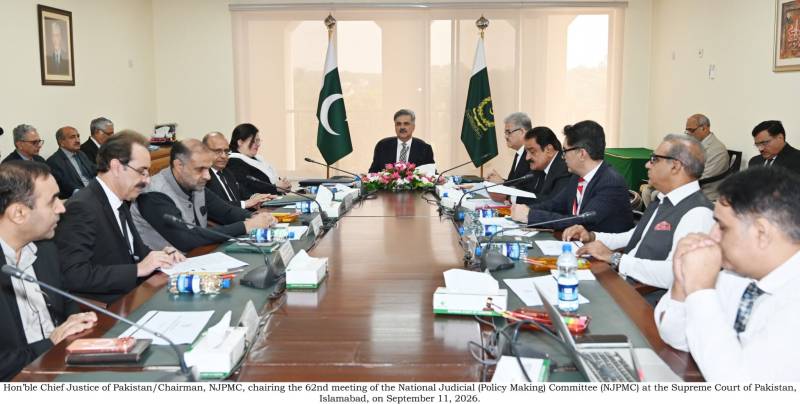

Chief Justice of Pakistan Justice Yahyah Afridi Friday chaired the 62nd meeting of the National Judicial (Policy Making) Committee (NJPMC) at the Supreme Court of Pakistan which was attended by the Chief Justices of Lahore, Peshawar and Sindh High Courts and the Registrar, Islamabad High Court.
The Secretary, Ministry of Law and Justice, the Additional Secretary, Ministry of IT and Telecom and Director General, National Cyber Emergency Response Team were also present on invitation.
According an official communique released by Registrar office, the Committee deliberated on policy issues besides reviewing implementation status of the decisions taken in its 61st meeting.
The Committee unanimously reiterated its resolve to strengthen institutional capacity, accelerate access to justice, and ensure efficient and effective justice delivery.
The NJPMC considered the progress shared by the Secretary, Ministry of Law and Justice on provision of redressal mechanism for dealing with cases of enforced disappearances and the constitution and terms of reference of the proposed commission.
It was decided that the Ministry of Law and Justice, shall take all necessary measures for the expeditious finalization of the matter and submit a comprehensive report to the Committee in its next meeting.
The Committee considered the Draft National Judicial Reform Framework and directed the Secretariat to circulate the proposed indicators included in the Tracker to all the High Courts for their review and suggestions, to be communicated within ten days.
It was decided that once finalised after incorporating suggestions from the High Courts, the Framework and the identified indicators shall be operationalized in phases.
The NJPMC appreciated the efforts of the Secretariat and the National Information Technology Board (NITB) towards development of the National Rule of Law Index and Judicial Reforms Tracker Portal.
The Committee directed the Secretariat to closely liaise with the High Courts, Federal and the Provincial Judicial Academies and the NITB for the conduct of comprehensive enduser training and a Master Trainers Programme to ensure the effective utilization and sustainable implementation of the Portal.
The Committee further directed the Secretariat to approach the Ministry of Information Technology and Telecommunication, for strengthening dedicated NITB technical team supporting justice sector initiatives, particularly the ongoing development and implementation of the National Rule of Law Index and Judicial Reforms Tracker Portal.
It was decided that the Rule of Law Tracker shall be made completely operational by 15th March, 2027 through all the tiers. The Committee took note of the progress regarding establishment of the Media and Strategic Communications Cell by the Ministry of Law and Justice. The Committee directed that the Cell be made fully operational forthwith under the coordination of the nominated focal person.
The Committee further directed that Standard Operating Procedures (SOPs) for the release and dissemination of judicial data be prepared and submitted for approval at the earliest, so as to ensure timely, accurate, coordinated and responsible dissemination of judicial data.
The Committee took note of the progress made on the proposed engagement of a consultant for undertaking a comprehensive assessment of Pakistan’s performance under the World Justice Project (WJP) Rule of Law Index.
The Committee directed the Ministry of Law and Justice to expedite the identification and hiring of a suitable person of international repute, having relevant expertise and exposure to the WJP Rule of Law Index and strong linkages with stakeholders and institutions at the international level, for undertaking objective performance assessment.
The Committee decided that the High Courts may consider the designs of the proposed women facilitation centres in accordance with their respective requirements and proceed further as deemed appropriate.
The NJPMC showed satisfaction on the progress made on the implementation of the Rotation Policy for members of the district judiciary, ICT. It was decided that the period of appointment on deputation under the Rotation Policy shall be for a specified period, which shall not be extendable in any circumstance. Similarly, the requisition of Officers from the High Courts shall not be by name and shall be at the option of the lending High Court.
The Committee appreciated the initiative and observed that the proposed system would constitute a significant step towards the digital transformation of the justice sector by enhancing efficiency, transparency and accessibility, and by facilitating a more streamlined, convenient and technology-enabled court process.
The NJPMC also appreciated the Bar Councils for their proactive role during engagement on this initiative and observed that, being main stakeholder, the Bar shall be taken on board on every step during pilot phase.
Accordingly, the Committee approved the proposed National Unified E-Filing and Electronic Judicial Record System for Courts in Pakistan; constitution of a Committee comprising the Registrars of all High Courts or their nominees from the Judicial and IT Wings, and two members nominated by each Provincial Bar Council and the Islamabad Bar Council, to review and finalise the standardised e-Filing templates; the pilot implementation of the System in family cases at selected stations in each Province and the Islamabad Capital Territory, covering the Family Court, District Court, respective High Court and the Supreme Court of Pakistan; and directed the IT Wings of the Supreme Court of Pakistan and all High Courts, in coordination with the LJCP Secretariat, to jointly prepare the Functional Requirements Specification, national judicial data and Universal Case Identification Number (UCIN) standards, interoperability and security framework, and pilot implementation plan.
The NJPMC directed the Director General, National Cyber Emergency Response Team (NCERT) to submit Cybersecurity Framework and governance structure for the proposed Judicial Cyber Emergency Response Team (JCERT). The Committee appreciated the successful integration of 17 prioritized case categories into the National Judicial Analytics Dashboard (NJAD), including district-wise and categorywise drill-down functionality and six-month trend analysis.
The Committee decided that the respective Registrars of the High Courts shall be responsible for ensuring the completeness and accuracy of the data uploaded to the NJAD, while the Member Inspection Teams (MITs) shall undertake periodic validation of the data relating to the District Judiciary and flag any discrepancies for timely rectification.
The Committee further decided that the High Courts shall institutionalize regular performance briefings of the Hon’ble Chief Justices, through the respective Registrars, based on the data and analysis available in the NJAD. Such briefings shall be conducted once monthly basis with particular focus on case disposal, pendency, backlog, categorywise performance and emerging trends requiring remedial action.
The Registrars of the High Courts shall ensure that the observations and directions arising from such performance briefings are appropriately recorded and followed up, and that the relevant data in the NJAD is updated to reflect subsequent progress.
The Committee highly appreciated and commended the exceptional performance of the District Judiciary in the disposal of time-bound cases, noting that 1,467,675 cases were decided during 01 September 2025 to 31 July 2026, against a reported pendency of 1,227,657 cases. The Committee observed that this landmark achievement demonstrates the effectiveness of clearly defined timelines, measurable targets and sustained institutional monitoring, and placed on record its appreciation of the High Courts, District Judiciary, judicial officers and staff for their concerted efforts.
The Committee noted that the performance of time-bound cases is already incorporated in the National Judicial Analytics Dashboard (NJAD) and asked the High Courts to continue using the Dashboard for regular performance monitoring and review.
The High Courts shall institutionalize and sustain the time-bound disposal mechanism, with regular performance reviews and timely remedial measures. Performance briefings before the Hon’ble Chief Justices shall be held at least once a month and, preferably with particular focus on disposal, pendency and compliance with prescribed timelines.
The NJPMC noted with great appreciation that the sustained disposal of cases by the Model Courts reflects the effectiveness of strong institutional commitment of the High Courts and District Judiciary. The Committee emphasized the need to sustain this momentum and urged the High Courts to focus on further reducing pendency, particularly of old and chronic cases, during the next reporting period.
The NJPMC unanimously decided that the High Courts shall adopt the health insurance policy approved by the Lahore High Court for the provision of medical facilities to judicial officers and staff of the District Judiciary.
The NJPMC unanimously decided that the High Courts may initiate process for providing a statutory framework for the judicial service, on the pattern of the Balochistan District Judiciary Act, 2021.
The meeting concluded with appreciation for the sustained efforts of all High Courts, the Ministry of Law and Justice, the Ministry of IT and Telecom and the Secretariat of the Law and Justice Commission of Pakistan for their valuable contributions toward strengthening the administration of justice, fostering institutional coherence, and enhancing public confidence in the judicial system.