
Total solar eclipse to turn day into night today
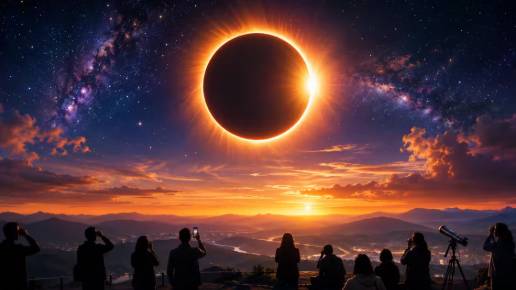

The day will briefly turn into night across a swathe of northern Spain on Wednesday (today), when the Moon will completely cover the Sun during a rare total solar eclipse, reported the 24NewsHD TV channel.
Eclipses happen when the Moon passes directly between the Sun and Earth, casting a narrow band of shadow across our planet.
It creates a strange twilight during which temperatures drop, shadows appear at strange angles, and some animals go to sleep.
These odd phenomena convinced ancient cultures that eclipses were signs of the apocalypse -- or messages from the gods.
However it is really the result of a "cosmic coincidence", according to NASA.
"Even though the Sun is about 400 times bigger than the Moon, it is also about 400 times farther away," the US space agency says.
This means that for people standing in the right spot, the Moon totally covers the Sun -- revealing its outer atmosphere called the corona.
On August 12, a remote region of northern Russia will be the first to see the total eclipse.
The "path of totality", as it is known, will then cross over Greenland, Iceland, Spain and the northeastern tip of Portugal.
In Spain, it will roughly move from the northern city of Oviedo to the island of Mallorca.
The eclipse will cross over areas that have been hit by devastating fires in Spain, which scientists say were made more likely by human-driven climate change.
For observers in Spain, the total eclipse will last under two minutes just before sunset.
The northern city of Burgos, for example, will be plunged into darkness for exactly one minute and 48 seconds.
It will last slightly longer in parts of Russia and Greenland, though still under two-and-a-half minutes.
However, partial eclipses -- which occur as the Moon starts and finishes crossing the Sun -- will last around one hour and 45 minutes.
AFP reported that millions of Europeans will contemplate the sky in awe on Wednesday as a rare total solar eclipse crosses part of the continent and plunges a swathe of Spain into eerie daytime darkness.
The shadow cast when the Moon blots out the Sun will begin in Russia's remote Arctic north at around 1700 GMT and continue in an arc over Greenland and Iceland.
In Spain, where the total eclipse will be best viewed, the shadow will cross the country diagonally from the northern Atlantic coast to the Mediterranean Sea, where it will vanish at around 1830 GMT.
Far more observers will see a partial eclipse, visible in most of Europe, Canada, the northern United States and northwest Africa.
This will be mainland Europe's first total eclipse since 2006.
Throughout human history eclipses have stirred amazement, fear and reverence, as they appear to momentarily halt the normal course of nature.
The shadow cast by the alignment of Sun and Moon creates a strange twilight during which temperatures drop, shadows appear at strange angles and some animals go to sleep.
But the phenomenon is fleeting: for observers in Spain, the total eclipse will last less than two minutes just before sunset.
It will last slightly longer in parts of Russia and Greenland, though still under two-and-a-half minutes.
The partial eclipse -- which occurs as the Moon starts and finishes crossing the Sun's path -- will last around one hour and 45 minutes.
The phenomenon will present scientists with a rare opportunity to study the Sun's atmosphere and its outermost layer, as they seek to uncover secrets about solar winds and our star's magnetic field.
- Eclipse fever -
Eclipse chasers will rush to secure a vantage point with an unimpeded sight of the setting Sun and pray for the dissipation of any clouds, dust or smoke.
Rain and clouds were forecast to spoil the occasion in the Westfjords region of northwestern Iceland, while Reykjavik, the capital, was set to experience its first total eclipse since 1433.
Further south, the Madrid-based AEMET weather agency has predicted clear skies for most of Spain, with a few exceptions in northern and eastern areas.
Eclipse fever is gripping the country, with the type of glasses certified to safely view the Sun hard to find in some places.
The country is banking on eclipse-driven tourism for an economic boost, especially in rural, northern regions that have suffered decades of population decline.
The net contribution to the economy is forecast to be 347 million euros ($400 million), with more than 446,000 extra tourists visiting the key areas affected by the eclipse, according to the economy ministry.
Sleepy villages that would normally never feature in a typical tourist itinerary have suddenly found themselves inundated with eclipse hunters from around the world.
In Benavente, a small northwestern town that is expected to offer excellent views of the total eclipse, accommodation options have run out.
"We're getting 50 calls a day to ask about where to stay, where to see it, where to park," Benavente tourism office worker Laura del Teso told AFP.
Benavente had "never" had so many foreign tourists, including visitors from Belgium, Britain, Australia, New Zealand, the Netherlands and Germany, she added.
- Hazards on horizon -
The expected rush has caused trepidation for the authorities, who are pleading for caution amid fears that the heavenly phenomenon will unleash hell on the ground.
Temperatures are expected to exceed 35C Wednesday in most of mainland Spain and could climb above 40C in parts of the northeast, posing health risks for those spending hours outdoors.
AEMET also forecasts a "very high" or "extreme" wildfire risk for much of the country -- with the risk amplified by thousands of people occupying parched countryside and clogging small rural roads with their cars.
Officials expect there to be as many as 1.5 million extra road journeys towards the band of totality.
Municipalities have set up dedicated observation points and beefed up security, emergency and transport resources in the hope of managing the mayhem during mainland Spain's first total eclipse in more than a century.
Another total eclipse will cross southern Spain and northern Africa in August 2027, while an annular eclipse -- when the Moon is not big enough to completely blot out the Sun, creating a so-called "ring of fire" -- is due to visit the Iberian Peninsula in 2028.