
Thousands evacuated as cyclone menaces Pakistan
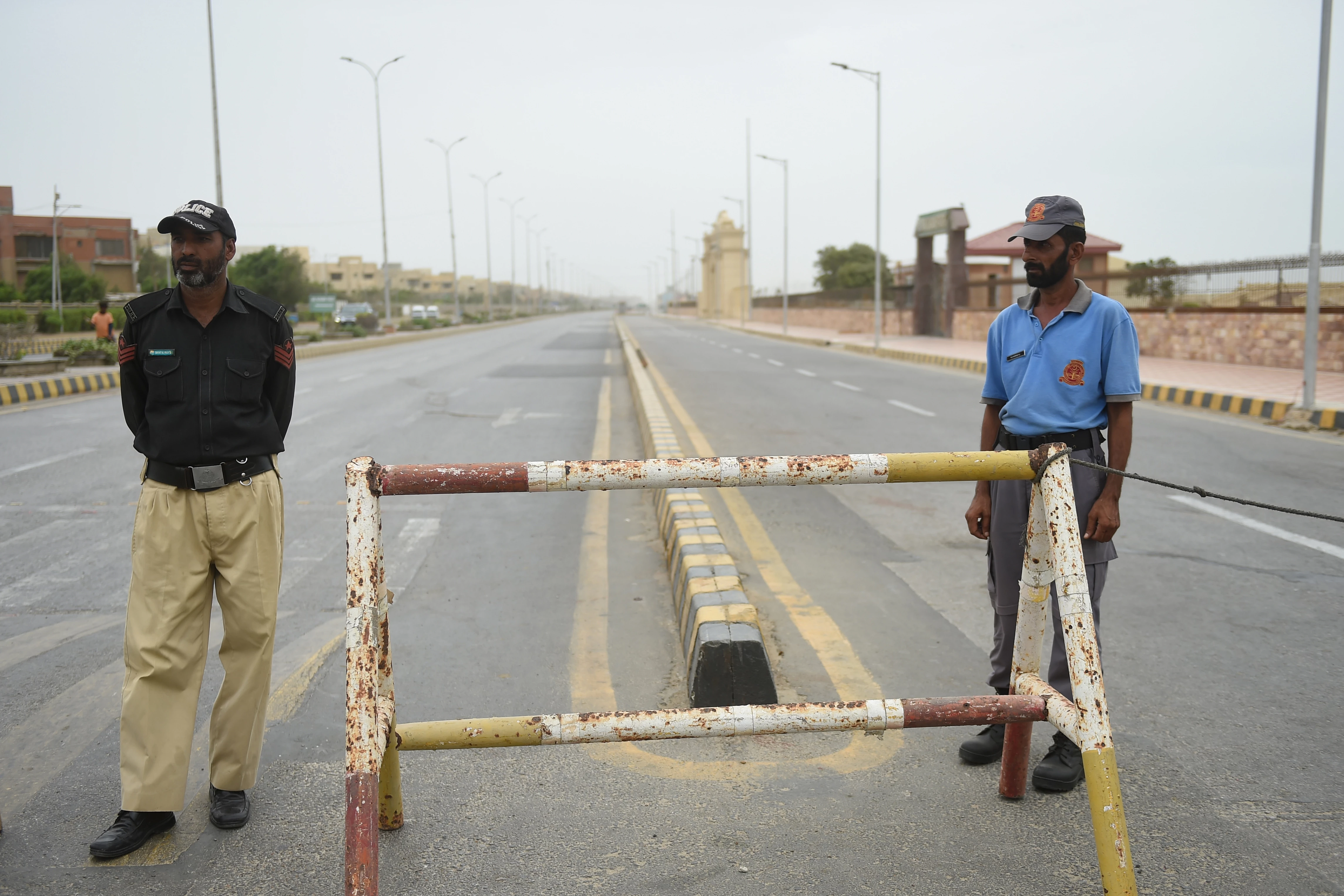

Thousands of people have been evacuated across the Pakistan coastline as a cyclone approaches with gales of up to 150 kilometres per hour predicted on Tuesday.
The cyclone -- named Biparjoy, meaning "disaster" in Bengali -- is making its way across the Arabian Sea and is forecast to make landfall as a "very severe cyclonic storm", government weather monitors warned.
In Pakistan's Sindh, officials said at least 20,000 people had been evacuated from the storm's path, while across the border in India's Gujarat state, authorities said they had also helped a similar number to move.
India's Meteorological Department said the storm would hit near the Indian port of Jakhau on Thursday evening with winds surging up to 150 kilometres per hour (93 miles per hour).
"Over 20,000 people have been evacuated," said CC Patel, the official in charge of relief operations in Gujarat state, adding that more people would be moved throughout Tuesday.
Fishing has been suspended along the Gujarat coast where there could be waves of up to three metres (over nine feet), and the Indian Coast Guard on Monday evacuated 50 personnel from an oil drilling ship due to rough conditions.
Shelters in schools
In Pakistan, the deputy commissioner of Badin district said between 22,000 and 23,000 people had been moved from seafront villages.
Agha Shahnawaz said that up to 10,000 were now living in 13 camps set up in government schools and colleges across the district. "Initially people were reluctant to leave their places, but we kept pursuing them," Shahnawaz said.
Sindh Information Minister Sharjeel Memon put the number of evacuees there at 22,400 around midday on Tuesday.
In an update, the Met Office reported that the cyclone has weakened into a "Very Severe Cyclonic Storm" Category 3, with sustained wind speeds of approximately 140-150 km per hour and gusts up to 170 kilometre per hour.
According to the National Disaster Management Authority, its current location is roughly 450km south of Karachi and 440km south of Thatta and 560km south east of Ormara.
According to the latest forecast, the tropical cyclone Biparjoy is expected to maintain a northward trajectory until the morning of Wednesday and then it is likely to recurve eastward and will make a landfall between Keti Bandar, southeast Sindh coastline and the Indian Gujarat coastline in the afternoon of Thursday.
The areas likely to be affected include Thatta, Badin, Sujawal, Tharparkar, Karachi, Mirpurkhas, Umerkot, Hyderabad, Ormara, Tando Allahyar Khan and Tando Mohammad Khan.
However, the Pakistan Metrological Department has said that there is no direct threat to Karachi from the storm. However, there may be rains with strong winds.
In 2021, the same coast was hit by Cyclone Tauktae, which killed more than 150 people and caused large-scale destruction.
Cyclones -- the equivalent of hurricanes in the North Atlantic or typhoons in the Northwest Pacific -- are a regular and deadly menace on the coast of the northern Indian Ocean where tens of millions of people live.
Scientists have warned that storms are becoming more powerful as the world gets warmer because of climate change.
Effects on Sindh
According to metrologists, the entire Sindh coastline could be affected. Approximately, 300-400 millimetres of rain will be poured down. Waves of up to 12 feet are expected to rise at Keti Bandar. The wind speed will be 122 kph. There is a possibility of rainfall of up to 100mm in Karachi.
The storm has already begun to show its effects in Sajawal. Strong winds have started blowing. Keti Bandar is facing danger. Fishermen have docked their boats on the shore. People have started evacuating Badin.
Winds have started blowing in Tharparkar too. An alert has been issued in the district in view of the possible cyclone. The local administration will start evacuating villages near Shakur Lake from today.
Pre-emptive measures
The Sindh local government minister has said the departments concerned have been put on high alert. Emergency has been imposed and the staff of the Sindh Solid Waste Management, KDA, DMCs, and KMC have been alerted, Nasir Hussain Shah said
The removal of billboards and panels from the city is in progress, he said, adding that special instructions have also been given to remove panels on pedestrian bridges and flyovers.
The staff of the Water and Sewerage Board and Solid Waste Management Board are making arrangements to keep the system running while the process of cleaning rain drains is in full swing.
Dewatering pumps have been installed at various places in the city. Sindh Chief Minister Syed Murad Ali Shah has taken a tour of the city to review the measures like the removal of billboards from different areas in the port city.
The minister urged citizens to be alert and stay home on Thursday and Friday to avert any untoward incident. The Sindh Building Control Authority is moving people from dilapidated buildings to safer places.
Mass evacuation
Pakistan authorities began an evacuation effort to move 80,000 citizens out of the path of an approaching cyclone.
Swathes of coastal communities in southern Sindh province are set to suffer storm surges up to 3.5 metres (12 feet), which could inundate low-lying settlements, as well as up to 30 centimetres of rain.
Sindh Chief Minister Murad Ali Shah said an emergency has been declared and the army drafted in to help relocate "more than 80,000 people" at risk.
"We will not request people but demand them to evacuate," Shah told reporters, adding that the order was being issued through social media, mosques and radio stations.
A spokesman for Shah said around 2,000 people have already been evacuated to "safe places" from the area of Shah Bandar, a fishing town nestled among mangrove deltas 45 kilometres (28 miles) west of India's Gujarat state.
However, in the nearby village of Gul Muhammad Uplano, authorities struggled to persuade families to leave.
"We will become helpless in the government camps, that is why we are better off at our own place," said 46-year-old Gul Hasan.
The Pakistan Meteorological Department has warned that traditional mud and straw homes which house the poorest in Pakistan will be vulnerable to disintegration in high winds.
But in the settlement of Haji Ibrahim, a cluster of such structures, fisherman Abu Bakar said concerns over losing their livelihoods prevail.
"Our boat, goats and camels are our assets," the 20-year-old said. "We cannot compromise on their safety."
"But if the danger becomes imminent, we will be forced to leave to save our lives," he conceded.
Rain forecast
Rain is expected to fall across the country from today. There is also a chance of hailstorms in some places.
It will rain today and tomorrow in Islamabad, Murree, Rawalpindi, Attock, Chakwal and Sialkot.
Rain will pour down in Lahore on June 14th and 15th.
Rain is also expected in Chitral, Dir, Swat, Haripur, Charsadda, Swabi, Peshawar and Mardan.
Adverse effects of climate change
Provincial lawmaker Muhammad Ali Malkani told AFP a decision had been made to evacuate the population living up to eight kilometres inland.
Karachi -- a port city home to around 20 million -- is also due to be deluged by dust and thunderstorms with winds whipping up to 80 kilometres per hour.
Billboards will be removed and 70 vulnerable buildings evacuated in the city, while construction will be stopped over the entire affected area.
India's Meteorological Department said Monday the storm will hit western Gujarat state around noon on Thursday, with winds gusting up to 150 kilometres per hour causing "total destruction of thatched houses".
Heavy rains and strong winds late Saturday killed 27 people in Khyber Pakhtunkhwa in Pakistan, including eight children, officials said.
"Undoubtedly, these are the adverse effects of climate change," Prime Minister Shehbaz Sharif said on Twitter Sunday.
Last summer, Pakistan was hit by massive monsoon rains which put a third of the country under water, damaged two million homes and killed more than 1,700 people.
Pakistan, the world's fifth most populous country with 220 million inhabitants, is responsible for only 0.8 per cent of global greenhouse gas emissions.
But the nation ranks highly among those vulnerable to extreme weather events, which scientists say are becoming more frequent and more severe owing to climate change.
Reporters Aadia Naz, Ahmad Mansoor and G R Junejo