
Pakistan abides by Makkah defence pact but operational details are ‘confidential’
Foreign Office spokesperson Sajjad Haider Khan says Islamabad is committed to implementing the pact as well as Strategic Mutual Defence Agreement (SMDA): India’s incursion at sea also violated bilateral agreement: Trashes India’s objections to Pakistan-China border agreement: Says Islamabad will continue issuing visas to Sikh yatrees
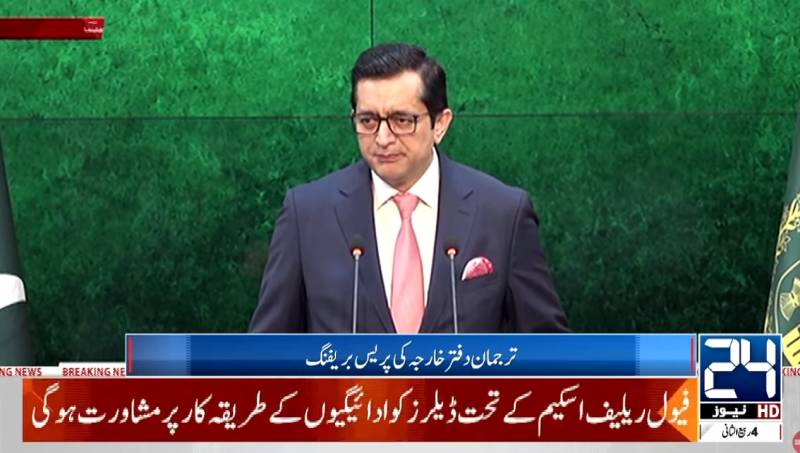

Pakistan remained committed “in intent and spirit” to implementing the Makkah Joint Defence Agreement (MJDA) with Saudi Arabia, but operational details about when, where and how the country would respond to threats “will remain confidential”, said Foreign Office spokesperson Sajjad Haider Khan, reported 24NewsHD TV channel.
Reacting to a question about Pakistan’s obligations under the agreement amid Houthi attacks on Saudi Arabia, Sajjad Haider Khan told his weekly news briefing in Islamabad on Thursday that Pakistan was committed to implementing the pact as well as the Strategic Mutual Defence Agreement (SMDA). “However, when, how, where, and what force will be used against what objectives, in which modes, and matters of operational confidentiality require us some discreetness at this stage,” he added.
The FO spokesperson said Prime Minister Shehbaz Sharif had condemned “in the strongest possible terms” the attempted drone attack targeting the holy sites in Makkah Al-Mukarramah, describing it as a deeply distressing incident for the people of Pakistan.
The FO spokesperson said Pakistan remained concerned about the continuing escalation and its implications for regional peace, maritime navigation and global energy supplies, adding Islamabad continued to advocate dialogue and diplomacy.
Pakistan slams Indian naval incursion
The FO spokesperson said Pakistan had summoned India’s Charge d’Affaires in Islamabad on Wednesday night and lodged a strong protest over what it called a “highly provocative and unacceptable” action by an Indian naval vessel in Pakistan’s Exclusive Economic Zone on September 15.
He said the incident occurred while the Pakistan Navy was conducting its biennial Sea Spark-26 exercise, with the Indian vessel allegedly carrying out aggressive manoeuvres dangerously close to a Pakistani naval ship, resulting in contact between the two vessels.
Pakistan considered the incident a serious violation of international law and the 1991 bilateral agreement on advance notice of military exercises, manoeuvres and troop movements, he said and added, Pakistan’s Charge d’Affaires in New Delhi was also scheduled to lodge a similar demarche with India’s Ministry of External Affairs.
Pakistan trashes India’s claims on boundary pact
The FO spokesperson categorically rejected India’s objections to the Pakistan-China Boundary Agreement of 1963 and the newly operationalised Pakistan-China Boundary Joint Commission. “China is not only our neighbour but an all-weather and tested strategic cooperative partner,” he said, describing the 1963 agreement as a valid arrangement between Pakistan and China.
The FO spokesperson also rejected India’s position on Jammu and Kashmir, saying Pakistan maintained that the territory remained an internationally recognised disputed territory whose final disposition should be determined in accordance with UN Security Council resolutions and the aspirations of the Kashmiri people. “Instead of advancing fictitious territorial claims, India should end its illegal occupation of Jammu and Kashmir and faithfully implement the UN Security Council resolutions,” Khan said.
Visas for Sikh yatrees
Responding to reports that Pakistani Sikh pilgrims had been prevented from travelling to India, the FO spokesperson rejected the claim that they had been stopped from boarding their flight. He said a private group of around 90 to 100 Pakistani Sikhs had reportedly planned to travel to India to visit religious shrines, but the visas issued by the Indian High Commission were not covered under the 1974 bilateral protocol governing pilgrimage visits.
Pakistan, he said, remained committed to welcoming Sikh pilgrims, citing more than 2,800 visas issued for Baisakhi alone this year, in addition to visas issued for other religious occasions.
He said the Kartarpur Corridor was currently closed by India and not Pakistan, adding Islamabad was ready to welcome Sikh pilgrims through the corridor “as and when India allows them”.
IAEA chief talks to Ishaq Dar
The spokesperson said Deputy Prime Minister and Foreign Minister Senator Ishaq Dar had held a telephone conversation with IAEA Director General Rafael Grossi on September 15, during which they discussed the evolving regional situation.
Both sides agreed that implementation of the Islamabad MOU remained the most effective course of action to reduce regional tensions, while Grossi offered technical support if required, Khan said.
PM Shehbaz to visit US
The FO spokesperson said Prime Minister Shehbaz Sharif would lead Pakistan’s delegation to the high-level segment of the 81st UN General Assembly session in New York next week.
He said the prime minister would highlight Pakistan’s positions on regional and global developments and stress dialogue, diplomacy, restraint and peaceful resolution of disputes. The delegation would also raise issues including sustainable development, climate change, counterterrorism, Islamophobia, global economic challenges, UN reforms, the Global South, Indian Illegally Occupied Jammu and Kashmir and Palestine.
SCO huddle
Pakistan hosted the 46th meeting of the Council of the SCO Regional Anti-Terrorist Structure (SCO-RATS) in Islamabad on September 14, Khan said. The meeting reviewed regional security developments and cooperation among member states against terrorism, separatism and extremism. Participants also agreed to strengthen information-sharing mechanisms and undertake joint activities in 2027.
Pakistan-China Boundary Commission
Meanwhile, the Pakistan-China Boundary Joint Commission was operationalised on September 16, with its inaugural meeting held at the Foreign Office in Islamabad. The commission will focus on border management, joint surveys, trade facilitation and people-to-people connectivity.
The FO spokesperson also acknowledged the retirement of Foreign Secretary Ambassador Amna Baloch after more than three decades of diplomatic service, praising her contributions to Pakistan’s foreign policy and diplomatic service.
The spokesperson said Lebanese Interior Minister Ahmad Al-Hajjar’s September 14-15 visit to Pakistan focused on strengthening bilateral cooperation, particularly in interior and security affairs.
During the visit, Pakistan and Lebanon signed a memorandum of understanding on the transfer of sentenced persons, providing a legal framework for convicted nationals to serve the remainder of their sentences in their respective home countries.
Khan said PM Shehbaz had reaffirmed Pakistan’s support for Lebanon’s sovereignty and territorial integrity, while Ishaq Dar also discussed ways to strengthen cooperation in law enforcement and people-to-people contacts with his Lebanese counterpart.
LIVE: Spokesperson's Weekly Press Briefing 17-09-2026 at Ministry of Foreign Affairs, Islamabad https://t.co/MAG2wSCFIU
— Ministry of Foreign Affairs - Pakistan (@ForeignOfficePk) September 17, 2026
Reporter Anwer Abbas