
Minister sees method behind May 9 madness
Ahsan Iqbal terms Pakistan’s May events equivalent to 9/11 of America: Says vandals don’t deserve any concession: Those who caused destruction in civil areas will be prosecuted under civil law, those who attacked military installations, will be tried under Army Act
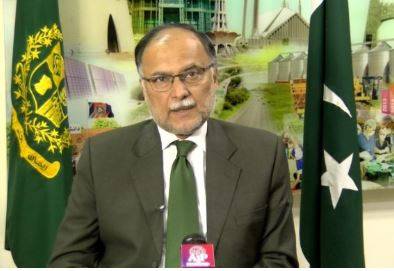

Planning and Development Minister Ahsan Iqbal has condemned the attack on the Jinnah House and vandalizing of memorials of martyrs, saying that those involved in the May 9 destruction do not deserve any concession, reported 24NewsHD TV channel.
Speaking to the media in Narowal on Sunday, the minister said that the enemies of Pakistan were happy over the steps taken by PTI Chairman Imran Khan. He said that the former premier staged a drama of US conspiracy. Now he (Imran) wants to come to power again, the minister added.
He maintained that the May 9 violence cannot be categorised as a political protest in any country under any circumstance.
He said that no democracy in the world allows protest to turn into terrorism and chaos. He revealed that security agencies had gathered evidence to track down those involved in the May 9 vandalism.
He blamed Imran Khan for launching a campaign against the establishment when it decided to remain neutral.
Separately, in an exclusive interview with the APP, Ahsan Iqbal termed the Pakistan Tehrik-i-Insaf workers’ May 9 vandalism of sensitive state installations as the “9/11-type” attacks on Pakistan’s national interests.
He said it was regrettable that a political party’s (PTI) workers on May 9 stormed and destroyed many symbols of Pakistan’s pride that include Jinnah House, Yadgare Shuhada, fighter jets of the famous 1965 war and Chagai mountain model.
He said this reaction to their leader’s (Imran Khan) arrest over corruption charges was unprecedentedly irrational, unacceptable and not less than the 9/11 attacks carried out in the US in 2001.
“The May-9 incident for Pakistan’s Armed Forces was equivalent to the September-11 of America. The violent workers of a political party attacked Pakistan’s heritage and the pride of the security departments. The ‘Jinnah House’ was not only the residence of a Corps Commander rather a heritage of the founder of the country,” he observed.
He regretted that the PTI workers broke the statue of Captain Karnal Sher Khan Shaheed, a symbol of courage and bravery demonstrated by the Martyr in the Kargil battlefield and even admitted by the arch-rival India. “If they have broken the fighter jets of 1965 war, [it means] they have attacked the pride of Pakistan Air Force attained by defeating the enemy in the air war.”
The minister said the model of Chagai Mountain, which reminded the nation of nuclear tests carried out by its scientists that made the country’s defence impregnable, was also set on fire.
“There seems a scheme/method behind this madness as all such symbols were targeted selectively which had a link either with national heritage or pride of the Armed Forces.”
Iqbal said such serious offences could not be tolerated and forgiven by any country, reminding that charges were framed against all those who attacked the United States Capitol Hill at the behest of ex-president Donald Trump; and UK courts opened at the night for giving exemplary punishment to those involved in street riots, loot and plunder.
“So, these people too do not deserve any mercy as they have attacked the national heritage and pride of the Armed Forces,” he said, adding that evidence-based legal proceedings would be initiated against those involved in the subversive activities.
“Those who caused destruction in civil areas will be prosecuted under the civil law, while those who attacked military installations, will be tried under the Army Act.”
He said the enemies of Pakistan kept celebrating the subversive activities of the PTI, “Thus we made our enemies happy and brought tears to the eyes of our nation.”
Answering a question, the minister said when the coalition government came into power last year; the national kitty was empty and the Finance Ministry was unable to release development funds for the last quarter of the fiscal year 2021-22-, which happened for the first time in the country’s history due to failed economic policies of the previous regime of PTI.
He said the PTI leadership was expecting that there would be a Sri Lanka-like situation within a few days, but the incumbent government under the dynamic leadership of Prime Minister Shehbaz Sharif took bold steps, faced the crisis, and streamlined the affairs to a great extent. “The tough decision taken by the government has started yielding good results.”
Last year, he said the country faced devastating floods in the majority districts of the country that caused around $ 30 billion loss to the national exchequer, but despite all the financial constraints, the government initiated reconstruction and rehabilitation work in the affected areas.
Commenting on the issue of inflation, Ahsan Iqbal said it was all because of the four-year rule of the PTI which damaged the investment pouring into the country under the China-Pakistan Economic Corridor (CPEC) projects.
He said the PTI government laid the foundation of inflation by devaluating the rupee against the dollar and allowing the $80 billion imports in its last year to show artificial growth and benefit friends by issuing import licences.
In the damage-repair efforts, he said the current government resumed the stalled programme of the International Monetary Fund (IMF) and restored ties with friendly countries that had been affected during the PTI rule.
Replying to another question, the minister said the CPEC was a game-changer project not only for Pakistan but also the entire region.
During the Pakistan Muslim League-Nawaz (PML-N) government’s last tenure, he said around 29 billion dollars investment from China poured into Pakistan’s various sectors including energy, infrastructure, Gwadar development, Thar and Hydel in a short period of time.
But as soon as the PTI government came into power in 2018, he said, the CPEC was targeted by putting its all projects on the back-burner under negative propaganda, adding Pakistan was expecting $30-50 billion investment during the next 5-7 years in diverse fields if the CPEC projects would have continued at the pace of 2017-18.
Now, he said, the incumbent government was focusing on the revival of the CPEC; and a few days back the Prime Minister and Iranian President jointly inaugurated a border market and a 100-megawatt transmission line for Gwadar which would be beneficial for increasing the trade activities in the deep seaport city. “This project was started in 2018 but the previous incompetent government also sabotaged it,” he said, adding the current government also completed various projects including water and electricity in Gwadar.
He said the PTI government showed criminal negligence by not carrying out the Gwadar port’s annual dredging, adding, now Rs4.5 billion dredging contract had been awarded so that big cargo vessels could be berthed there.
Besides, he said the government launched an Rs800 million project under which the latest boats would be given to fishermen enabling them to earn their livelihood and contribute to the national progress.
He said Chinese investment was pouring into the Gwadar Free Zone at a rapid pace, a trade and expo centre had been completed in the port city during a record six-month time; the second phase of the Karakoram Highway and the Main Line-I project of Railways were also in progress.
Iqbal also emphasized the need to develop industries on modern lines so that the economy could be steered in the right direction to create a prosperous society.
To steer the country out of the financial crisis and turn around Pakistan to a stable platform, he said the incumbent government was making concerted efforts to develop a framework based on five Es (Exports, E-Pakistan, Equity, Energy and Environment) which needed to be pursued vigorously.
He said the biggest challenge for the current government was to meet the development budget in the prevailing economic situation.
In 2013, the minister recalled that the country’s development budget was Rs300 billion which increased to Rs1000 billion by 2018, and unfortunately, when the incumbent government took over after the PTI’s four-year rule, the development budget had reduced to Rs550 billion.
Now when the incumbent government was making a development budget for the next fiscal year, he said, there were demands of about Rs1900 billion, and “We have an envelope of Rs727 billion only.”
In the next fiscal plan, he hinted the government would focus on the projects that were near to completion, and highlighted the importance of making the seaports secure and strong, improving the communication infrastructure, promoting the higher education and information technology sector, besides uplifting the agriculture sector, once considered backbone of the national economy under the Green Revolution-2.