
Ishaq Dar lands in Dhaka on two-day official visit
Pakistan and Bangladesh are expected to sign six agreements tomorrow
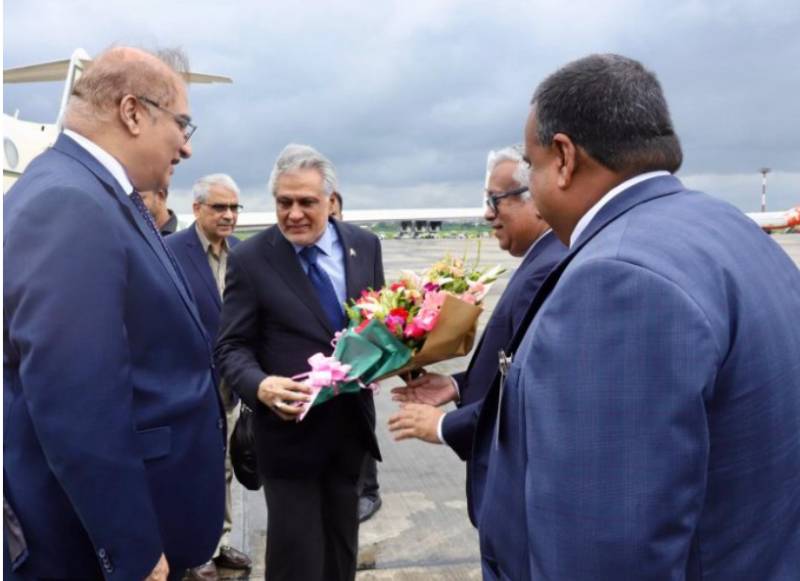

Pakistan's Deputy Prime Minister and Foreign Minister Ishaq Dar landed in Dhaka on Saturday on a two-day official visit as the nations seek to rebuild ties with regional power balances shifting, reported 24NewsHD TV channel.
Ishaq Dar is the most senior Pakistani official to visit Dhaka since 2012, with Islamabad calling it a "significant milestone in Pakistan-Bangladesh relations".
At the airport, Dar was received by Ambassador Asad Alam Siam, Foreign Secretary of Bangladesh alongside Pakistan’s High Commissioner to Bangladesh Imran Haider and other senior Bangladeshi officials, Foreign Office Spokesperson said in a press release.
Islamabad is giving importance to reviving relations as well as increasing closeness at the political level during this bilateral visit. Six agreements and memorandums of understanding (MOU) are expected to be signed during the visit.
Deputy Prime Minister / Foreign Minister, Senator Mohammad Ishaq Dar @MIshaqDar50, reached Dhaka on an official visit. He was received at the airport by Ambassador Asad Alam Siam, Foreign Secretary of Bangladesh, along side Pakistan’s High Commissioner to Bangladesh, Mr. Imran… pic.twitter.com/96oZ2Hhi9c
— Ministry of Foreign Affairs - Pakistan (@ForeignOfficePk) August 23, 2025
Although Ishaq Dar was scheduled to visit Dhaka on April 27, his visit was postponed in the context of border tensions due to the Pahalgam attack in Indian-occupied Kashmir.
Bangladesh Foreign Ministry officials told 24 News TV channel that the main meeting of the Pakistani Foreign Minister on the second day of the visit, Sunday, will be with Foreign Affairs Advisor to the Bangladesh Interim Government of Bangladesh Md. Towhid Hossain. On that day, the two ministers will initially meet in private and later at the delegation level.
After the meeting, six agreements and MOUs are expected to be signed between Bangladesh and Pakistan.
According to relevant sources, various bilateral issues including trade, investment, connectivity, facilitating the movement of people of Bangladesh and Pakistan at various levels will be discussed in the Towhid-Dar meeting.
In continuation of the foreign secretaries' meeting, Bangladesh will emphasize mutual respect, understanding and common interests in the foreign minister-level talks to advance the relationship.
On Sunday afternoon, Ishaq Dar will pay a courtesy call on Dr Muhammad Yunus, the Chief Advisor to the Interim Government of Bangladesh, in Dhaka.
During his visit to Dhaka, Ishaq Dar will exchange views with political leaders of Bangladesh. As part of that, Dar will meet with Khaleda Zia, the chairperson of Bangladesh's main political party, BNP, at her Gulshan residence in Dhaka. Dar is also scheduled to meet with leaders of Bangladesh's Jamaat-e-Islami.
The Bangladesh foreign minister has already met Pakistani foreign minister four times since the formation of the interim government in Bangladesh. Last month, Pakistan's Interior Minister Mohsin Naqvi visited Dhaka as the head of the Asian Cricket Council (ACC). In addition, Pakistan's Commerce Minister Jam Kamal Khan is currently in Dhaka on a four-day visit.
Deputy Prime Minister and Foreign Minister, Senator Mohammad Ishaq Dar @MIshaqDar50, embarks upon a historic visit to Bangladesh. In Dhaka, he will hold important meetings with Bangladeshi leaders. The visit is a significant milestone in Pakistan-Bangladesh relations as a… pic.twitter.com/In13QwBcJj
— Ministry of Foreign Affairs - Pakistan (@ForeignOfficePk) August 23, 2025
According to AFP, analysts say neighbouring India, which fought a four-day conflict with Pakistan in May, will be watching closely.
Relations between Dhaka and New Delhi turned icy in August 2024 after a mass uprising in Bangladesh ended the autocratic rule of prime minister Sheikh Hasina, prompting her to flee to India.
"Bangladesh had been one of India's closest partners in its neighbourhood, and now it is flirting with India's chief adversary," said Michael Kugelman, a US-based analyst, ahead of the visit.
Pakistan and Bangladesh began sea trade last year, expanding government-to-government commerce in February.
Islamabad's Commerce Minister Jam Kamal Khan held talks Thursday in Dhaka, where he agreed to set up joint commissions to boost trade and investment.
On Friday, top military commanders from both nations met in Pakistan.
After 1971, Bangladesh leaned heavily on India, which almost encircles the country of 170 million people.
But Bangladesh's interim government, led by Nobel Peace Prize winner Yunus, is furious that India took Hasina in -- where she remains and continues to refuse to attend her trial on charges amounting to crimes against humanity.
"The toppling of Hasina was a strategic setback for India, and the improved relations between Bangladesh and Pakistan are a consequence of her ouster", said Thomas Kean of the International Crisis Group.
Dhaka accused India this month of backing Hasina's now-outlawed Awami League party, charges that New Delhi rejected, saying it "does not allow political activities against other countries to be carried out" from its soil.
Reporter Salim Reza/AFP