
Why China’s rise cannot be ignored
From the ashes of the ‘Century of Humiliation’, China has risen like a phoenix into a global superpower, and the future of the world now depends on whether the United States and China choose coexistence over confrontation

For thousands of years, China had stood among the world’s oldest civilisations. It had been the seat of learning, contributing very significantly in philosophy, science, education, astronomy and various other fields. Dynasties rose and fell, but China continued its journey, affecting the world through its culture, language and statecraft.
But it was all going to change. In 1793, George Macartney led the first diplomatic mission to Qing China during the reign of Emperor Qianlong. The mission failed, as the emperor saw the British as a tributary state rather than an equal power. This failure ushered in chaos and humiliation for China as Britain, being the premier hegemon, shifted its strategy from diplomacy to coercion.
Under the garb of balancing the trade imbalance between the two, British merchants, with support from the East India Company, massively expanded the illegal opium trade into China from India. Resultantly, millions of Chinese became addicted, leading to severe moral degeneration.
In 1839, Lin Zexu cracked down under orders of the emperor, destroying British opium stocks in Canton. This led to the “First Opium War”. It ended in Chinese humiliation. The emperor signed the “Treaty of Nanking” on Monday, 29 August 1842. (Nanking is a city in eastern China, on the banks of the Yangtze River.)
As a result, Hong Kong was ceded to Britain, several Chinese ports were opened, and Britain gained major commercial privileges inside China. This marked the beginning of the “Century of Humiliation” for the Chinese.
To understand China today, the above historical realities have to be kept in mind. Otherwise, the analysis would not be correct. Moreover, the encirclement of China by the Western world, led by the USA, the Taiwan enigma, the South China Sea geostrategic dilemma and many other factors have played a major role in shaping the policies of China under President Xi Jinping.
In the recently concluded visit by President Trump, three facts have stood out.
When President Trump visited China in 2017, the USA was the only superpower and treated China as a distant second. By nominal GDP, the USA had an economy of around $19.5 trillion, whereas the economic size of China was $12.3 trillion. But by purchasing power parity, China was about $19.6 trillion, whereas the USA was $19.5 trillion.
But today, as per the IMF and other international estimates for 2025–2026, the USA economy in nominal terms is $32–33 trillion, whereas the Chinese economy is $20–21 trillion. However, by purchasing power parity, the Chinese economy stands at $41 trillion as against the USA’s $31 trillion. Whereas America is still the dominant financial and technological superpower, China has become the largest industrial and manufacturing economy, with a trade surplus of more than $1 trillion in 2025.
The impact of this change was apparent during this visit. The deference shown by the Americans towards the Chinese was an acknowledgement of coexistence and the avoidance of armed conflict.
Secondly, the façade of the American military albatross is cracking. After its humiliating withdrawal from Afghanistan in 2021, the aura was already dented. But the recent Iran war, started by the USA on behalf of Israel, has exposed the limits of American power, with Iran refusing to bow down.
The role of China, which remains the biggest trading partner of Iran and has not given much importance to American sanctions, has further gained significance. This is apparent from public announcements by the Trump administration that they seek Chinese mediation in resolving the conflict at the earliest.
This is also proof of the changing geostrategic balance between the two countries.
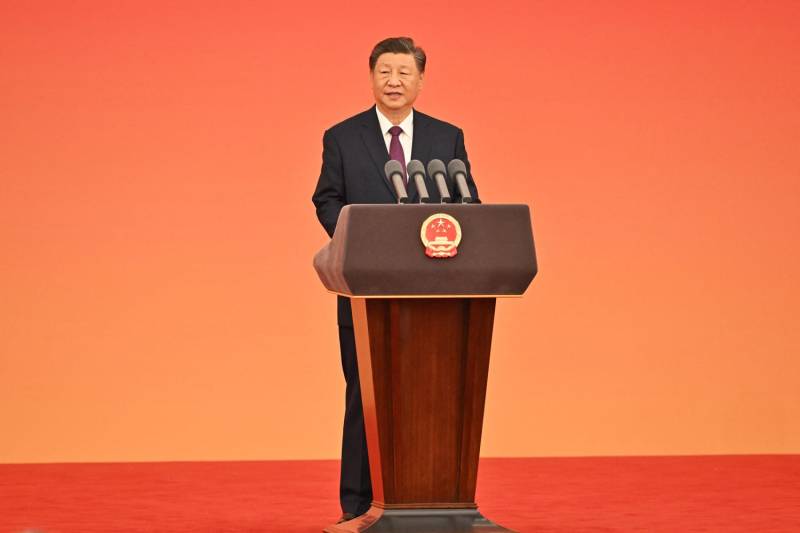
Thirdly, the confidence of the Chinese was on full display. They behaved as equals. In both speeches by President Xi, his message was that the world is standing at a crossroads. China was ready to shoulder its responsibilities as a superpower through peaceful coexistence. President Xi explicitly referred to the “Thucydides Trap”, proposing that mutual respect, peaceful coexistence, managed competition, a new paradigm of major power relations and avoidance of violating clear red lines would avert conflict.
For the rest of the world, this visit is of paramount importance. The 21st century is going to be defined by competition between these two countries.
If, as President Xi has proposed, America agrees to a peaceful coexistence formula, the world will be a safer and happier place. With the colossal Chinese juggernaut spreading its tentacles through economic power across the world, it could lead to a win-win situation for everyone.
If the relationship turns into a Cold War, with China, Russia, North Korea, Iran and other countries in one camp and the USA with its allies in the other, we will witness a sharp deterioration in international politics. The last decade has exhibited a dilution of the Westphalian international structure and, with the right gaining power across a host of countries, the law of the jungle may rule the roost.
If there is a conflict over Taiwan or any other issue, keeping in view the power spectrum of the two countries, the situation will, in all likelihood, spiral out of control. The chances of a world-ending World War III cannot be ruled out.
History has come full circle for China. From the ashes of the “Century of Humiliation”, China has risen like a phoenix in less than two centuries, becoming one of the greatest economic, technological and strategic powers. There is hardly any other comparable example of a civilisation which has exhibited such resilience, discipline and transformation on such a colossal scale.
If the United States exhibits wisdom over arrogance, cooperation over confrontation and respect for international law, the chances of avoiding the Thucydides Trap are very bright. With nearly 20% of the world’s population being Chinese, there is no way to stifle their growth.
What is required is statesmanship and maturity, along with very strong international bodies to ensure that conflicts are resolved through mutual respect and under international law.
Let us hope for a better future.