
73% more rainfall recorded this year as fifth monsoon spell makes entry
High flood in River Indus washes away police checkpoint in Attock
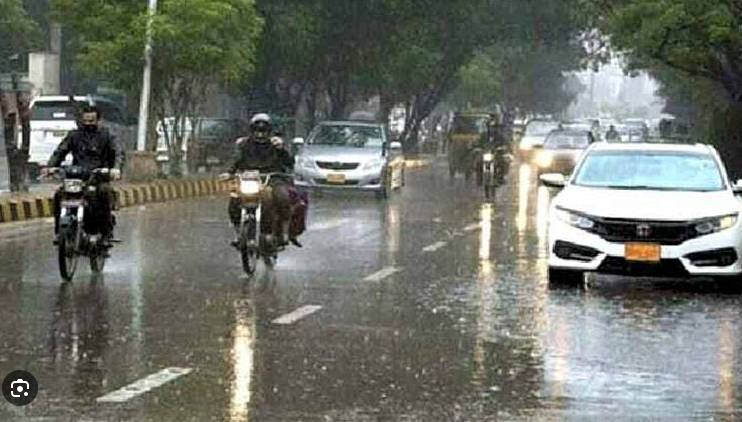

The fifth spell of monsoon rains, billed as more powerful than the preceding ones, entered the country on Saturday, bringing rainfall to several Punjab cities, including Lahore, reported 24NewsHD TV channel.
The Met Office while issuing an alert of urban and flash flooding forecast that rains coupled with thunder will hit Khyber Pakhtunkhwa, Gilgit Baltistan and Azad Kashmir.
The rivers, streams and nullahs across the country have swollen following heavy monsoon rains and melting of glaciers.
River Sind is in high flood at Tarbela, Kalabagh and Chashma while in moderate flood at Taunsa.
73 percent more rainfall recorded this year
On the other hand, Relief Commissioner Punjab Nabeel Javed said that compared with last year, different parts of the country received 73 per cent more rains this year.
He directed the commissioners and deputy commissioners of the province to keep themselves posted about the evolving situation. “The staff deployed at emergency control rooms must remain ready,” he said, adding, “Disaster Response Teams of the Rescue 1122 must also remain on their toes.”
The relief commissioner also directed the concerned departments to complete their preparations to deal with any emergency.
Meanwhile, Provincial Disaster Management Authority (PDMA) DG Irfan Ali Kathia said that the people should also take precautionary measures. “Heavy rains may trigger landslides in Murree and Galyat,” the DG said, adding, “People, including tourists, are advised to avoid travelling unnecessarily during inclement weather.”
People must stay at safe places, he added, in case of flash or urban flooding. “Do not pass your vehicles through swollen streams,” he urged.
Kathia asked people to dial the helpline number 1129 in case of an emergency.
On Friday, the PDMA spokesman issued an alert for the fifth spell of monsoon rains in the Punjab.
The spokesman said that under the impact of the fresh monsoon system, most parts of the province would receive showers.
“Rains are expected in Murree, Galyat, Attock, Chakwal, Rawalpindi, Islamabad, Jhelum, Mandi Bahauddin, Gujrat, Gujranwala, Hafizabad, Lahore, Sheikhupura, Sialkot, Narowal, Sahiwal, Jhang, Toba Tek Singh, Khushab, Sargodha, Mianwali, Nankana Sahib, Chiniot, Faisalabad, Okara,” he said, adding, “Dera Ghazi Khan, Bhakar, Bahawalpur, Khanewal, Pakpattan, Vehari, Lodhran, Muzaffargarh and Rajanpur would receive rains from July 29 to July 31.”
Met Office forecasts more rains
Meanwhile, the weather department forecast more rains for most parts of the country due to the entry of a fresh monsoon system.
It said that besides Punjab, parts of KP, Kashmir and Gilgit-Baltistan (GB) would also receive showers. “There may be torrential rains in Sindh and Balochistan between July 29 and July 31,” the department warned.
Half of victims were children
Almost half of the 266 deaths linked to Pakistan's heavier-than-normal monsoon rains were children on their national school holidays. Most of the deaths have occurred in Punjab, the most populous province, where monsoon rainfall has been 70 percent higher than last year, said Mazhar Hussain from the Punjab Provincial Disaster Management Agency.
"Children are very vulnerable to this situation. They are playing in the water, bathing, and electricity shocks can happen," he told AFP.
"That's why their ratio is higher than any other, especially because it's a holiday in Punjab so schools and colleges are closed."
The national disaster agency said on Friday that 266 people had been killed across Pakistan since the moon hit on June 26, with 126 of them children.
Flash floods, building collapses, lightning strikes and drownings were among the causes of death.
Hundreds more have been injured.
An agency spokeswoman told AFP this week that the heaviest rains usually start later in the monsoon season.
"Such death tolls are usually seen in August, but this year the impact has been markedly different," she said.
Rains are expected to strengthen in August, the agency has warned.
A landslide this week caused by torrential rains swept away several cars in the Gilgit-Baltistan region, a popular tourist destination marked by towering mountains, deep valleys and wide rivers.
In late June, at least 13 tourists were swept to their deaths while sheltering from flash floods on a raised river bank.
Monsoon season brings South Asia 70 to 80 percent of its annual rainfall, and runs from late June until September in Pakistan.
The annual rains are vital for agriculture and food security, and the livelihoods of millions of farmers, but also bring destruction.
In 2022, monsoon floods submerged a third of the country and killed 1,700 people.
Floods wreak havoc in GB
Rescue and search operations are underway across the Gilgit-Baltistan as floods have caused great destruction in Kunduz and Baltistan.
According to spokesperson GB government Faizullah Faraq floods have also wreaked havoc in Gancha.
Faizullah Faraq said floods in Baltistan have destroyed many houses, water channels, communication roads, standing crops, shops and electricity poles.
The Silk Road, which was closed at Chalas Thor Minar, has been restored, spokesperson said.
The GB government has distributed hundreds of tents, thousands of food packets and medicines to the affected people across the GB and search for missing persons is underway on Babusar Highway.
GB spokesperson said some tourists trapped in Ferry Meadows have been rescued by helicopter while the rescue operation of the remaining tourists from Ferry Meadows is underway.
The Karakoram Highway is open for all types of traffic.
Gilgit-Baltistan Chief Minister Haji Gulbar along with the cabinet will hold an important press conference today on flood disasters and rehabilitation operations.
River Indus washes away police checkpoint in Attock
A two-storey police checkpoint at Formilli collapsed after a sudden rise in the water level in the River Indus at Attock on Saturday.
However, police personnel were not present inside the building at the time of the incident.
The footage, showing the building collapsing with its debris falling into the river, has surfaced.
The water level in the river reached a dangerous level after an increase in the discharge of water from the Tarbela Dam.
It is reminded here that last year too, a part of the building had collapsed and fallen into the river.
But finally, the entire edifice came crashing down due to the negligence of the authorities.
Reporters: Afshan Rizwan, Hashir Warraich and Iqbal Salik