
Saudi Arabia won’t allow airspace use for ‘any attack’ on Iran; Turkey urges nuclear talks
Crown Prince Mohammed bin Salman holds talks with President Pezeshkian: Tehran warns against 'instability' after US strike group arrives: Turkey urges US to start nuclear talks with Iran: Tehran rejects negotiations with US in 'atmosphere of threats'
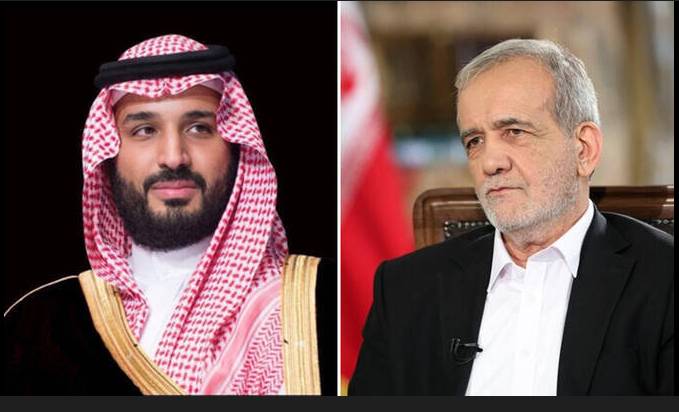

Iran's president has warned US "threats" against the Islamic republic would only cause instability, as a US naval strike group led by an aircraft carrier took up position in Middle Eastern waters, while Saudi Arabia said Riyadh "will not allow its airspace or its territory to be used for any military actions" against Iran
Washington has not ruled out military intervention against Tehran over its crackdown on protests -- which rights groups say left thousands of people dead -- and President Donald Trump has dispatched the USS Abraham Lincoln to the area "just in case".
Iranian President Masoud Pezeshkian hit out at US "threats" in a call with Saudi Crown Prince Mohammed bin Salman on Tuesday, saying they were "aimed at disrupting the security of the region and will achieve nothing other than instability".
The US also maintains several bases in the Middle East, prompting a Revolutionary Guards commander to issue a warning to Iran's neighbours on Tuesday.
"Neighbouring countries are our friends, but if their soil, sky, or waters are used against Iran, they will be considered hostile," Mohammad Akbarzadeh, political deputy of the IRGC naval forces, was quoted as saying by the Fars news agency.
Saudi Arabia's foreign ministry said the crown prince had promised Pezeshkian that Riyadh "will not allow its airspace or its territory to be used for any military actions" against Iran.
Since Iran launched its crackdown on protests earlier this month, accompanied by a blanket internet blackout, Trump has given mixed signals on intervention, which some opponents of the clerical leadership see as the only way to bring about change.
"We have a big armada next to Iran. Bigger than Venezuela," Trump told the Axios news site on Monday, weeks after the US military captured the Latin American nation's president, Nicolas Maduro.
But he added: "They want to make a deal. I know so. They called on numerous occasions. They want to talk."
Tehran has previously said a channel of communication is open between Foreign Minister Abbas Araghchi and US envoy Steve Witkoff, despite the lack of diplomatic relations between the two foes.
Axios said Trump declined to discuss the options presented to him by his national security team, or which he prefers.
Analysts say options include strikes on military facilities or targeted attacks against the leadership under supreme leader Ayatollah Ali Khamenei in a bid to bring down the system that has ruled Iran since the 1979 Islamic revolution that ousted the shah.

- 'Weakest point' -
The New York Times reported that Trump has received multiple US intelligence reports "indicating that the Iranian government's position is weakening", and that its hold on power "is at its weakest point" since the shah's fall.
US Senator Lindsey Graham told the paper he had spoken with Trump in recent days about Iran and that "the goal is to end the regime".
"They may stop killing them today, but if they're in charge next month, they'll kill them then," he said of the authorities' treatment of protesters.
The US briefly joined Israel's 12-day war against Iran in June with strikes on nuclear sites.
Israeli Prime Minister Benjamin Netanyahu said Tuesday that "Trump will decide what he decides; the State of Israel will decide what it decides".
But, he added, if Iran attacked Israel, "we will respond with a force that Iran has never seen".
Iranian officials have in recent days appeared wary of pouring oil on the fire.
But the Hamshahri conservative newspaper on Tuesday quoted Revolutionary Guards spokesman Mohammad Ali Naini as saying that "if their aircraft carrier made a mistake and entered Iranian territorial waters, it would be targeted" -- only to later retract the report and apologise to Naini.
The conservative Javan newspaper said Iran was "ready for a major response" and would seize the strategic Strait of Hormuz, a key transit hub for energy supplies.
Meanwhile, an anti-US billboard has appeared in Tehran that appears to show an American aircraft carrier being destroyed.
- 'Mass arrests, intimidation' -
Rights groups have described the crackdown as the deadliest ever against protests in Iran, and warn that compiling tolls has been complicated by an almost three-week internet blackout they say is aimed at masking the extent of the repression.
Monitor Netblocks on Tuesday reported intermittent connectivity but warned internet access remained "heavily filtered on a whitelist basis" and users would still need workarounds.
In an updated toll, the US-based Human Rights Activists News Agency (HRANA) said it had confirmed that 6,126 people had been killed, including 5,777 protesters, 86 minors, 214 members of the security forces and 49 bystanders.
But the group, which has an extensive network of sources inside Iran and has tracked the protests on a daily basis since they began, added it was still investigating another 17,091 possible fatalities.
At least 41,880 people have been arrested, it said.
"Security agencies continue to pursue an approach centred on mass arrests, intimidation, and control of the narrative," HRANA said.
Over the weekend, Persian-language TV channel Iran International, which is based outside Iran, said more than 36,500 Iranians were killed by security forces between January 8 and 9, citing reports, documents and sources.
It was not immediately possible to verify the report.
Turkey urges US to start nuclear talks with Iran
Turkey's top diplomat urged Washington to start nuclear talks with Iran in an interview broadcast on Wednesday, as US warships arrived in the region ahead of a possible strike over Tehran's protest crackdown.
"It's wrong to attack Iran. It's wrong to start the war again. Iran is ready to negotiate on the nuclear file again," Turkish Foreign Minister Hakan Fidan told Qatar-based Al-Jazeera television in English.
"My advice has always been to our American friends: close the files one by one with the Iranians. Start with the nuclear issue and close it. Then move on to the others," he said.
Fidan's comments after a US naval strike force led by an aircraft carrier took up position in Middle Eastern waters, US Central Command said on Monday, without revealing its precise location.
Washington has not ruled out new military intervention against Tehran over its harsh response to the protests, which according to rights groups saw thousands of people killed within days.
Since Iran began its crackdown earlier this month accompanied by a nationwide internet blackout, US President Donald Trump has given mixed signals on intervention.
NATO-member Turkey, which shares a 530-kilometre (330-mile) border with Iran, has often expressed opposition to military operations targeting the Islamic Republic.
Last week, President Recep Tayyip Erdogan described the unrest in Iran as a "new test" for Tehran, pledging Turkey would "stand against any initiative" that would drag the region into chaos.
He said he hoped diplomacy and dialogue would help Iran get through this "trap-filled period".
Speaking to Al-Jazeera, Fidan said the problems with Iran should be tackled individually.
"Do not treat them as a package. If you put everything together as one package, it will be very difficult for our Iranian friends to digest and truly process it," he said.
"In some cases, it may even seem humiliating for them. It would be hard to explain not only to themselves but also to their leadership."
Fidan also urged Iran to build trust in the region.
"When I was in Iran two months ago, I was very frank with my Iranian friends. They need to build trust in the region," he said.
"They need to pay attention to how they are perceived by regional countries".
Iran rejects negotiations
There can be no negotiations between Washington and Tehran if the United States makes threats against the Islamic republic, the Iranian foreign minister said Wednesday, with President Donald Trump refusing to rule out military action over Iran's crackdown on protesters.
"Conducting diplomacy through military threat cannot be effective or useful. If they want negotiations to take shape, they must certainly set aside threats, excessive demands and raising illogical issues," said Abbas Araghchi after the US deployed an aircraft carrier in the region.
"One cannot speak of talks in an atmosphere of threats," he said in televised comments, adding that in recent days he had "no contact" with US Middle East envoy Steve Witkoff and that "Iran has not sought negotiations".