
SC judge asks whether May 9 crimes were more serious than terror attacks
Justice Mandokhel says courts set up under special law have limited powers: Justice Mandokhel says bench wants to ensure protection of basic human rights: Petitioner’s lawyer says civilians can’t be tried in military courts under Article 8 III
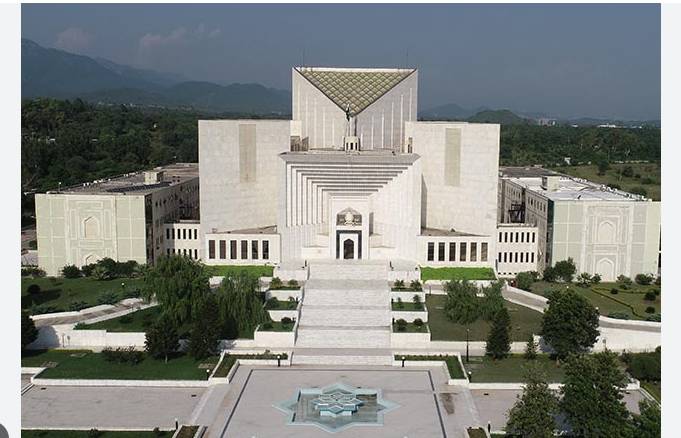

Justice Jamal Khan Mandokhel of the constitutional bench (CB) of the Supreme Court (SC) said on Thursday that yesterday the media quoted him saying that it had now become a tendency that or two judges declared a verdict given by an eight-member bench ‘flawed’ although he had not said this, reported 24NewsHD TV channel.
During the hearing of intra-court appeals filed against declaring the trial of civilians in military courts null and void, the judge said what he had said was that not two judges, but two ordinary citizens, who found faults with the eight-member bench.
A seven-member bench, headed by Justice Aminuddin Khan, heard the petitions.
Khawaja Haris, counsel for the Defence Ministry, said there was a mention of courts under Article 175 of the constitution. “But military courts are governed by a separate law,” he added.
Justice Mandokhel remarked that the powers of the courts set up under Article 175 were vast. “However, the courts which are set up under a special law have a limited jurisdiction.”
Justice Mandokhel went on to say that the verdict in the case pertaining to the 21st Amendment showed that military courts were set up in a warlike situation.
Justice Hassan Azhar Rizvi said that there was also a mention of attacks on Kamra and Mehran airbase in that verdict.
Justice Rizvi asked whether those who were involved in the May 9 riots committed more serious crimes than those who carried out these attacks.
Haris replied that the militants who had carried out an attack on the Mehran airbase were later all killed.
Justice Rizvi asked whether an investigation was conducted after the incident to ascertain who these militants were, where they had come from, and how they managed to sneak into the base. “Were the killings of militants enough? Did it mean that there would be no further negotiations and the chapter was closed?”
Haris informed the bench that the militants who had attacked the GHQ were tried in a military court. “And that too prior to the 21st Amendment.”
Justice Rizvi remarked that was what propelled the lawmakers to introduce the amendment to the constitution. “Because without that, there were difficulties in conducting military trials,” the judge opined.
Justice Muhammad Ali Mazhar said that one of the meanings of the word ‘nexus’ could be a connivance to commit a crime or a conspiracy while the other could be an offence committed against the armed forces.
Haris replied it referred to interfering in the ‘work of defence’.
Justice Musarrat Hilali said that the definition of ‘work of defence’ could be expanded to cover many other things.
Justice Mandokhel said the bench was trying to ensure that the fundamental human rights were not infringed upon. Haris finally completed his arguments in the case.
Speaking on the occasion, counsel for the government of Balochistan Iskandar Bashir Mohmand said that he too relied on the arguments given by Khawaja Haris.
Justice Mandokhel asked him how he could represent the provincial government. “First you will have to tell us what the provincial government has to do with this case,” the judge added.
Advocate Khawaja Ahmad Hussain, counsel for Jawad S. Khawaja, said he wanted to read Article 8 III of the constitution.
He said that the words, ‘members of the armed forces’ were written in the Article. “Authors of the constitution, by mentioning these words, have made everything crystal clear,” he said, adding that there was no doubt now that the Article did not apply to ordinary citizens. “If its purpose was to include civilians, then the words must have been different.”
The second thing, the lawyer went on to say, was that the military trial could be held when it could be proved that the civilians acted in connivance with each other.
He further said that it was said during the hearing that a convict could appeal the military court’s decision in a high court. “But this could not be used as an excuse to usurp a civilian’s rights.”
Justice Hilali asked, “Is a suspect, who is a civilian, not different from the suspect, who is serving in the armed forces?”
The constitution, the judge added, guaranteed the basic rights to civilians. “And the constitution is supreme,” she asserted.
Advocate Hussain replied that certainly there was a difference between a suspect who was a civilian and the one who belonged to the armed forces. “Those who join the forces submit themselves to the Army Act. While the case of an ordinary citizen is different.”
Later the bench adjourned the case’s hearing until tomorrow.
Reporter: Amanat Gishkori