
The Hague Court rules Indus Waters Treaty remains fully in force
Restricts India’s Ratle Dam construction
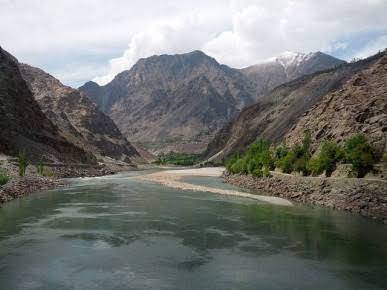

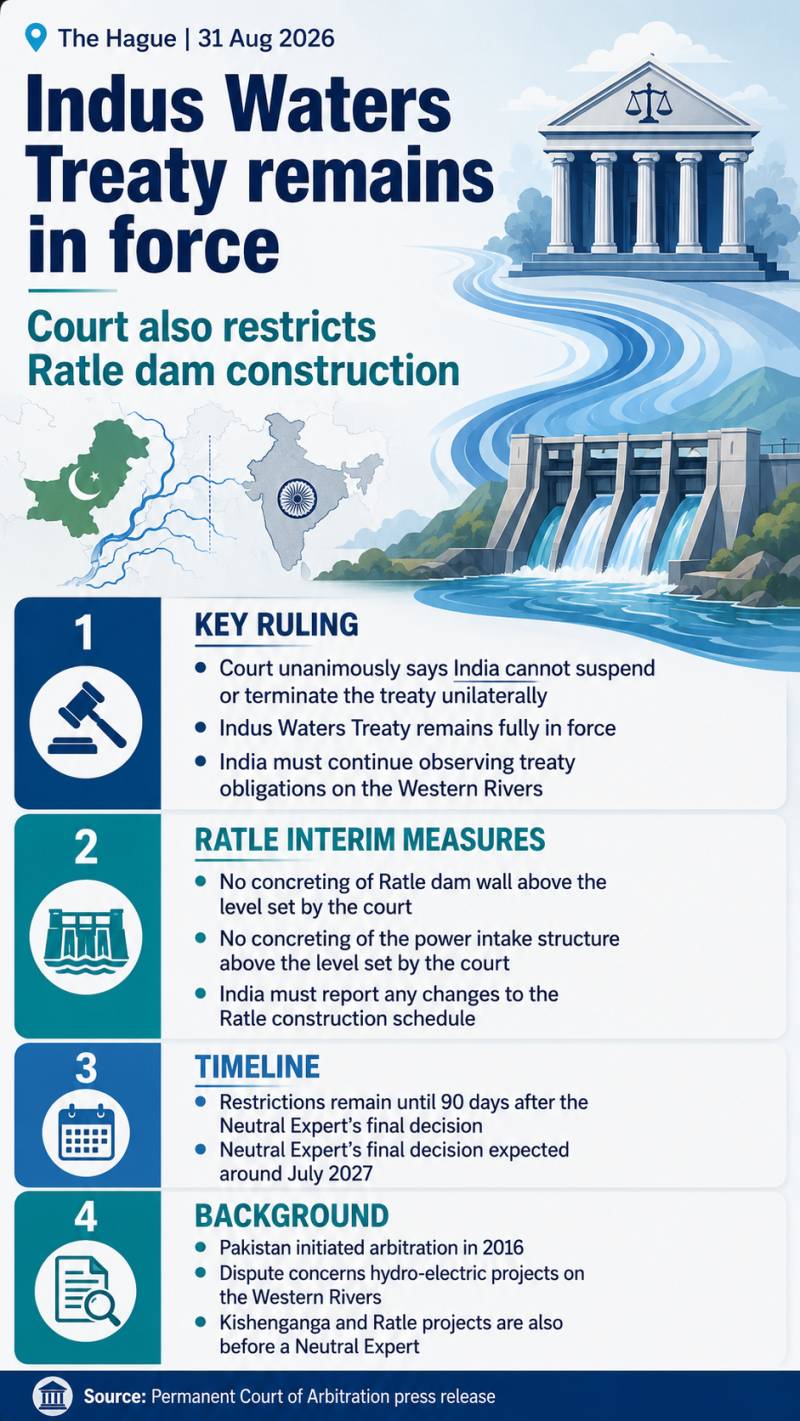
The Court of Arbitration has unanimously ruled that the Indus Waters Treaty remains fully in force and that India cannot unilaterally suspend or terminate the agreement, while also imposing interim restrictions on construction of key components of the Ratle Hydro-Electric Plant pending a decision by a Neutral Expert.
The court issued two decisions on Monday in the Indus Waters Western Rivers Arbitration initiated by Pakistan against India: an Award on the Status of the Indus Waters Treaty following India’s decision to place the treaty “in abeyance,” and an Order on Interim Measures concerning Pakistan’s request for restrictions on work at the Ratle project.
In its ruling on the treaty’s status, the court examined India’s April 2025 decision to hold the 1960 Indus Waters Treaty “in abeyance” following an attack in India-administered Jammu and Kashmir.
🔸 #PCA Press Release | The Indus Waters Western Rivers Arbitration (Islamic Republic of Pakistan v. Republic of India) 🔸
— Permanent Court of Arbitration (@PCA_CPA) August 31, 2026
𝗧𝗵𝗲 𝗖𝗼𝘂𝗿𝘁 𝗼𝗳 𝗔𝗿𝗯𝗶𝘁𝗿𝗮𝘁𝗶𝗼𝗻 𝗜𝘀𝘀𝘂𝗲𝘀 𝗔𝘄𝗮𝗿𝗱 𝗼𝗻 𝘁𝗵𝗲 𝗦𝘁𝗮𝘁𝘂𝘀 𝗼𝗳 𝘁𝗵𝗲 𝗜𝗻𝗱𝘂𝘀 𝗪𝗮𝘁𝗲𝗿𝘀 𝗧𝗿𝗲𝗮𝘁𝘆 𝗮𝗻𝗱… pic.twitter.com/0QWASt85Cw
The tribunal concluded unanimously that none of the grounds advanced or reflected in India’s public statements provided a legal basis for suspending or terminating the treaty.
“Accordingly, the Indus Waters Treaty remains fully in force,” the court said, adding that India must continue to observe its obligations, including those governing the design and operation of hydroelectric projects on the Indus, Jhelum and Chenab rivers and their tributaries, collectively referred to under the treaty as the Western Rivers.
India cannot place treaty in ‘abeyance’ unilaterally
The court said the term “abeyance” does not appear in the Indus Waters Treaty and has no technical meaning in international treaty law. It considered India’s position as potentially amounting to a claim that the treaty had either been suspended or terminated.
After examining the treaty itself, the tribunal found that it contains no provision allowing either India or Pakistan to suspend or terminate it unilaterally.
The treaty instead provides that it will remain in force unless India and Pakistan jointly agree to modify or terminate it through another treaty.
The court also rejected the proposition that a state’s sovereignty allowed it to disregard treaty obligations, citing the fundamental international law principle of pacta sunt servanda — that agreements must be kept.
Court examines India’s arguments
The tribunal examined several circumstances cited by India in public statements that could potentially have been invoked to justify suspension of the treaty.
On India’s contention that Pakistan had failed to engage in negotiations to modify the Indus Waters Treaty, the court found there was no treaty provision requiring Pakistan to enter such negotiations. It also said its examination of correspondence between the two governments showed Pakistan had been willing to discuss possible modifications.
The court also considered India’s complaints that Pakistan had created “legal roadblocks” by objecting to Indian hydroelectric projects before the Permanent Indus Commission and initiating dispute settlement proceedings.
It ruled that the treaty specifically provides mechanisms for objections and dispute settlement and found no basis for concluding that Pakistan breached the treaty by using those procedures.
The tribunal separately addressed India’s allegations concerning cross-border terrorism.
While saying it took the allegations “extremely seriously,” the court found that even assuming the allegations were true, they would not constitute a material breach of the Indus Waters Treaty because the agreement deals specifically with rights and obligations relating to the waters of the Indus River system and does not address terrorism or the use of force.
The tribunal also said it had not found evidence that the alleged terrorism had prevented India from constructing hydroelectric projects on the Western Rivers.
Demographic, climate and energy changes do not justify suspension
The court also considered whether what international law describes as a “fundamental change of circumstances” could justify India suspending or terminating the treaty.
India had referred to demographic changes, its need for clean energy, developments in dam technology, escalating cross-border terrorist attacks and the effects of climate change.
The tribunal found that the legal conditions required to invoke a fundamental change of circumstances had not been satisfied. Among other findings, it said some changes were foreseeable when the treaty was signed, were not an essential basis of the original agreement or had not radically transformed India’s obligations under the treaty.
The court also examined whether an international armed conflict could justify suspension or termination.
It concluded that no such conflict existed at present and said that, in any event, the Indus Waters Treaty was of a type intended to continue operating during armed conflict. It noted that the treaty had remained in force through multiple armed conflicts between Pakistan and India since 1960.
The tribunal further rejected the possibility that suspension or termination could be justified as a lawful “countermeasure” against Pakistan.
It ultimately concluded that India’s decision to place the treaty in abeyance was not permissible under either the treaty itself or other applicable rules of international law.
India therefore remains bound by the agreement, including its provisions concerning hydroelectric projects and dispute settlement, the court said.
Restrictions imposed on Ratle project
In a separate but simultaneous decision, the Court of Arbitration partly accepted Pakistan’s request for interim measures concerning the Ratle Hydro-Electric Plant, or RHEP.
Pakistan had sought restrictions on construction pending the Neutral Expert’s decision on whether the project’s design complies with the treaty.
The court unanimously granted three of the five measures sought by Pakistan, with modifications, and rejected two others.
Under the first measure, India is prohibited from concreting the Ratle dam wall above a level specified by the court until the Neutral Expert completes his consideration of the project.
The tribunal said the restriction was necessary because the latest construction schedule envisaged substantial concreting work, including work on disputed components, before the Neutral Expert was expected to issue his decision.
If those components were subsequently found to violate the treaty, modifying or removing reinforced concrete could be extraordinarily difficult and costly, the court said.
A second measure prohibits India from concreting the Ratle power intake structure above a specified level during the same period.
The third requires India to notify the Court of Arbitration, the Neutral Expert and Pakistan of any changes to the Ratle construction schedule.
The tribunal said transparency over developments “on the ground” was necessary to protect the interests involved and the ongoing dispute-settlement processes.
Two Pakistani requests declined
The court did not grant two other interim measures requested by Pakistan.
One would have expressly declared that India was proceeding with construction of Ratle at its “own risk,” meaning it would bear the consequences if any components were later found incompatible with the treaty.
The court said the “own risk principle” applied generally under international law but that a separate interim order affirming it was unnecessary.
Pakistan had also requested an order requiring India to return to full treaty compliance pending a decision on the treaty’s status. The tribunal found that measure unnecessary because it had simultaneously issued its award confirming that the treaty remains in force.
The restrictions on concreting the dam wall and power intake will remain in effect until 90 days after the Neutral Expert issues his final decision on whether the Ratle design complies with the treaty. The reporting requirement will remain in place until the Neutral Expert issues that decision.
The Neutral Expert’s current work programme envisages a final decision around July 16, 2027.
Arbitration dates back to 2016
Pakistan initiated the arbitration proceedings in August 2016 under Article IX and Annexure G of the Indus Waters Treaty.
India subsequently sought appointment of a Neutral Expert to consider questions concerning the Kishenganga and Ratle hydroelectric projects. The World Bank initially paused both processes in December 2016 before lifting the pause in 2022, after which the Court of Arbitration was constituted and the Neutral Expert appointed.
The Court of Arbitration rejected India’s objections to its competence in July 2023 and later issued decisions addressing general interpretation of the treaty in August and November 2025 and maximum pondage in May 2026.
India did not submit written or oral arguments during the latest proceedings on treaty status and interim measures despite being invited to participate. The court said it nevertheless considered India’s positions as reflected in official communications, statements and conduct outside the proceedings.
The Court of Arbitration is chaired by Professor Sean D. Murphy of the United States, with Professor Wouter Buytaert of Belgium, Professor Jeffrey P. Minear of the United States, Judge Awn Shawkat Al-Khasawneh of Jordan and Dr Donald Blackmore of Australia serving as members. The Permanent Court of Arbitration acts as secretariat for the proceedings.